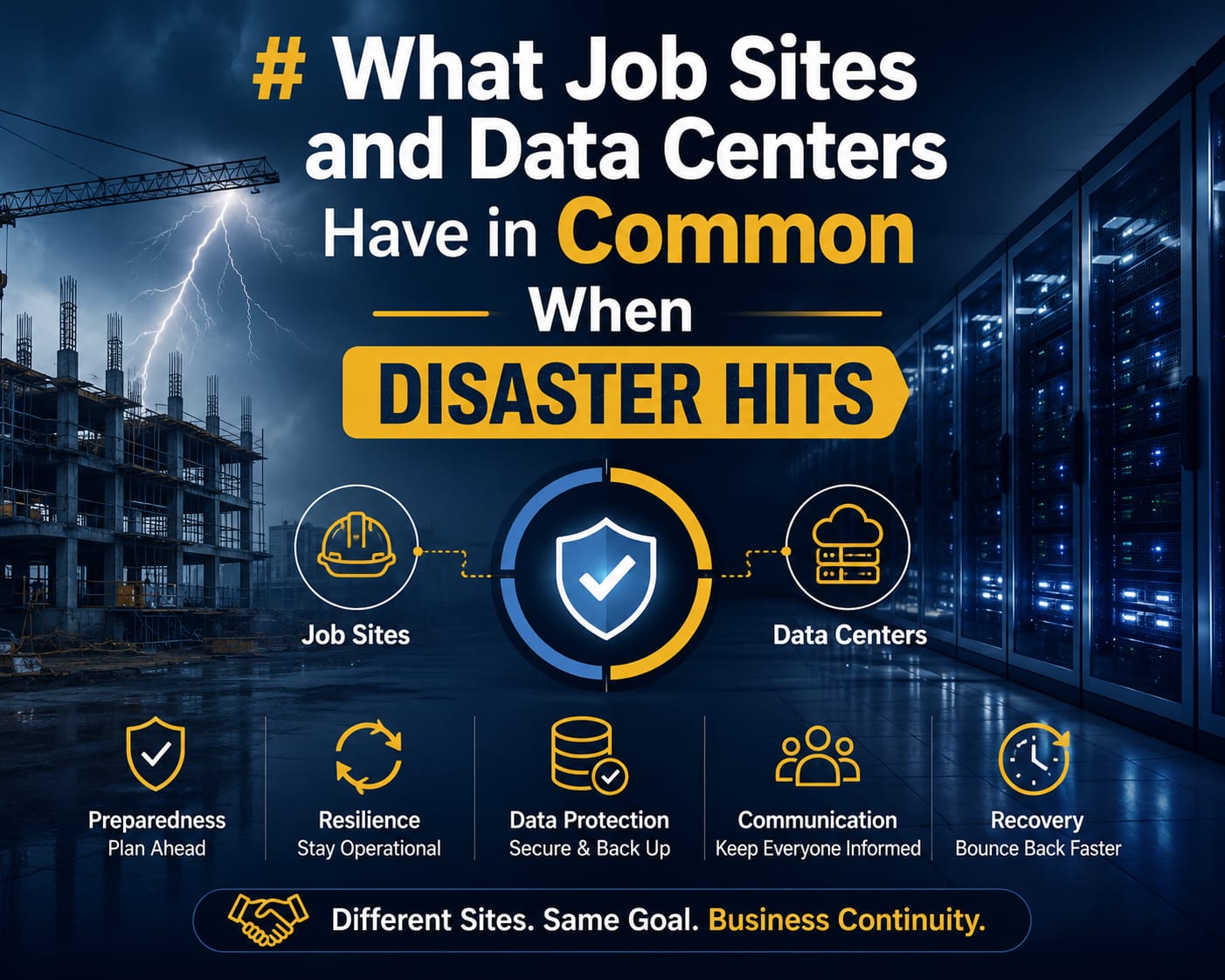
A general contractor in Denver had a scaffolding collapse on a downtown high-rise project last spring, not from weather, just a rigging failure at 6 a.m. before the crew arrived. Nobody was hurt. But the site sat exposed for eleven hours while OSHA documentation got sorted, and in that window, tools worth roughly forty thousand dollars walked off the property. The superintendent later admitted the site’s emergency plan covered injuries and equipment fires. It said nothing about what to do when the perimeter itself failed.
That gap shows up more often than people expect, and it says something about how disaster planning gets built in the first place.
Active Sites Are Different From Finished Buildings
A completed building has doors that lock and walls that hold. A construction site has neither, most of the time. It’s an open perimeter with expensive materials, unfinished structural elements, and liability exposure that changes daily depending on what phase of work is happening. Plan for a fire at a finished office building and you’re plan for smoke damage and downtime. Plan for the same fire on an active site, mid-framing, and you’re also planning for theft, for weather intrusion through gaps that shouldn’t exist yet, for the possibility that an inspector shows up and can’t verify what damage happened before or after the incident.
This is exactly the situation where temporary construction walls stop being a line item and start being part of the actual disaster response. A site that gets sectioned off fast after an incident limits exposure, keeps unauthorized foot traffic out, and gives insurers a clean boundary for assessing what happened. Contractors who already have a relationship with a barrier vendor, someone who can show up same-day, recover faster than those improvising with plywood and hope.
The Documentation Problem Nobody Budgets For
Here’s the part that surprises people: the physical damage is often the easy part to fix. The paperwork is what stalls everything. Insurance claims, OSHA reporting, subcontractor liability disputes — all of it depends on establishing a clear timeline of what was secured, when, and by whom. Sites that lack a documented incident response procedure end up in weeks-long disputes over responsibility that a two-hour site walk with photos could have prevented.
Disaster Recovery Testing Isn’t Just an IT Exercise
Construction firms tend to think disaster recovery testing belongs entirely to the IT department, something involving servers and failover regions, unrelated to job sites. That’s a mistake. The same discipline applies to physical operations.
Knowing how to do disaster recovery testing for a construction business means running through scenarios before they happen: who calls the barrier vendor, who documents the site, who notifies the client, what’s the sequence if the superintendent is unreachable. A tabletop exercise twice a year, walking through a fire scenario or a structural failure scenario with the actual people who’d respond, exposes gaps a written plan never will. Most firms discover during their first real test that two people assumed the other one had the vendor’s phone number. Nobody had it.
The firms that skip this step aren’t being reckless, exactly. They’re just betting that the plan on paper will hold up under pressure, which is a bet that rarely pays off cleanly.
Insurance Adjusters Notice the Difference
Adjusters see hundreds of sites a year. They can tell within minutes whether a contractor treated site security as a real function or an afterthought. A site that gets properly enclosed, documented, and reported within hours settles faster and with less friction over liability. A site that sat open for a day because nobody had a plan tends to draw more scrutiny, more questions, and slower payouts. That difference alone justifies having the plan before it’s needed, not while the crew is standing around waiting for someone to figure out what happens next.
The contractors who handle this well aren’t the ones with the biggest safety binders. They’re the ones who’ve actually rehearsed the moment when the site itself becomes the emergency, not just the thing the emergency happens to.