
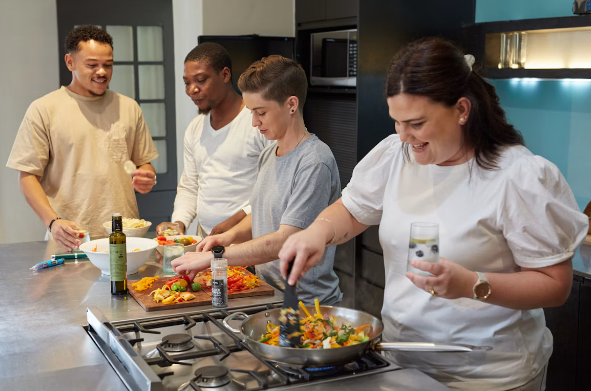
Interactive culinary experiences give colleagues a practical way to build team spirit away from meetings, targets and everyday routines. Preparing food together creates shared tasks, easy conversation and plenty of opportunities for people to help one another. The activity also produces something tangible that everyone can enjoy at the end.
For employers, that mix of collaboration and enjoyment can support stronger relationships across teams. It also turns an ordinary company social into an experience people are more likely to remember and discuss afterwards.
Why shared experiences improve morale
Morale often grows through small positive interactions. During a culinary workshop, colleagues exchange ideas, divide tasks and solve minor problems together. Someone might master a decorating technique quickly, while another keeps the group organised and makes sure nobody falls behind.
These moments reveal skills and personalities that may not appear during a typical working day. They can also support psychological safety, as participants have room to experiment and make harmless mistakes without formal assessment. When senior staff join in on equal terms, the usual workplace hierarchy feels less prominent. That can make future conversations across roles feel more natural and help colleagues approach one another with greater confidence.
Food provides an easy common ground
Culinary activities are accessible because food is familiar, social and naturally linked with celebration. Participants don’t need specialist knowledge before they arrive. Clear demonstrations and manageable tasks allow beginners to contribute whilst giving more confident cooks space to be creative.
A team might work in pairs to create different flavours, then gather to compare the results. This provides a ready-made subject for conversation, which helps people who find unstructured networking uncomfortable. There is also less pressure to perform socially when everyone has something practical to do.
Organisers should ask about allergies, dietary requirements and accessibility in advance. Suitable alternatives help each participant take part fully and show that the company has considered individual needs.
Choosing an experience that suits your team
Start with the purpose of the event. A newly formed department may benefit from collaborative tasks that encourage introductions, while an established team celebrating a successful quarter may prefer a relaxed and creative session. Group size, venue access and available time will also shape the choice.
Hands-on formats such as chocolate team building can suit corporate teams seeking an interactive workshop for staff engagement or client entertainment. Before booking, ask how the host manages different confidence levels, how much active participation is involved and whether the session can accommodate dietary needs.
Keep the event long enough for people to settle into the activity. Around 90 minutes to two hours often allows time for instruction, making, conversation and tasting without taking over the entire working day.
Turning one event into stronger connections
The value of a culinary experience can continue after the last plate has been cleared. Photos, recipes or friendly awards give colleagues something specific to revisit. A shared chat channel could feature the finished creations, although participation in photographs should always be optional.
Managers can also use the session as a starting point for better working habits. If the activity showed that quieter colleagues had useful ideas when given space, apply that lesson during meetings. If cross-department pairs worked particularly well, create further opportunities for those teams to exchange knowledge.
These follow-up choices connect the event with the principles in building a strong company culture. Consistent behaviour after the workshop shows that collaboration matters beyond a single afternoon.
Measure what people actually gained
Attendance figures reveal very little about an event’s effect. Send a short anonymous survey within two working days and ask focused questions: Did participants speak with someone they rarely work with? Did they feel included? Would they recommend the format for another company event?
Three or four questions usually produce more useful responses than a long feedback form. Look for patterns across departments and seniority levels, especially if some participants felt unable to join fully. You can then adjust the timing, venue or activity format for the next event.
The clearest sign of success may appear later, when colleagues refer back to a shared joke, offer help more readily or start a conversation with someone new. A tray of slightly uneven creations can become a surprisingly effective reminder that good teamwork leaves room for experimentation.