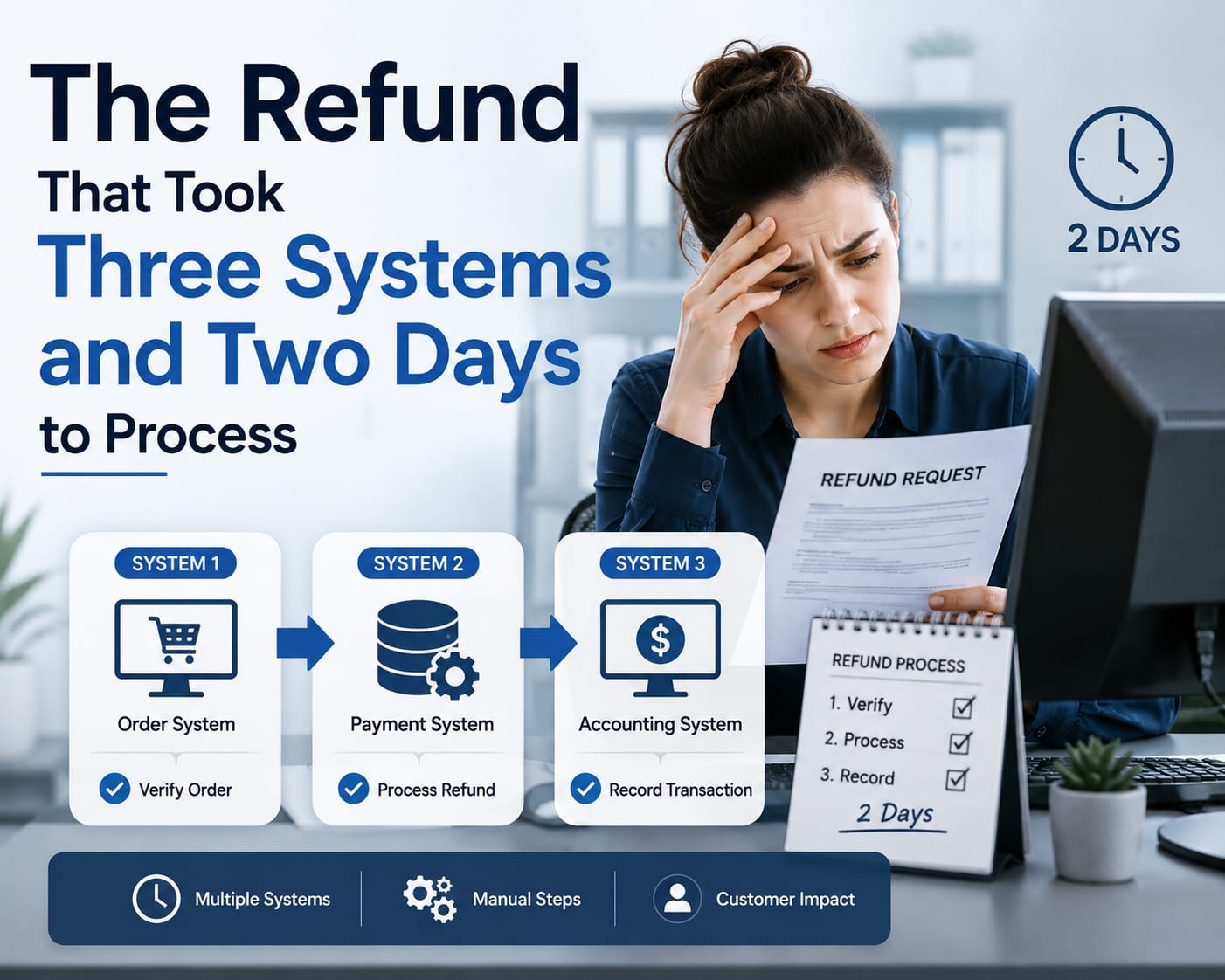
A customer at a mid-size e-commerce brand asked for a refund on a duplicate order. Simple request. It took two days to resolve, not because anyone was slow to respond, but because the order lived in one system, the payment lived in another, and nobody had access to both without asking someone else to check. By the time the refund actually processed, the customer had already left a public complaint about it.
Disconnected Systems Turn Simple Requests Into Small Crises
This kind of delay rarely comes from bad customer service instincts. It comes from architecture. When billing and order data live in separate systems that don’t talk to each other, every request that touches both, refunds, order changes, subscription adjustments, requires someone to manually bridge the gap. That bridging takes time, and it’s exactly where small requests turn into multi-day problems that shouldn’t have taken more than an hour.
The fix isn’t hiring more people to check both systems faster. It’s reducing how often two systems need checking in the first place.
Billing System Architecture Decisions Get Made Once and Live for Years
This is the part that gets underestimated when businesses are choosing tools early on. Billing system architecture decisions, whether payment data connects natively to order records or exists as a separate silo requiring manual reconciliation, tend to get made quickly during setup and then quietly shape every operational headache for years afterward. Nobody revisits the decision because revisiting it means a migration project, and migration projects get postponed indefinitely in favor of whatever’s urgent this quarter.
A business that chose a billing platform with genuine order-system integration from the start avoids the two-day refund problem structurally. A business that bolted two separate systems together with a manual workaround will keep hitting that same wall, at increasing cost, as order volume grows and the manual reconciliation stops scaling with it.
Manual Reconciliation Is a Cost That Doesn’t Show Up on a Budget Line
Here’s something worth sitting with: the cost of disconnected billing and order systems rarely appears as a line item anywhere. It shows up as an employee spending forty minutes a day cross-checking two spreadsheets, a customer service rep unable to answer a billing question without escalating it, a refund that takes two days instead of one hour. None of that gets tracked as “system architecture cost.” It just gets absorbed into everyone’s workload as if that’s normal.
It isn’t normal. It’s a symptom of a decision made early that nobody’s gone back to fix.
Using Software to Manage Your Orders Well Means Choosing Integration Over Features
When evaluating order management tools, a common mistake is prioritizing feature lists over integration quality. A platform with impressive inventory forecasting and reporting dashboards isn’t actually useful if it can’t sync cleanly with your billing system, because you’ll end up doing manual reconciliation regardless of how good the individual features look in a demo.
Using software to manage your orders effectively starts with asking a narrower, less exciting question first: does this connect natively to how you bill customers, or will someone need to manually match records between two systems every time a request touches both? That question should be answered before comparing any feature lists, because a beautifully designed order dashboard sitting disconnected from billing data solves less than a plainer tool that actually talks to your payment system.
Fixing This Later Is Possible, Just More Expensive Than Fixing It Early
None of this means a business with disconnected systems is stuck. Migrations happen, integrations get built after the fact, and plenty of companies eventually connect what should have been connected from the start. It’s just considerably more expensive and disruptive to do that migration once years of order history live in a system that was never designed to sync with billing.
The businesses handling this well aren’t the ones with the fanciest individual tools. They’re the ones who asked the integration question honestly before committing to either system, and who treated the two-day refund as evidence of a structural problem rather than an unlucky one-off.