
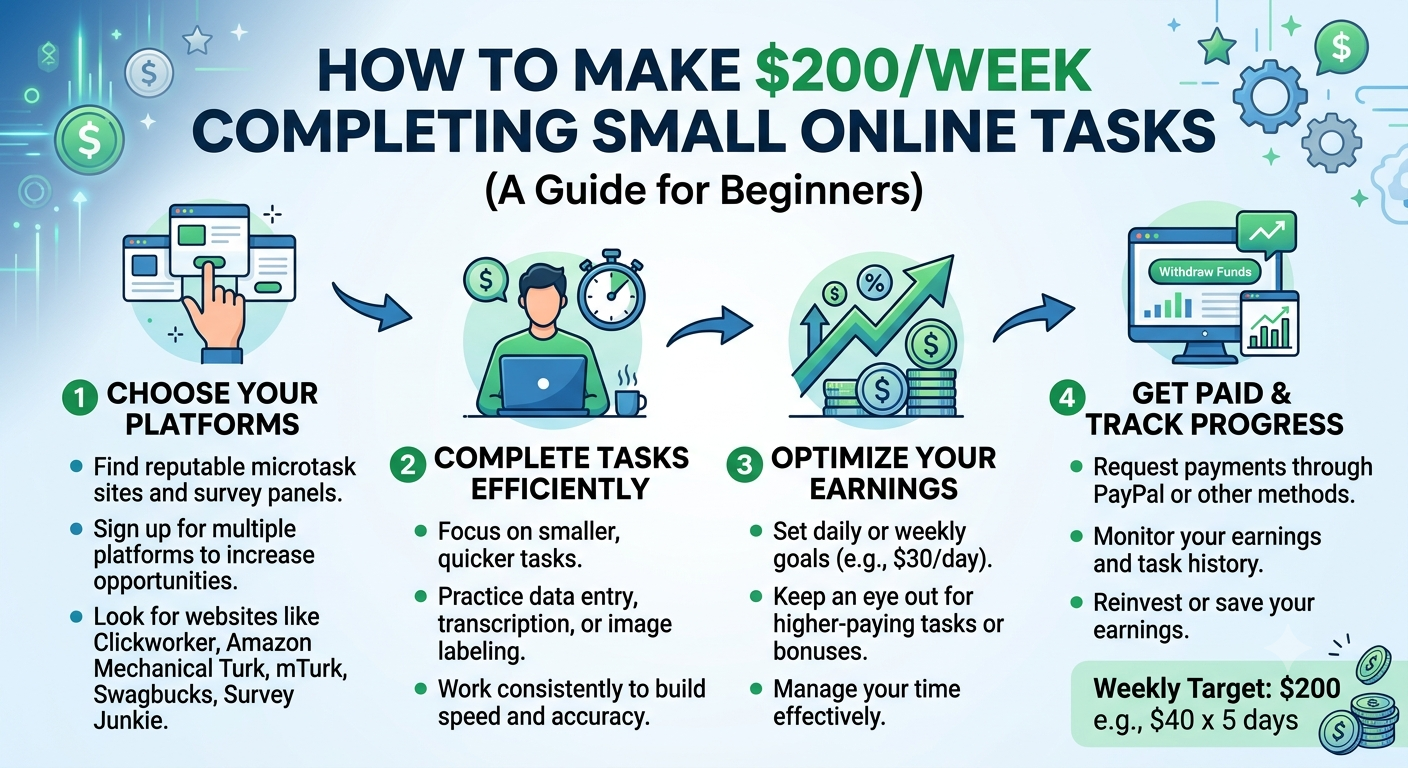
$200 a week is $800 a month — enough to cover a car payment, a utility bill, or a steady contribution to emergency savings. Earned entirely in the spare hours around a job, studies, or family, it is not a life-changing income, but it is one of the most reliable side incomes you can build without a specific skill set.
The catch is that the workers who actually reach that number do not treat microtasks as random clicking. They pick the right platforms, prioritise the right task categories, and track their results. This guide walks through exactly how they do it.
Is $200 a Week Actually Realistic?
Yes, but the math only works with the right task mix.
Split across five working days, $200 means $40 per day. What that looks like depends on what you are doing:
- Social media tasks (likes, follows, short comments) pay roughly $0.10–$0.50, so you need 80–400 of them per day.
- App reviews pay $0.50–$2.00 — around 20–80 per day.
- Surveys pay $0.50–$3.00 — 13–80 per day.
- Data entry pays $1.00–$5.00 — 8–40 per day.
- AI training tasks such as image labelling or transcription pay $2.00–$10.00 — 4–20 per day.
You could grind through 400 social media tasks a day and burn out in a week. Or you could do 15–20 well-chosen mid-tier tasks and hit the same number in a quarter of the time. The whole strategy comes down to that choice.
Step 1: Pick a Platform That Can Actually Support the Goal
Most microtask platforms cannot get you to $200 a week on their own. The ones that can share three properties: enough task volume to fill your working hours, average pay above roughly $0.50 per task, and fast enough approval that you are not waiting days to see whether your work counted.
A microjob platform such as RapidWorkers fits this profile — task supply is available around the clock, employers are verified and approve quickly, and there is enough variety that you are not stuck repeating the same $0.10 job.
The important part is to start with one platform, learn how its rating system, task queue, and payout schedule actually work, and only add more once you understand it. Spreading yourself thin across five platforms on day one is the fastest way to make no progress on any of them.

Step 2: Prioritise Task Categories by Pay per Minute
This is the single biggest lever between $80 and $200 a week. Beginners chase volume; experienced workers chase pay per minute of active work.
Task categories tend to fall into three tiers.
Tier 1 — highest effective hourly rate. AI data labelling and annotation, audio transcription, search engine evaluation, and detailed product or service reviews.
Tier 2 — solid mid-range. App store reviews (usually download plus written review), surveys, website usability feedback, Google Maps or Trustpilot reviews.
Tier 3 — high volume, low pay. Social media likes and follows, website visits, account signups, and simple yes/no categorisation.
To reach $200, the majority of your active time should sit in Tier 1 and Tier 2. Tier 3 is best used to fill gaps between higher-value tasks or to warm up an account when you are new to the platform.
Step 3: Build a Consistent Daily Schedule
Consistency beats intensity. Workers who check in for two or three focused hours a day almost always outperform those who try to grind eight hours on weekends, because the highest-paying tasks disappear within hours of being posted.
A schedule that consistently produces $200 a week looks something like this:
- 7:00–7:30 in the morning: scan for newly posted high-value tasks and claim them before the pool empties.
- 12:00–13:00 midday: work through a batch of Tier 1 tasks while your attention is fresh.
- 19:00–20:00 evening: catch tasks published by international employers whose working day is starting.
Add a two-hour Saturday catch-up and you land at about 14.5 hours a week. At $14 per hour — realistic once you are past the beginner learning curve — that is $200 plus.
Step 4: Protect Your Completion Rate
Completion rate — the share of your submitted tasks that get approved — is the most important metric on any microtask platform. It determines which tasks you can even access, how fast the platform starts trusting you with higher-paying work, and whether employers actively pick your account for their campaigns.
Keeping it above 90% is mostly about discipline:
- Read the full task instructions before starting. Most rejections come from skipping a small step, not from bad work.
- Take screenshots or short recordings when a task involves visiting a site or performing an action — this often decides borderline reviews in your favour.
- Never rush written content. Automated quality checks catch low-effort responses quickly.
- If a task looks confusing, skip it. An abandoned task hurts your account far less than a rejected one on most platforms.
Step 5: Run Two or Three Platforms in Parallel
One platform rarely has enough continuous supply to fill 14 hours a week reliably. Once you are comfortable with your primary platform, add a second, then optionally a third specialty option:
- Primary — your highest-paying, most reliable source, aiming for 60–70% of earnings.
- Secondary — fills time when the primary queue is slow.
- Specialty — one AI-focused platform such as Appen or Remotasks for higher-paying tasks that need a qualification test.
With this setup you are never sitting idle waiting for tasks to appear, and the option currently paying you the most is always available.
Step 6: Track Everything in a Spreadsheet
Unglamorous, but this is what separates workers stuck at $80 a week from workers earning $200 or more.
Log every session with at minimum: date, platform, tasks completed, earnings, hours worked, and calculated hourly rate. After two weeks the patterns are obvious — which task types actually pay you well per minute, which platforms are worth showing up for, and which hours of the day produce the best queue.
Then you double down on what works and cut everything else. Most beginners never do this step, which is exactly why their earnings plateau.
Step 7: Reinvest Early Earnings into Qualifications
Once you have a steady baseline, the fastest way to lift your ceiling is to qualify for task categories most workers cannot access. Many platforms offer training paths for AI model evaluation, audio transcription certification, or search quality rating. Each takes a few hours to complete, but can double or triple your hourly rate.
A worker earning $8 an hour on basic tasks can move to $18–$25 an hour on evaluation work after passing a qualification test. That single change is often what pushes weekly earnings from around $120 up past the $200 mark without adding a single hour of work.
A Realistic Week-by-Week Roadmap
Week 1 — setup and learning (target $20–$60). Sign up on your primary platform, complete 10–15 easy tasks to learn the workflow, verify your identity, and get familiar with the rating system. Earning is not the goal yet.
Week 2 — building momentum (target $60–$100). Add a second platform. Start noticing which task types feel most efficient. Begin tracking daily.
Week 3 — optimising (target $100–$150). Cut time spent on Tier 3 tasks. Log in early to claim the best-paying jobs of the day. Attempt your first Tier 1 tasks.
Week 4 — hitting the target (target $150–$200+). A daily schedule is in place, two or three platforms run in parallel, and you are applying for advanced qualifications.
Most workers reach $200 a week somewhere between week four and week eight. The ones who get there faster are almost always the ones tracking their data and adjusting quickly.
Five Mistakes That Keep People Stuck Below $100
Chasing volume instead of value. 200 tasks at $0.10 each is $20. 20 tasks at $1.00 each is the same money in a fraction of the time. Effective hourly rate is what matters.
Inconsistent login times. The best tasks are gone within a few hours of being posted. Workers who log in once a day at random hours miss most of them.
Ignoring rejection feedback. Every rejection contains information. Reviewing rejections and adjusting before the next batch is what separates a 70% completion rate from a 95% one.
Sticking to one platform too long. Supply fluctuates. A second platform is what keeps earnings stable during slow periods on the first.
Delaying account verification. Most platforms unlock their higher-paying tasks only after you verify your identity. Do it on day one, not week three.
Conclusion
$200 a week from microtasks is achievable, but not accidental. It comes from choosing platforms with enough supply and pay, prioritising higher-value task categories, working on a consistent schedule, tracking results, and reinvesting into qualifications that raise your hourly ceiling.
If you are starting from zero, the fastest way to test the whole system is to join a global microjob marketplace that connects workers with verified employers. Tasks are available around the clock, signup takes a few minutes, and it is realistic to complete your first paid task on day one.
Start this week, log every session, and adjust based on what your own data shows. By week four, $200 a week is well within reach.