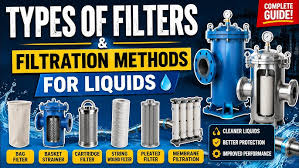
Many localities use filtration. Removes dirt and unwanted particles from liquids and gases. Common in factories, hospitals, food plants, and water systems.
There are different types of filters for different jobs. There are certain filters that eliminate large dirt particles. Others can remove very tiny particles. The correct filter can be used to save time and help safeguard machines.
This guide provides explanations of Types of Filtration Techniques in a very simple way.
What Is Filtration?
The simplest method of cleaning a liquid or gas.
The liquid/gas is filtered through an opening. It collects unwanted particles in the filter. The clean material flows through.
For instance, dirt can be separated out of water by a water filter. Dust can be taken out of the air by an air filter.
Why Is Filtration Important?
There are many reasons why filtration is important.
Removes liquids and gases from being contaminated. It also protects machines from dirt.
Helpful filtration:
Remove dust
Remove dirt
Protect machines
Improve product quality
Reduce repair costs
Make production safer
The right filter will also enable the machine to operate longer.
Gravity Filtration
Gravity filtration is an extremely simple technique.
The liquid is drawn through the filter due to gravity. No machine/pump is required.
This technique is commonly employed in the case of small tasks. It can be found in laboratories too.
Gravity filtration is very inexpensive and simple. However, it’s not ideal for very large quantities of liquid.
Vacuum Filtration
Vacuum filtration is a technique in which a vacuum is applied to draw the liquid through the filter.
This results in quicker filtration than gravity filtration.
It is often used in laboratories and factories.
Vacuum filtration can be used for separating liquid from solid material if quick separation is required.
Pressure Filtration
Pressure filtration is filtration induced by application of pressure to a liquid.
This method is useful for large amounts of liquid.
One advantage of pressure filtration is the rapidity with which it can be achieved, and this is why many factories employ pressure filtration.
It is frequently used in the treatment of water, chemical plants, and oil systems.
Mechanical Filtration
Mechanical filtration involves filtering solid particles.
The filter has a barrier effect. Dirt does not wash off the filter. It conveys clean liquids or air.
This is the simplest type of filtration.
It is utilized in water systems, air systems, and industrial machines.
Surface Filtration
Surface filtration involves trapping dirt on the surface of the filter.
The particles remain in the surface layer. The clean material goes through.
This type of filter would work well for removing larger particles.
Easily cleaned after a number of uses.
Water systems, food production, and industrial equipment use surface filters.
Depth Filtration
The process of depth filtration is different.
The dirt stays on the surface no longer. It penetrates the filter substance. It passes into the filter material.
The filter has numerous small spaces. The particles are trapped as the liquid flows through these spaces.
A lot of dirt can be collected in a depth filter. They can be used when the liquid has a wide range of particle sizes.
Membrane Filtration
In the case of membrane filtration, an extremely thin filter is employed.
The holes in the filter are very small. These holes permit some materials to go through while others are blocked.
This is a technique commonly employed for water purification and food processing.
Membrane filtration is a type of filtration process that has several types.
Microfiltration
Microfiltration is the process of filtering out small particles from liquids.
It can also kill some bacteria.
It is used in water as well as in the food industry.
Ultrafiltration
Uses an even smaller filter (ultrafiltration).
Can remove very small particles and some proteins.
It has applications in water treatment, food manufacturing, and in other industries.
Nanofiltration
Nanofiltration membranes have very small pores.
It is capable of filtering very small particles and some dissolved substances.
Commonly used for water treatment.
Reverse Osmosis
The reverse osmosis process is a very fine filtration process.
It applies pressure to force water through a special membrane.
The membrane prevents many unwanted substances.
Very clean water is made by reverse osmosis.
Air Filtration
An air filtration system filters out unwanted particles from the air.
Such particles can be dust, smoke, or dirt.
In lots of locations, clean air is vital.
In a factory, hospital, office, and in an air conditioning system, air filters are employed.
Air filtration can also help keep machines and products safe.
Liquid Filtration
Liquid filtration is used to clean different liquids.
These liquids may be water, oil, chemicals, and other liquids.
The type of liquid and the size of the particles determine which filter is required.
A good filter will help to keep the liquid clean and safeguard equipment.
Sintered Filters
There are also many industrial systems that use sintered filters.
They are produced by combining small metal particles and heating them. There are small spaces left within the filter.
These spaces permit air or fluids to flow through. Meanwhile, they block unwanted particles.
The sintered filters are tough and can be used in challenging situations.
Usually, they are applied to air, gas, oil, and other industrial fluids.
Why Choose a Sintered Bronze Filter?
Bronze is a strong material. It is heat- and pressure-resistant.
Many applications can also be made with a sintered bronze filter that can be cleaned and reused.
It can filter for a long time without any problems.
Choose NESIA Sintered Bronze Filter for a strong filter for industrial purposes.
How to Choose the Right Filter
There is no need to be overwhelmed by the choice of filters.
It is important to first determine what you want to filter.
Is it air, water, oil, or another liquid?
Then, measure the particle size.
It is also important to consider pressure, temperature, flow velocity, and frequency of cleaning.
Here are some basic tips for selecting the appropriate filter.
Final Thoughts
There are a lot of types of Filtration Techniques. Gravity filtration is an easy process. Vacuum filtration is very rapid. Pressure filtration is suitable for large jobs. Membrane filtration is useful for very small particles. Mechanical, surface, and depth filters are also employed in a number of industries.
The type of filter you use will vary according to your work. A well-designed filter can help to keep materials clean, help protect machinery, and cut maintenance expenses. A filter made from sintered bronze may be a good, strong option for industrial use.