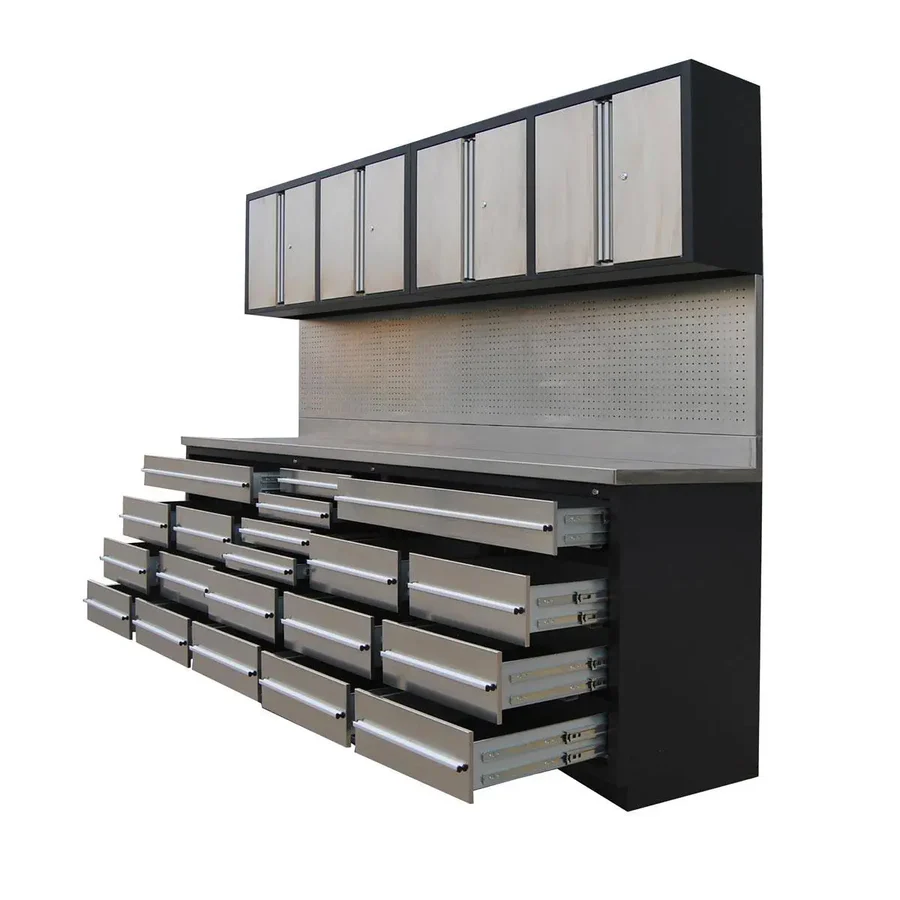
Every Canadian workshop is built around one surface
In garages, farm shops and trades across Canada, work happens at a bench, and the quality of that bench quietly sets the pace of everything done on it. A stainless steel workbench gives a shop a surface that stays flat, clean and rust-free for decades, which is why it has become the centrepiece of serious workspaces.
The appeal is easy to miss until a wooden bench fails. Timber absorbs oil and water, swells, splinters and eventually racks out of square, while a painted steel top chips and then rusts outward from the wound. A bench is the one tool that touches every job, so when it degrades, every job degrades with it.
A stainless surface sidesteps both problems, and the reason is chemistry rather than coating. Understanding that chemistry explains why one bench lasts a working lifetime while another is scrap in a few years.
An invisible layer that heals itself
Stainless steel resists corrosion because the chromium in the alloy reacts with air to form an ultra-thin, transparent oxide film across the surface. Scratch it with a dropped tool and the exposed chromium re-seals the wound within moments. Ordinary carbon steel has no such guardian, so once its paint is breached, rust spreads beneath the surface unseen.
Think of it as a skin that repairs itself the instant it is broken. That is why solvents, cutting oil, battery acid and spilled coffee wipe away instead of staining or eating into the top. The same non-porous surface is the reason stainless is standard in kitchens, laboratories and hospitals, where a quick wipe must leave a genuinely clean result.
Why a good bench is really about not moving
The job of a workbench is to stay still. When you file, hammer, press or assemble, the force you apply should pass into the work, not into flexing or rocking the bench. That is the quiet test every bench passes or fails, and it is easy to overlook in a showroom.
A rigid top on a braced frame returns that energy to the task. A bench that deflects steals effort and ruins precision, the way a wobbling table makes careful writing impossible. The difference shows up most in precision work, where even a small flex throws off a drilled hole or a filed edge.
Mass and bracing are what buy that stillness, so a heavy cabinet base does more than store tools; it anchors the whole bench against the forces of the work. Working height matters too: a top set near the height of the wrists lets the arms hang naturally and spares the back the stooping a low bench forces.
Storage that keeps the next tool within reach
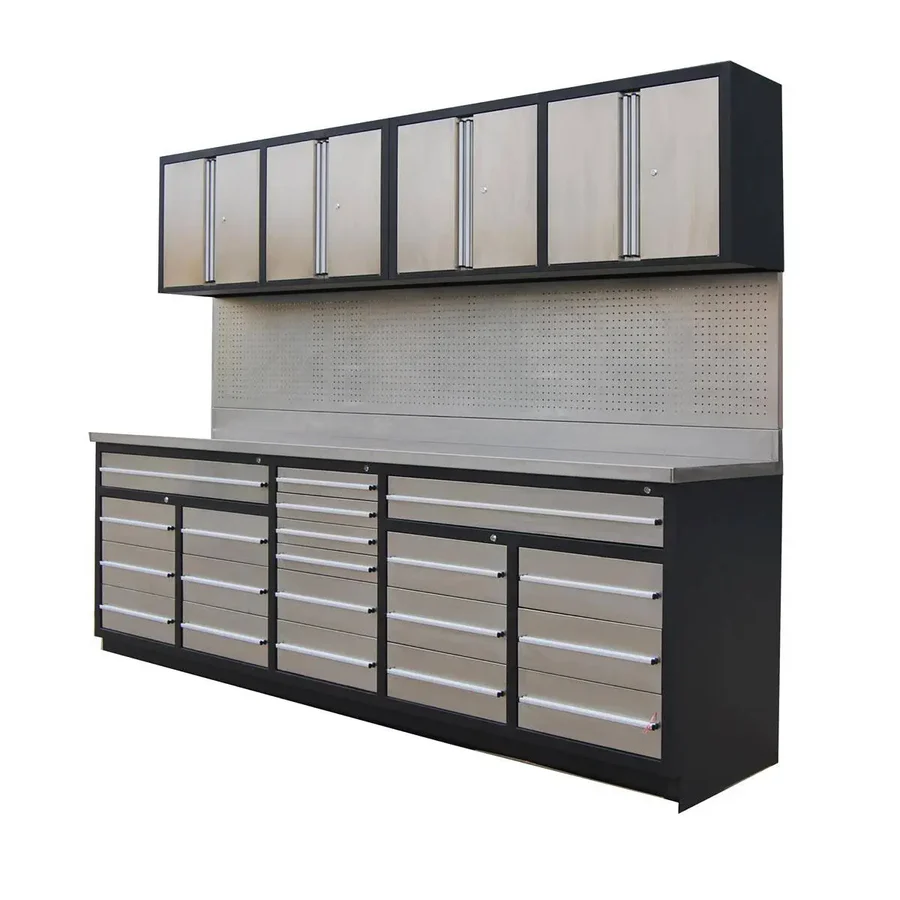
A bench is also a system for organizing tools, and how that storage is arranged decides how fast work flows. This stainless steel workbench pairs drawers, a pegboard and wall-mounted cabinets, each suited to a different kind of tool.
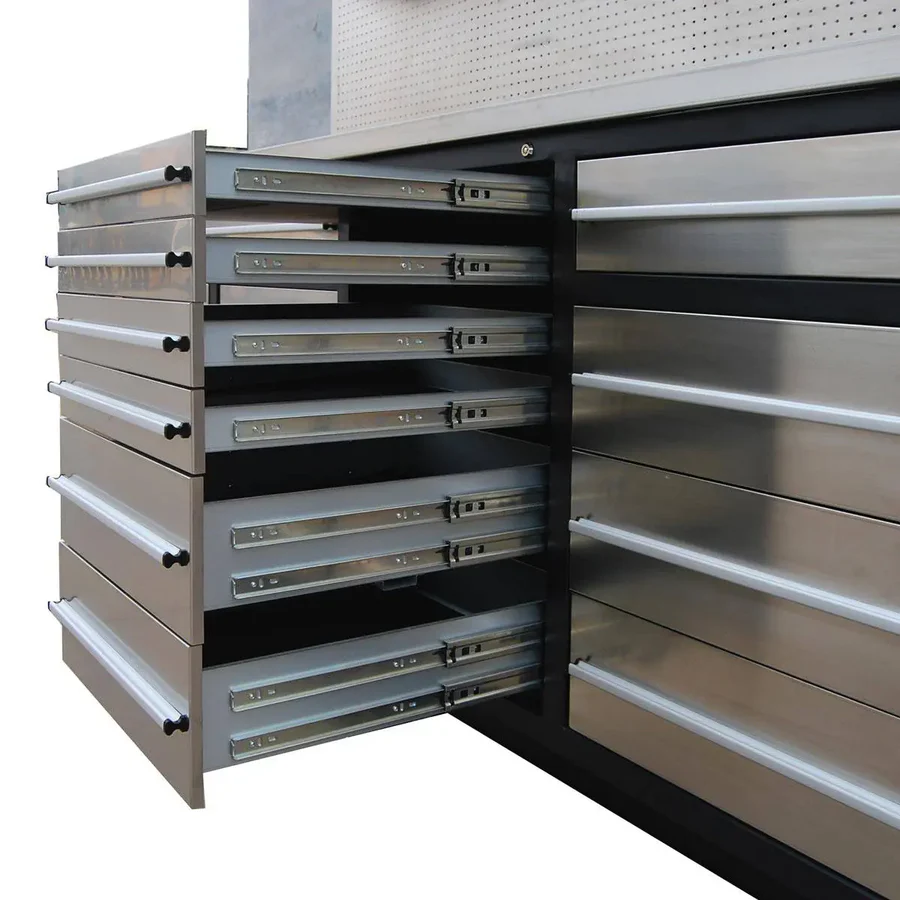
•Drawers on smooth slides hold heavy tools and keep them dust-free
•A pegboard puts frequently used hand tools in plain sight
•Wall cabinets lift bulk storage off the bench and clear the work area
The principle is simple. The tools used most often belong where the hand falls naturally, and everything else moves outward by how often it is needed. Smooth ball-bearing slides matter here, because a drawer that binds under a load of steel tools is a drawer that slowly stops being used.
Reading the choices behind a workbench
Benches are easiest to compare by two questions. The first is the worktop material, which decides how it handles spills, heat and impact.
•Wood: warm and quiet, but it absorbs fluids and wears
•Laminate: smooth and inexpensive, but it chips and swells once breached
•Stainless steel: non-porous, hygienic and corrosion-resistant
The second question is the storage layout, from a bare open frame to a full drawer-and-cabinet combination. A stainless steel workbench paired with enclosed drawers suits a shop that wants both a durable surface and dust-free tool storage.
Where it earns its cost, and where it does not
The strengths are straightforward. A stainless steel workbench shrugs off oil, water and solvents, wipes clean for tasks that demand hygiene, and holds its flat surface and square frame through years of heavy use.
The trade-offs are honest too. Stainless costs more than wood or laminate, it shows fingerprints and fine scratches, and a hard tool dropped on an edge can still dent it. For a shop that values durability and cleanliness over the lowest price, that exchange is easy to make.
Judged on how a shop actually works, the material and the layout are what matter most. A well-built stainless steel workbench is less a piece of furniture than a stable, lasting foundation for everything a Canadian workshop builds on it.