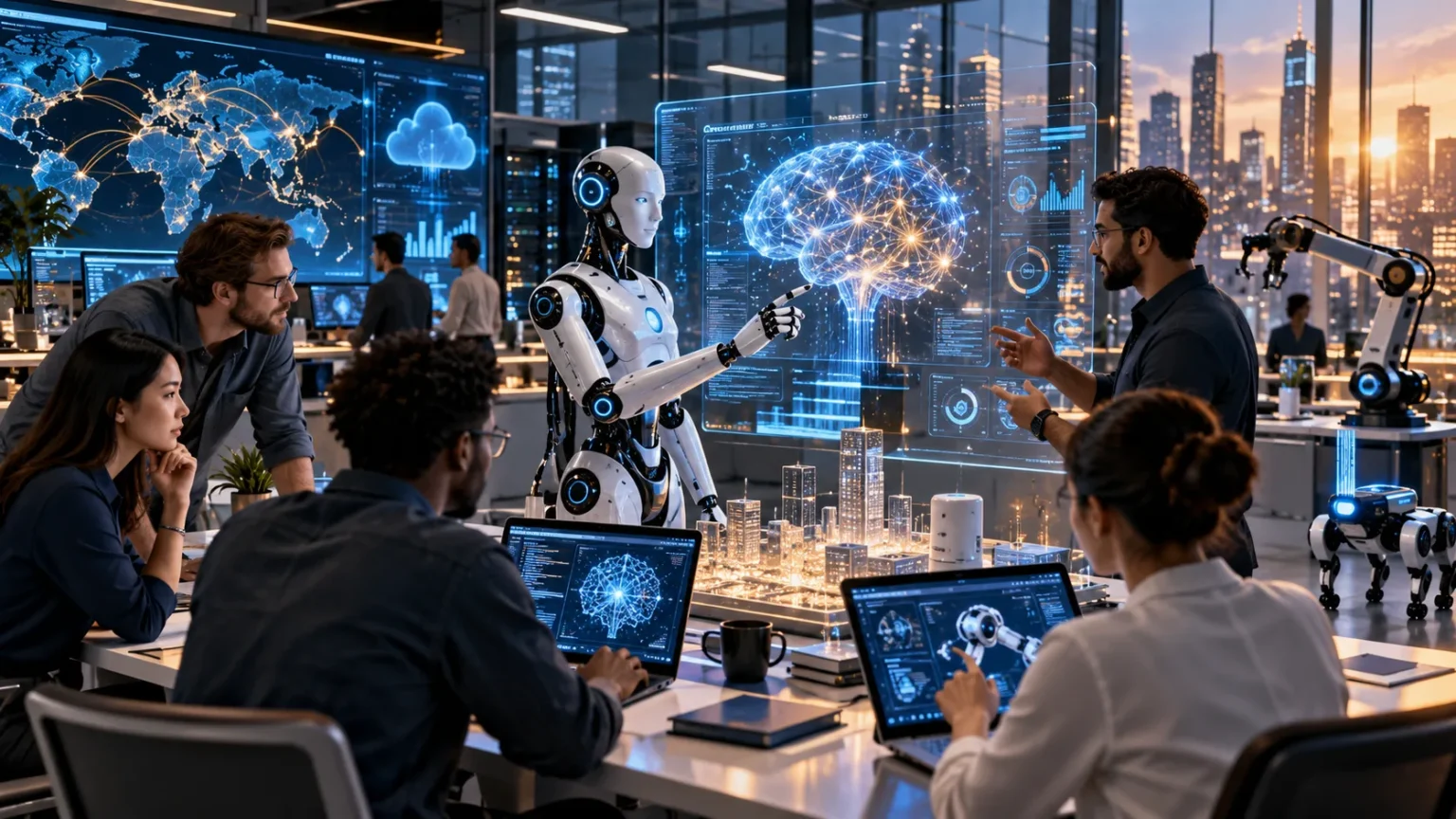
Artificial intelligence has become one of the most influential technologies in the modern world. From smartphones and search engines to business software and cloud computing, AI is changing how technology companies develop products and deliver services. What began as a specialized research field has evolved into a powerful technology supporting innovation across many industries.
Understanding how artificial intelligence influenced the tech industry helps explain why businesses are investing in intelligent automation, machine learning, and advanced digital systems. AI allows computers to analyze information, identify patterns, generate content, and assist with complex tasks. These capabilities have introduced new opportunities for software developers, technology companies, and businesses seeking to improve efficiency.
The influence of AI extends beyond faster computers and automated applications. It has changed software development, cybersecurity, customer service, data analytics, and the skills expected from technology professionals. This guide explores the evolution of artificial intelligence, its major contributions to the technology industry, and the challenges and opportunities shaping its future.
What Is Artificial Intelligence in the Technology Industry?
Artificial intelligence refers to computer systems designed to perform tasks that traditionally require aspects of human intelligence. These tasks include understanding language, recognizing images, analyzing patterns, generating content, and making predictions. In the technology industry, AI is used to develop smarter applications and improve existing digital services.
Machine learning is an important branch of artificial intelligence that allows systems to identify patterns from training data. Deep learning uses layered neural networks to process complex information, including images, speech, and text. Generative AI extends these capabilities by producing new content such as written responses, computer code, and visual materials.
Technology companies incorporate AI into consumer products, enterprise applications, and development platforms. Search engines use intelligent systems to interpret queries, while business software may automate document processing or information analysis. These applications demonstrate how AI has moved from specialized research environments into everyday technology products and services.
How Artificial Intelligence Evolved Over Time
Artificial intelligence has developed through decades of research in computer science, mathematics, and cognitive science. Early researchers explored whether computers could imitate certain reasoning and problem-solving abilities. The field gained formal recognition during the 1956 Dartmouth research workshop, which helped establish artificial intelligence as an area of scientific investigation.
Early AI systems relied heavily on predefined rules and symbolic reasoning. Although these programs could perform specific tasks, they struggled with uncertainty and complicated real-world information. Improvements in computing power, digital storage, and statistical methods later encouraged greater interest in machine learning and data-driven approaches.
During the 2010s, advances in deep learning significantly improved technologies such as speech recognition and image classification. The emergence of powerful generative AI systems in the 2020s introduced new capabilities for creating text, images, and software code. These developments accelerated AI adoption throughout the technology industry and changed expectations about what software could accomplish.
How AI Transformed Software Development
Software development is one of the technology fields most visibly affected by artificial intelligence. Developers increasingly use AI-powered tools to suggest code, explain unfamiliar programming concepts, and identify potential errors. These capabilities can reduce time spent on repetitive tasks and help programmers focus on more complicated development challenges.
AI coding assistants can generate functions, recommend improvements, and help create preliminary software documentation. Developers may also use these tools to understand existing codebases or prepare test cases. However, generated code can contain security weaknesses, incorrect assumptions, or unnecessary complexity that requires careful human review.
Artificial intelligence has also influenced how development teams organize their workflows. Some organizations are experimenting with AI agents that assist across multiple stages of software production. Successful adoption still depends on experienced developers who can evaluate requirements, test results, maintain security, and ensure applications meet actual user needs.
The Impact of AI on Business Automation
Artificial intelligence has expanded the possibilities of business automation beyond traditional rule-based systems. Earlier automation tools usually followed fixed instructions for completing repetitive tasks. Modern AI applications can interpret less structured information, classify documents, and assist with processes that previously required extensive manual review.
Technology companies use AI to support activities such as processing customer requests, organizing information, and generating routine reports. Intelligent automation can also help businesses identify unusual transactions or prioritize incoming support tickets. These applications are particularly valuable when organizations handle large volumes of information across connected digital systems.
However, automation does not automatically produce better business results. Poor data quality, unreliable predictions, and complicated integrations can introduce new operational problems. Companies need clear objectives, appropriate testing, and human supervision to ensure AI-powered workflows provide meaningful improvements rather than simply adding technological complexity.
How Artificial Intelligence Changed Cloud Computing
Cloud computing provides much of the infrastructure needed to develop and operate modern AI systems. Training advanced models can require substantial processing power, large datasets, and specialized hardware. Cloud platforms help organizations access these resources without purchasing and maintaining every component themselves.
Major cloud providers offer AI development services, machine learning platforms, and access to specialized computing infrastructure. Businesses can use these services to train models, deploy intelligent applications, and manage AI-related workloads. This flexibility has made certain advanced capabilities more accessible to organizations with limited internal infrastructure.
The relationship between AI and cloud computing has also increased demand for efficient data centers and powerful computing equipment. Providers must balance performance, electricity consumption, operational costs, and system reliability. As AI workloads expand, cloud infrastructure continues evolving to support larger models and more demanding applications.
How AI Influenced Cybersecurity and Digital Protection
Cybersecurity has changed significantly as organizations introduce AI-powered monitoring and threat detection technologies. Security systems can analyze network activity, identify unusual behavior, and prioritize potential threats for further investigation. These capabilities help security professionals examine large volumes of information that would be difficult to review manually.
AI-based security tools may detect suspicious login patterns, classify potentially harmful messages, and support investigation of unusual system activity. Automated analysis can also help security teams organize alerts and focus on higher-priority incidents. However, inaccurate predictions may generate false alarms or overlook threats that require additional investigation.
Artificial intelligence introduces new cybersecurity challenges as well. Malicious actors may misuse AI to create deceptive messages or automate certain harmful activities, while AI applications themselves can expose sensitive information when poorly secured. Strong access controls, testing, responsible development, and human oversight remain essential for protecting digital systems.
The Role of AI in Data Analytics and Decision-Making
Data analytics has become more powerful as artificial intelligence enables organizations to examine large and complicated datasets. Traditional reporting systems often focus on describing previous performance. Machine learning applications can additionally identify patterns and estimate possible future outcomes based on historical information.
Technology companies use predictive analytics to understand customer behavior, identify operational trends, and improve product recommendations. For example, an online platform may analyze previous interactions to suggest relevant content. Businesses can also use forecasting systems to support inventory planning, demand estimation, and resource allocation.
However, predictions depend on the quality and relevance of the data used. Incomplete information, changing conditions, and biased training datasets can produce misleading results. AI should therefore support informed decision-making rather than replace careful evaluation, professional judgment, and responsibility for important business outcomes.
How Artificial Intelligence Improved Customer Experience
Artificial intelligence has influenced how technology companies interact with customers through websites, applications, and digital support services. AI-powered chatbots can answer common questions, explain product features, and help users navigate available resources. These systems may provide assistance outside conventional business hours, depending on their implementation.
Recommendation engines are another important application of AI in customer experience. Streaming platforms, online stores, and digital services analyze permitted user interactions to suggest potentially relevant content or products. Personalization can make large platforms easier to navigate by highlighting options that match an individual’s interests.
Despite these benefits, automated customer service has limitations. AI systems may misunderstand requests, provide inaccurate information, or struggle with unusual situations. Businesses should offer clear ways to reach human support when necessary and maintain privacy safeguards when processing customer conversations or personal information.
How AI Changed Smartphones and Consumer Technology
Artificial intelligence has become a familiar feature of smartphones and other consumer devices. Modern phones use machine learning to support photography, speech recognition, translation, and accessibility features. These capabilities can make technology more convenient by helping devices interpret information and respond to user needs.
Computational photography is one example of AI’s influence on mobile devices. Smartphone cameras use sophisticated processing to adjust exposure, reduce noise, and improve image quality under challenging conditions. Voice assistants and predictive text systems also rely on intelligent models to interpret language and suggest relevant responses.
AI is increasingly incorporated into laptops, wearable devices, and home technology products. Some functions operate directly on the device, while others use cloud-based processing. Manufacturers must consider performance, privacy, battery life, and accuracy when deciding how intelligent features should be integrated into everyday products.
The Influence of AI on Search Engines and Digital Marketing
Search engines have used artificial intelligence for years to improve how they interpret queries and organize information. Machine learning systems can help recognize relationships between words, concepts, and user intentions. These capabilities allow search technology to move beyond simple keyword matching toward more sophisticated information retrieval.
Generative AI has introduced additional changes through conversational search experiences and AI-generated summaries. Users can ask complex questions and receive synthesized responses rather than relying exclusively on traditional search result listings. These developments are influencing how websites present information and how businesses approach online visibility.
Digital marketers are also using AI for content planning, audience research, advertising analysis, and customer communication. However, AI-generated content still requires fact-checking, originality, and editorial judgment. Providing useful, accurate information remains important regardless of whether technology assists with the content creation process.
How AI Influenced the Semiconductor and Hardware Industry
The growth of artificial intelligence has created substantial demand for specialized computing hardware. Advanced machine learning models require processors capable of performing many calculations efficiently. Graphics processing units, AI accelerators, and specialized chips have therefore become increasingly important parts of modern computing infrastructure.
Technology companies are investing in processors designed specifically for AI training and inference. These chips can support the calculations used by neural networks while addressing different performance and energy requirements. Demand for AI hardware has also influenced data center construction, memory technologies, and semiconductor manufacturing priorities.
The expansion of AI computing creates opportunities and challenges for hardware manufacturers. Advanced chips depend on complicated supply chains, manufacturing capacity, and specialized engineering expertise. Increasing electricity requirements and equipment costs have also encouraged research into more efficient computing architectures and smaller AI models.
How Artificial Intelligence Is Changing Tech Jobs
Artificial intelligence is reshaping the responsibilities of many technology professionals. Software engineers, data analysts, cybersecurity specialists, and IT support teams increasingly encounter AI-assisted tools in their work. These systems can help complete certain routine tasks while creating additional responsibilities involving evaluation, integration, and quality control.
Some organizations are reconsidering workflows and staffing needs as automation becomes more capable. Entry-level responsibilities may change when AI handles portions of coding, documentation, or information processing. However, the overall employment impact differs across occupations and companies, making simple predictions about widespread job replacement unreliable.
AI adoption is also creating demand for skills involving machine learning, data engineering, system security, and AI evaluation. Professionals who understand both technology and business requirements may be better prepared to adapt. Communication, critical thinking, and problem-solving remain valuable because automated systems still require effective human direction and oversight.
Challenges and Risks of Artificial Intelligence in Technology
One major challenge associated with artificial intelligence is the possibility of inaccurate or misleading output. Generative models can produce convincing responses that contain factual errors or unsupported claims. These limitations become particularly important when businesses use AI in sensitive applications or decisions affecting customers.
Privacy and data security are additional concerns because some AI systems process large amounts of personal or confidential information. Organizations must establish appropriate permissions, storage protections, and data retention practices. Unfair outcomes can also occur when AI models rely on incomplete or unrepresentative information.
Another challenge involves the economic and environmental cost of operating advanced AI systems. Training and deploying large models may require expensive hardware and substantial electricity. Businesses should evaluate actual benefits, operational requirements, and potential risks before adopting AI simply because a technology has become popular.
The Future of Artificial Intelligence in the Tech Industry
The future of artificial intelligence is likely to involve deeper integration with software, cloud infrastructure, and digital business processes. Developers are exploring AI agents that can coordinate multiple tasks and interact with authorized tools. These applications may support more advanced automation while introducing additional requirements for monitoring and control.
Smaller and more efficient models are another important area of development. Running selected AI features directly on smartphones, laptops, and specialized devices may improve responsiveness and reduce certain privacy concerns. Advances in hardware and model optimization could make useful capabilities accessible across more products and industries.
However, the direction of AI development will depend on technical progress, economic conditions, public trust, and regulatory requirements. Not every proposed application will deliver the expected benefits. Companies that focus on reliability, responsible data use, and measurable outcomes are better positioned to develop useful AI technologies.
Conclusion
Artificial intelligence has significantly influenced the technology industry by changing how software is developed, data is analyzed, and digital services are delivered. AI-powered tools are supporting automation, improving selected workflows, and enabling new product capabilities. Its influence extends across cloud computing, cybersecurity, smartphones, search engines, and specialized hardware.
These developments have created important opportunities for businesses and technology professionals. Companies can use intelligent systems to improve certain processes, while developers gain tools that assist with coding, testing, and information management. However, challenges involving accuracy, privacy, security, employment, and infrastructure require responsible planning.
Understanding how artificial intelligence influenced the tech industry provides valuable insight into the future of digital innovation. AI will continue evolving, but its success depends on how effectively people design, evaluate, and manage the technology. Combining intelligent tools with human expertise can help organizations develop reliable products and achieve meaningful technological progress.
Frequently Asked Questions (FAQs)
How has artificial intelligence influenced the tech industry?
Artificial intelligence has transformed software development, cloud computing, cybersecurity, data analytics, and customer service. It helps automate selected tasks, improve information processing, and create new digital products across the technology industry.
What are the biggest benefits of AI in technology?
Major benefits include improved efficiency, faster data analysis, personalized services, intelligent automation, and assistance with software development. Actual improvements depend on implementation quality, reliable data, and appropriate human oversight.
How is AI changing software development?
AI helps developers generate code, identify potential errors, prepare documentation, and understand unfamiliar programming concepts. However, developers still need to review generated code, test applications, and maintain security and reliability.
Will artificial intelligence replace jobs in the tech industry?
AI may automate portions of some technology jobs and change demand for particular skills. However, employment effects vary, and many responsibilities still require human judgment, technical expertise, communication, and accountability.
What is the future of artificial intelligence in technology?
AI is expected to become more integrated into software applications, consumer devices, cybersecurity systems, and business automation. Future progress will depend on reliability, computing efficiency, responsible development, and measurable practical benefits.