If you shoot at a club, a range or a clay ground, you probably have your routine sorted: ear defenders, safety glasses, and a clear idea of the rules. Respiratory protection is the item that most people leave out, because the risk is invisible. There is no bang, flash or sting to remind you. But fired ammunition releases fine particles and fumes, and over years of regular shooting they add up.
This guide covers what you’re actually breathing, how indoor and outdoor shooting differ, and what to look for when choosing a mask.
What’s in the air when you shoot?
Each shot leaves a small cloud around the firing line. Depending on the ammunition, it can include:
- Lead. Many primers contain lead compounds, and exposed lead bullets shed more as they fly and hit the backstop.
- Other metal particles. Antimony and barium appear in some primer compositions.
- Soot and combustion gases. Burnt powder leaves carbon particles and fumes that irritate the airways.
- Settled dust. Floors, berms and baffles hold years of residue that gets thrown back into the air.
Lead is the main worry because it builds up in the body. You can breathe it in, but it also gets in through hands, food and drink if residue stays on your skin. Early exposure rarely causes obvious symptoms, which is exactly why it’s so easy to ignore.
Indoor versus outdoor shooting
Indoor ranges concentrate everything. Even a well-run range with good extraction has spots where smoke lingers, especially during long sessions with plenty of rounds. Handgun shooters and anyone doing extended practice blocks are exposed the most.
Outdoor ranges and clay grounds are generally better because the wind clears the air. You can still end up in the cloud on still days, at the back of a bay, or when several shooters fire from a row. Calm weather and a full line can create a visible haze.
So a mask pays off most indoors and in still, enclosed or crowded conditions, but it makes sense anywhere you can see smoke or smell fumes.
What to look for in a mask
The right filtration rating
In the UK and Europe, look for masks certified to EN 149, which sorts filtering facepieces into FFP1, FFP2 and FFP3. FFP2 filters at least 94 percent of airborne particles and FFP3 at least 99 percent. For the fine particles produced by shooting, FFP2 is generally treated as the minimum, with FFP3 adding a further margin. A cloth covering or a basic surgical mask isn’t designed for this job.
A seal that actually works
A filter only helps if air passes through it rather than around it. The mask should sit firmly across the bridge of the nose, the cheeks and the chin. Facial hair can break the seal, so keep that in mind. A quick test: breathe in sharply with the mask on. It should draw slightly against your face without air leaking at the edges.
Compatibility with the rest of your gear
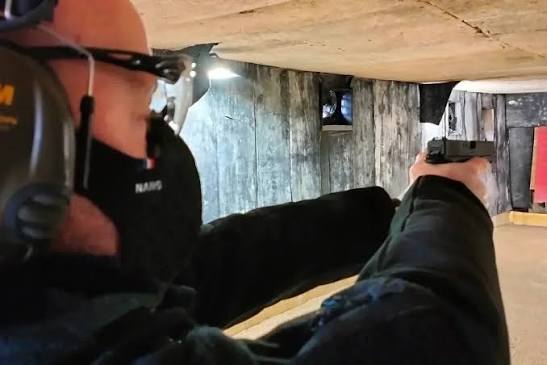
You wear more than a mask. Glasses, ear defenders and a cap all share the same space. A bulky mask can push your glasses up, break the seal of your ear defenders or fog your lenses with every breath. Try it with everything on before you commit, and look for a low profile that sits clear of your eyes.
Comfortable breathing
Shooting demands concentration. If the mask is hard to breathe through, you’ll end up taking it off. Low breathing resistance, and ideally an exhalation valve for warmer days, make a real difference over a long session.
Reusable or disposable
Disposable masks are fine for the odd visit. For regular shooters, a reusable mask with replaceable filters usually gives better value and a more consistent fit. Whichever you choose, replace filters as the maker advises and never wear a damaged or damp mask.
Why a purpose-built mask makes sense
General dust masks were not designed for ranges, and the gap shows in fit and in how they work with eye and ear protection. A dedicated shooting mask is made for these conditions, so it’s worth comparing one before you adapt a workshop mask.
Habits that go with the mask
A mask reduces what you breathe in, but a few habits cut your exposure further:
- Wash your hands and face after shooting and before eating, drinking or smoking.
- Keep food and drink away from the firing line.
- Change out of your range clothes when you get home and wash them separately.
- Clean firearms in a ventilated space and avoid dry sweeping.
- If you shoot often, ask your GP whether a blood lead test makes sense.
Hearing and eye protection are standard at every range, and lung protection deserves the same status. It costs little, it’s easy to build into your routine, and it protects something that’s hard to repair. Check the rating, test the fit with your own kit, and wear it whenever the air at the firing line is anything less than clear. If you want to see what’s available, R-Pur makes respiratory masks for sport shooters.