The accounting industry is at an exciting crossroads when cutting-edge artificial intelligence capabilities and traditional knowledge collide. An important technical development created especially for accounting contexts is CA GPT, which refers to particular AI language models created for chartered accountancy and financial applications. These specialist algorithms, in contrast to generic AI tools, comprehend accounting jargon, identify financial patterns, and decipher regulatory frameworks, along with offer contextually appropriate advice for challenging professional situations. Accounting professionals need to be aware of these technologies’ capabilities, and constraints, as well as suitable uses as they become more advanced and widely available. Understanding CA GPT enables practitioners to use technology efficiently while upholding the ethical norms and professional judgment that are essential to the accounting profession.
1. What CA GPT Actually Means and Represents
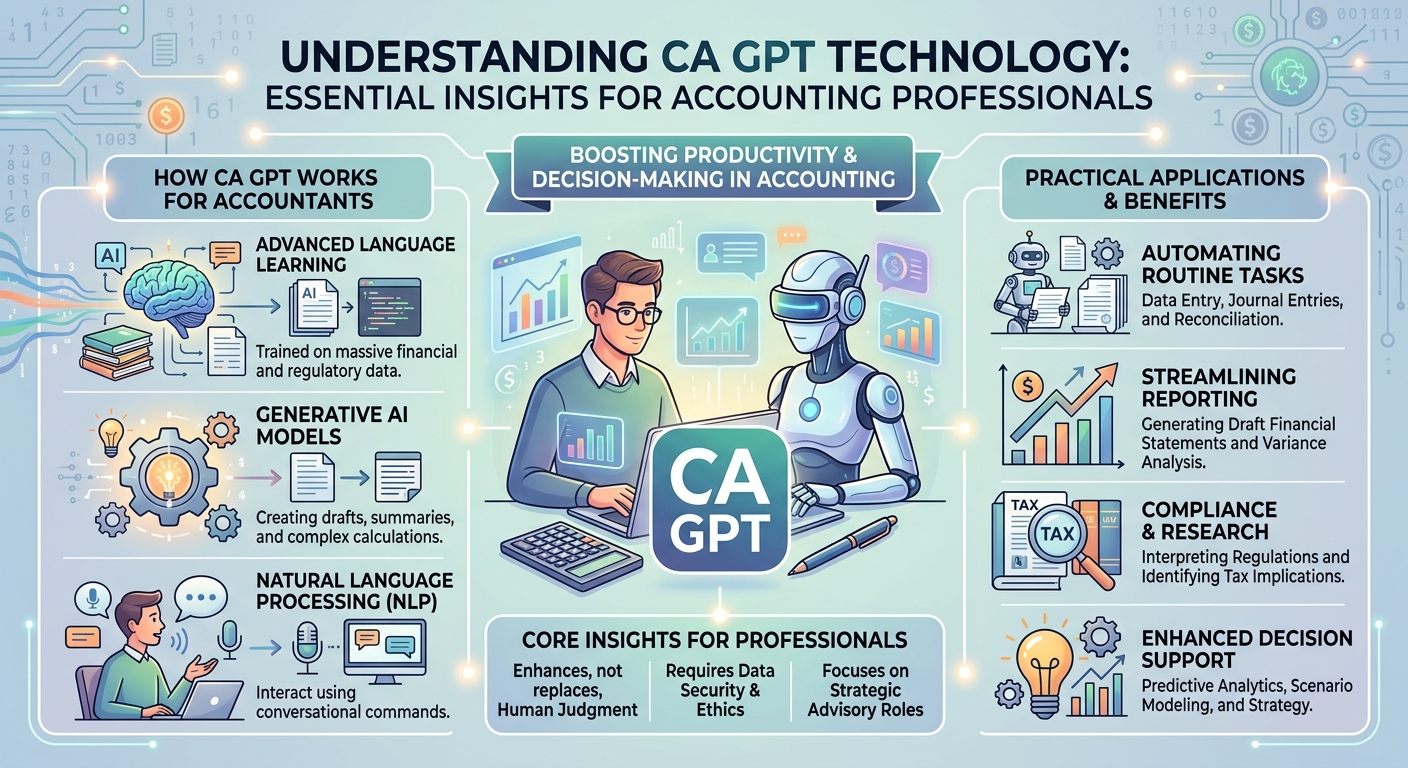
The term “CA GPT” refers to artificial intelligence language models that have been specially trained or modified for use in chartered accountancy applications. These models combine deep accounting knowledge with natural language processing. In addition to incorporating specific training using accounting literature, tax codes, audit standards, financial regulations, and professional assistance resources, these systems build upon fundamental AI technology. The generative pre-trained transformer architecture, which powers a number of conversational AI systems, is indicated by the “GPT” component. CA-focused versions, on the other hand, provide further instruction on accounting-specific material, allowing them to comprehend professional jargon, and identify suitable accounting procedures, along with producing contextually appropriate answers to technical questions. Their specialty sets them apart from general-purpose AI, which could offer inaccurate or shallow advice on intricate accounting issues.
2. Core Capabilities in Accounting Applications
When correctly installed and overseen, CA GPT systems have remarkable capabilities across a variety of accounting processes. They are able to decipher intricate accounting standards and, using pertinent guidelines, provide suitable handling for atypical transactions. The technology creates financial statement disclosures, develops audit working papers, and creates technical memos outlining accounting viewpoints. Technical inquiries concerning tax laws are addressed by systems, which offer preliminary advice that experts can confirm and improve. By swiftly discovering pertinent standards, case law, or regulatory guidance from extensive databases of professional literature, they aid in research. During reviews or audits, CA GPT assists in the analysis of financial data to spot patterns, irregularities, or areas that need attention. The system creates explanations, letters, and customer communications that are customized for particular circumstances.
3. Limitations and Accuracy Considerations
In order to use CA GPT technology properly, practitioners must be aware of its significant limits, despite its outstanding capabilities. A problem known as “hallucination” occurs when these algorithms produce information that sounds convincing but is factually incorrect, especially when it comes to certain regulation citations, case details, or technological specifications. They are unable to use the sophisticated professional judgment that comes from years of expertise in a variety of client scenarios because they lack practical experience. When seemingly simple situations actually entail subtle complexity that call for professional examination, the technology might not be able to identify them. If training data comes before updates to accounting standards, tax legislation, or regulations, system knowledge may not instantly reflect those changes. AI-generated counsel might not take into account the cultural context, business realities, and practical implementation factors that seasoned personnel naturally take into account.
4. Ethical and Professional Responsibility Issues
Accounting professionals must carefully negotiate the ethical issues raised by using CA GPT within their regulatory frameworks. According to professional norms, practitioners must remain competent, and use caution, along with accepting accountability for work completed in their names. If mistakes or omissions go unnoticed, blindly accepting AI-generated information without adequate inspection may violate these commitments. When sensitive client data is entered into external AI systems that may misuse or hold data, confidentiality issues come up. If AI technologies establish linkages or dependencies that weren’t thoroughly considered, independence criteria could be jeopardized. Instead of accepting technological outputs without question, professional skepticism—a fundamental component of audit practice—must be applied to them.
5. Practical Integration Into Daily Workflows
It takes careful application rather than random adoption to successfully integrate CA GPT into professional practice. Start with low-risk applications, such as preliminary research, draft preparation, or regular correspondence, where mistakes have little negative impact along with evaluation is simple. Clearly define the jobs that can be assisted by AI as well as those that need to be completed by humans. Establish verification processes that guarantee experts examine all content produced by AI before depending on or distributing it. Educate team members on appropriate use, which includes acknowledging constraints and upholding professional skepticism regarding results. As required by quality control processes, properly document the use of AI in working documents or engagement files. Prior to widespread implementation, start with pilot initiatives that test efficacy in controlled environments.
6. Impact on Professional Skill Development
The emergence of CA GPT technology raises concerns regarding how it impacts the technical skill development of aspiring accountants. Traditionally, mundane tasks like research, draft preparation, and documentation—exactly the areas where AI excels—were used to teach junior practitioners. How do novices acquire the discernment and proficiency that come from repeated practice if technology takes care of these fundamental tasks? While some contend that AI expedites the transition to more complicated work by doing away with tiresome chores, others are concerned about skill gaps that arise when professionals lack practical expertise with the foundations. Through modified training strategies that strike a balance between efficiency advantages and developmental demands, the profession must carefully address these issues. When technological execution is automated, it becomes more crucial to emphasize professional skepticism, ethical reasoning, and client communication, as well as critical thinking.
Conclusion
When utilized sensibly along with within the proper bounds, CA GPT is a potent technology that offers real productivity gains. Accounting professionals can effectively use AI by comprehending its potential, acknowledging its limitations, resolving ethical issues, and implementing carefully, along with safeguarding sensitive data, as well as taking developmental consequences into account. When it comes to providing high-quality professional services, technology enhances rather than replaces human knowledge by managing mundane tasks while humans contribute their judgment, and skepticism, in addition to interpersonal skills.