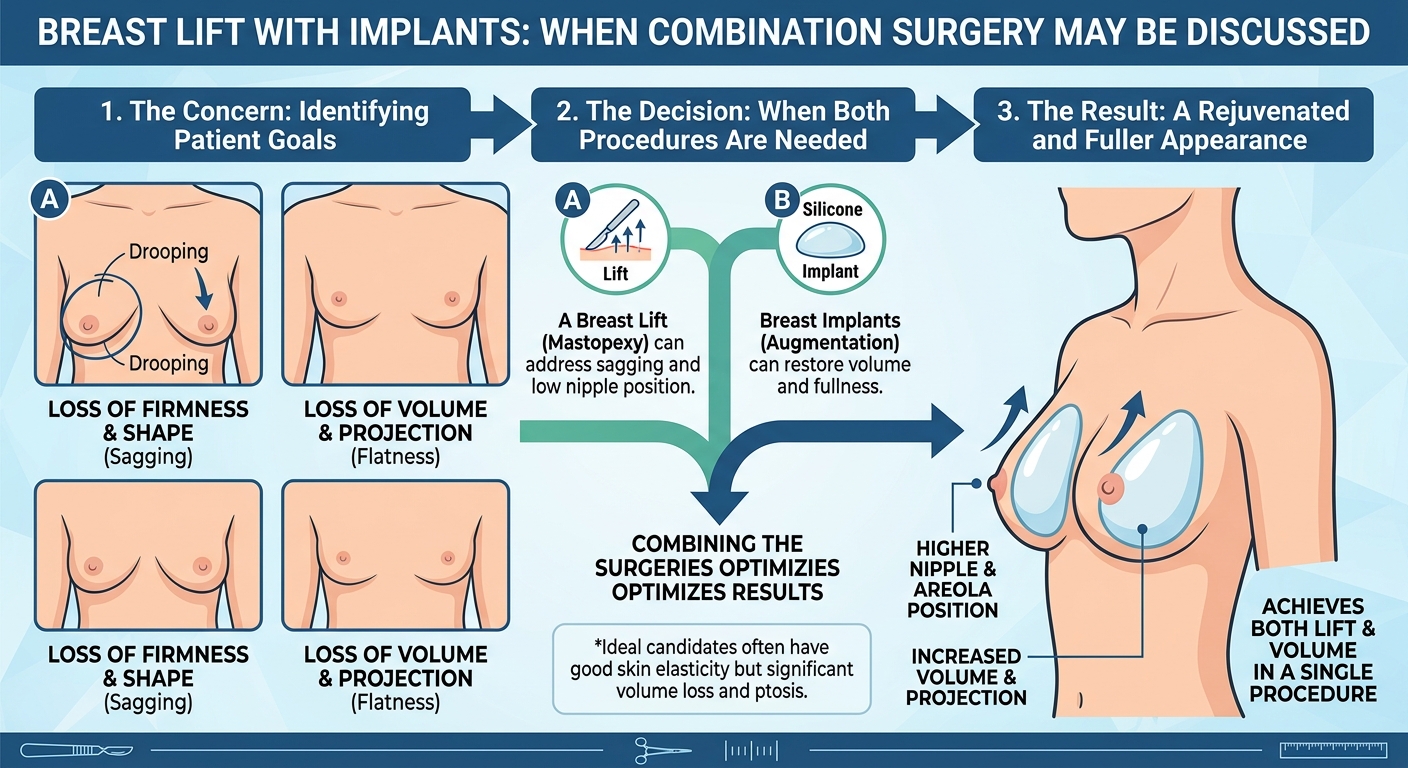
A breast lift with implants may be discussed when a patient wants to address both breast sagging and loss of volume. A breast lift, also called mastopexy, repositions breast tissue and the nipple-areola complex. Breast implants are used to increase volume or change breast fullness. When performed together, the procedure aims to address breast position and breast volume in one surgical plan.
Not every patient who wants breast implants needs a lift. Not every patient who needs a lift requires implants. The decision depends on breast shape, nipple position, skin quality, existing breast tissue, body proportions, expectations and medical suitability.
A consultation helps determine whether breast lift alone, breast augmentation alone, or a combined approach may be appropriate.
Why Breast Lift and Implants May Be Discussed Together
Breast shape can change due to ageing, pregnancy, breastfeeding, weight changes, genetics or skin elasticity. Some patients may notice that the breasts sit lower on the chest, the upper breast looks flatter, or the nipple position has moved downward.
A breast lift may address sagging by reshaping and repositioning breast tissue. However, a lift alone may not provide the degree of upper breast fullness that some patients want. Implants may be discussed when additional volume is also desired.
Combination surgery may be considered when there is:
- Breast sagging
- Loss of breast volume
- Downward nipple position
- Reduced upper breast fullness
- Skin laxity
- Breast shape changes after pregnancy or weight loss
- Desire for both repositioning and added volume
- Breast asymmetry that may need further planning
The suitability of combination surgery depends on individual assessment.
Breast Lift vs Breast Augmentation
A breast lift and breast augmentation address different concerns. Understanding the difference can help patients discuss their goals clearly.
A breast lift may help when the main concern is breast sagging, lowered nipple position or loose skin. The procedure removes excess skin and repositions the breast tissue and nipple-areola complex.
Breast augmentation may help when the main concern is breast volume. Implants or fat transfer may be discussed depending on the patient’s anatomy and preferences.
If a patient has both sagging and volume loss, one procedure alone may not fully address both concerns. This is where combination surgery may be discussed.
When Breast Lift Alone May Be Discussed
A breast lift alone may be suitable when the patient is mainly concerned about breast position and shape rather than volume. It may be considered when there is adequate existing breast tissue, but the breast sits lower than desired.
A lift alone may be discussed if:
- The patient is satisfied with current breast volume
- The main concern is nipple position
- There is loose skin but enough breast tissue
- The patient does not want implants
- The goal is reshaping rather than increasing size
- Implant-related considerations are not preferred
Patients should understand that a lift alone may not create the same fullness that implants can provide. This should be discussed before surgery.
When Breast Augmentation Alone May Be Discussed
Breast augmentation alone may be discussed when the breasts have limited sagging and the main concern is volume. If the nipple position is still suitable and the skin envelope can support an implant, augmentation may be enough.
However, implants alone may not adequately address significant sagging. If the nipple sits too low, placing an implant without a lift may not produce the desired shape and may leave the breast tissue sitting lower than the implant.
A surgeon may assess nipple position, breast fold, skin quality and tissue distribution before advising whether augmentation alone is suitable.
Signs That Combination Surgery May Be Considered
A breast lift with implants may be discussed when both breast position and volume need to be addressed. This is often identified during consultation through measurements and examination.
Combination surgery may be considered if:
- The nipple sits below the breast fold
- The breast appears deflated after pregnancy or weight loss
- There is loose skin with reduced fullness
- Breast tissue sits low on the chest
- Implants alone may not address the sagging
- A lift alone may not provide the desired volume
- Breast asymmetry needs careful reshaping
- The patient wants both repositioning and added fullness
These signs do not automatically mean combination surgery is required. The decision should be based on assessment and a clear discussion of risks, limitations and recovery.
Nipple Position and Breast Fold
Nipple position is one of the main factors assessed during breast lift planning. The surgeon may look at where the nipple sits in relation to the breast fold, also called the inframammary fold.
If the nipple sits at or above a suitable position, breast augmentation alone may be discussed. If the nipple sits lower, a lift may be needed to reposition it.
The degree of nipple repositioning can also affect the type of breast lift technique used. Patients should ask where the incisions may be placed and what scar pattern may be expected.
Skin Quality and Breast Tissue
Skin quality plays an important role in deciding whether a lift, implant or combination procedure may be suitable. Skin that has stretched due to pregnancy, weight changes or ageing may not support an implant in the same way as firmer skin.
The amount of existing breast tissue also matters. Patients with thinner tissue may need careful implant planning to reduce risks such as implant visibility, rippling or excessive tissue tension. Patients with heavier tissue may need a lift to reposition the breast before or during implant placement.
A consultation may include assessment of skin elasticity, tissue thickness, breast base width, nipple position and breast symmetry.
Choosing Implant Size in Combination Surgery
Implant size should be discussed carefully when combined with a breast lift. A larger implant may create additional tension on the skin and incisions. This may affect wound healing, scar tension and long-term breast position.
The surgeon may consider:
- Chest width
- Existing breast tissue
- Skin elasticity
- Degree of lift required
- Implant base width
- Implant projection
- Desired breast proportion
- Risk of tissue stretch
- Lifestyle and activity level
Patients should avoid choosing implant size based only on cup size or reference photos. The final plan should account for anatomy and healing considerations.
Implant Placement
Implant placement may be above or below the chest muscle, depending on anatomy, tissue coverage, implant type, lifestyle and surgeon assessment.
Placement may affect:
- Breast shape
- Implant coverage
- Recovery experience
- Upper breast fullness
- Movement during exercise
- Long-term appearance
- Suitability for the patient’s tissue
The surgeon should explain why a particular placement is being recommended and how it may affect recovery and future changes.
Incision Patterns and Scarring
A breast lift requires incisions to remove excess skin and reposition tissue. The scar pattern depends on the degree of lift needed and the surgical technique.
Common breast lift incision patterns may include:
- Around the areola
- Around the areola with a vertical line downward
- Around the areola, vertically downward and along the breast fold
When implants are added, incision planning may also need to account for implant placement. Patients should ask where scars may be located, how they may change over time and what scar care may involve.
Scars usually mature gradually. Their final appearance depends on skin type, healing response, wound tension, aftercare and whether complications occur.
Risks and Considerations
A breast lift with implants is a combined procedure, so patients should understand risks related to both lifting and implant placement.
Possible risks may include:
- Bleeding
- Infection
- Bruising
- Swelling
- Pain
- Scarring
- Changes in nipple or breast sensation
- Wound healing problems
- Breast asymmetry
- Implant malposition
- Implant visibility or rippling
- Capsular contracture
- Fluid collection
- Skin or nipple tissue compromise
- Need for revision surgery
- Anaesthesia-related risks
The risk profile depends on the patient’s health, breast anatomy, implant size, surgical plan and recovery care. Patients should ask which risks are most relevant to their case.
Recovery After Breast Lift With Implants
Recovery after combination surgery may involve swelling, bruising, tightness, soreness and activity restrictions. Patients may need to wear a surgical bra or support garment as advised.
Recovery instructions may include:
- Caring for incisions
- Wearing support garments
- Avoiding heavy lifting
- Sleeping in a recommended position
- Avoiding strenuous exercise temporarily
- Taking medication as advised
- Attending follow-up appointments
- Monitoring wound healing
- Avoiding pressure on the chest
- Returning to work based on job demands
Patients with desk-based work may return earlier than those whose work involves lifting, physical activity or prolonged movement. Exercise should be resumed only when cleared.
Timing After Pregnancy or Weight Changes
Pregnancy, breastfeeding and weight changes can affect breast size, skin elasticity and breast position. Patients considering breast lift with implants after pregnancy or weight loss may be advised to wait until weight and breast size are stable.
Timing considerations may include:
- Whether breastfeeding has ended
- Whether breast size has stabilised
- Whether future pregnancy is planned
- Whether major weight loss is still ongoing
- Whether the patient can take time for recovery
- Whether support at home is available
Future pregnancy or weight changes may affect results, so this should be discussed before surgery.
Consultation and Decision-Making
A detailed consultation helps determine whether combination surgery is suitable. Patients should be prepared to discuss their goals, medical history, previous breast changes, lifestyle and expectations.
During consultation, the surgeon may assess:
- Breast volume
- Breast position
- Nipple location
- Skin quality
- Chest width
- Tissue thickness
- Symmetry
- Scarring tendency
- Implant options
- Recovery needs
A breast lift with implants may be discussed when a patient has both breast sagging and volume loss. The lift addresses breast position and skin laxity, while implants add volume. However, combination surgery is not suitable for every patient.
The decision depends on nipple position, skin quality, breast tissue, chest width, implant size, lifestyle, medical history and recovery expectations. Patients should understand the differences between a lift, augmentation and combination procedure before deciding.
A clear consultation can help patients understand what may be suitable, what risks should be considered and what recovery may involve.
FAQs About Breast Lift With Implants
What is a breast lift with implants?
A breast lift with implants is a combination procedure that repositions breast tissue and the nipple-areola complex while adding volume with implants.
Who may consider a breast lift with implants?
It may be discussed when a patient has both breast sagging and reduced breast volume, especially after pregnancy, breastfeeding, weight changes or ageing.
Can implants alone lift sagging breasts?
Implants can add volume, but they may not correct significant sagging. If the nipple sits low or there is loose skin, a breast lift may be discussed.
Will a breast lift with implants leave scars?
Yes. A breast lift involves incisions, and scar patterns depend on the degree of lift needed and the surgical technique used.
How long is recovery after breast lift with implants?
Recovery varies depending on the surgical plan, implant placement, healing response and work demands. Patients should follow activity restrictions and attend follow-up appointments.
Can breast shape change after combination surgery?
Yes. Breast shape can change with ageing, pregnancy, breastfeeding, weight changes and implant-related factors. Future revision surgery may be discussed in some cases.
This article is for general information only and should not replace medical advice from a qualified healthcare professional.