Understanding Crystal Oscillators
A crystal oscillator is an electrical circuit for generating an electrical frequency with exceptional perfection grounded on the mechanical resonance of a wobbling crystal. A crystal clear oscillator operates on the principle of piezoelectricity and is made up of many unique accoutrements , most frequently quartz. This is balanced by using the frequency of oscillations of the crystal itself. The oscillation serves as the master timing reference the wristwatch counts on to determine the time signal within that gadget or, in the case of telecommunications, very complex units such as 3G and 4G equipment.
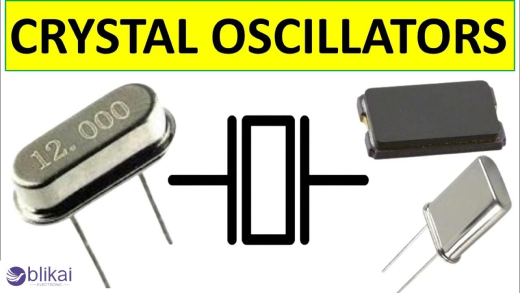
Key Components of a Crystal Oscillator
- Crystal: Usually made from quartz, the main component of the oscillator.
- Oscillator circuit: Typically consists of an amplifier and feedback network.
- Capacitors: Used for frequency adjustment and stability.
- Resistors: Help in biasing and controlling the oscillator’s operation.
- Power supply: Provides the necessary energy for sustained oscillation
Types of Crystal Oscillators
- Pierce oscillator: A common type used in microcontrollers and digital circuits.
- Colpitts oscillator: Known for its stability and use in radio frequency applications.
- Temperature-compensated crystal oscillator (TCXO): One means is to provide stable temperature variation.
- Oven-controlled crystal oscillator (OCXO): In this manner, it has high-temperature stability since it cannot be influenced much by the external environment.
Operating Principles of Crystal Oscillators
Startup process
The startup process begins when power is applied to a crystal oscillator circuit. Initially, the circuit had some electrical noise, which provided small excitation to the crystal, forcing it to vibrate. This weak output from the crystal is fed back into the amplifier circuit.
The amplifier then reinforces this signal, increasing its amplitude. This amplified signal is fed back to the crystal, enhancing its vibration. This positive feedback loop continues until the oscillation reaches a stable amplitude, typically within milliseconds.
Steady-state operation
As the four-second wavelength is reinforced in the amplifier, its amplitude is raised. This amplified signal-the feedback signal-is fed back onto the crystal, enhancing its vibrations. The positive feedback loop continues until the oscillation stands at a stable amplitude, usually within a few milliseconds.
The crystal’s high Q factor (quality factor) maintains frequency stability. It acts as a narrow bandpass filter, rejecting frequencies that deviate from its resonant frequency, thus ensuring a pure, single-frequency output.
Temperature effects on oscillation
Temperature variations can significantly affect the operation of different crystal oscillators. As the temperature changes, a crystal’s size and elastic properties change. These changes alter the crystal’s resonant frequency, leading to frequency drift.
Compensating schemes attempt to counter the effects of temperature change. The TCXO, or temperature-compensated crystal oscillator, works by further circuiting at the crystal oscillator frequency to provide a relative frequency that is affected directly by known temperature values. The OCXO, or oven-controlled crystal oscillator, is equipped to provide temperature control to the crystal, thus guaranteeing better frequency stability from thermal variations.
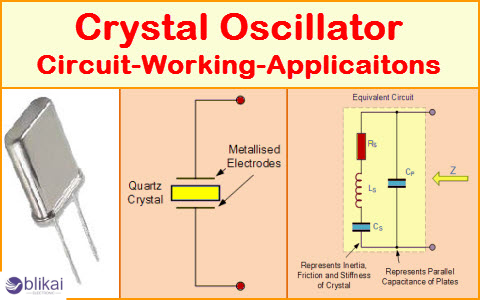
Applications of Crystal Oscillators
Timekeeping devices
Crystal oscillators are indispensable to timekeepers, providing the heartbeat for millions of clocks and watches. Their frequency stability makes their use crucial for both analog and digital time devices. In everything from simple wristwatches to large wall clocks, crystal oscillators assure accurate time through a steady pulse that drives the actual timekeeping mechanism.
Telecommunications
Crystal oscillators are the background players that ensure clear communication in telecommunications. They provide a stable reference frequency for radio transmitters and receivers so that signals are correctly transmitted and received. This precision is necessary for clear voice calls, data transmissions, and satellite communications.
Digital electronics
A crystal oscillator is an essential element of electronic circuits. They generate clock cycles that microprocessors, microcontrollers, and other devices utilize. Such signals are necessary for synchronizing many operations in complex electronic systems. From computers to smartphones, these oscillators ensure that all components work harmoniously, enabling the precise execution of instructions and data processing.
Aerospace and military use
Aerospace and service operations calculate on crystal clear oscillators for high-delicacy timing and frequency control mechanisms. Crystal oscillators give precise timing in navigation systems similar to GPS, which is consummate when determining position. They also find operations in radar systems, secure dispatch outfit, and flight control systems, where trustability and delicacy are critical.