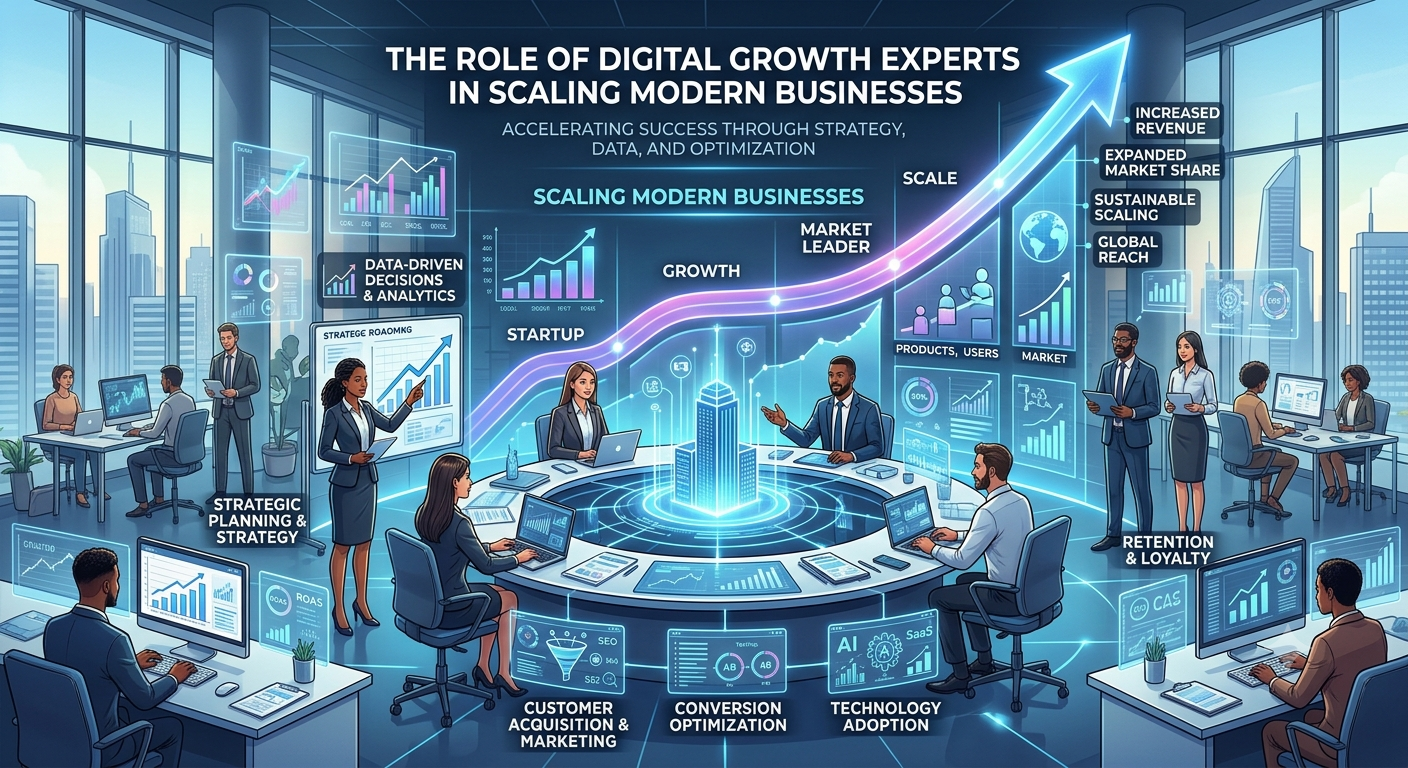
Growing a business today involves much more than increasing website traffic or running online advertising. Sustainable growth comes from understanding customer behaviour, improving marketing performance and making informed decisions based on reliable data. As digital marketing becomes increasingly complex, many businesses turn to digital growth experts to help identify opportunities, solve performance challenges and build strategies that support long-term success.
Experienced digital growth specialists combine marketing strategy, analytics, search engine optimisation (SEO), paid advertising, content marketing, website optimisation and customer insights to help businesses grow efficiently. Rather than focusing on individual marketing channels in isolation, they look at how every part of a business’s digital presence contributes to enquiries, sales and customer retention.
Their goal isn’t simply to generate more traffic—it’s to generate better business outcomes.
Sustainable Growth Starts With Data
One of the biggest mistakes businesses make is assuming they know what’s driving results.
A website may receive thousands of visitors every month, but if those visitors aren’t becoming customers, traffic alone offers little commercial value. Likewise, an advertising campaign may generate clicks while producing very few qualified enquiries.
Digital growth experts begin by understanding what the data actually says.
This often involves analysing:
- Website traffic
- User behaviour
- Conversion rates
- Lead sources
- Customer journeys
- Sales data
- Marketing attribution
Google Search Central recommends creating helpful, reliable, people-first content because search engines increasingly reward websites that genuinely answer users’ questions.
Looking beyond traffic numbers allows businesses to identify which marketing activities are producing meaningful commercial outcomes and which areas require improvement.
Identifying Growth Bottlenecks
Increasing marketing spend isn’t always the solution.
Sometimes the biggest opportunities come from fixing existing problems rather than attracting more visitors.
Digital growth experts examine every stage of the customer journey to identify where potential customers stop progressing.
Common issues include:
- Slow-loading websites
- Confusing navigation
- Weak calls to action
- Poor landing page content
- Complicated enquiry forms
- Low-performing advertising campaigns
- Gaps in SEO visibility
For example, a business may invest heavily in Google Ads while directing visitors to a page that doesn’t clearly explain its services. Improving that landing page may generate more enquiries without increasing advertising spend.
Similarly, a website may rank well in search results but fail to convert visitors because important customer questions aren’t being answered.
Finding and removing these barriers often produces stronger returns than simply investing more money in marketing.
Digital Growth Combines Multiple Marketing Channels
One reason experienced digital growth specialists deliver better results is that they don’t treat each marketing activity as a separate project.
SEO, paid advertising, social media, email marketing, website optimisation and content marketing all influence one another.
A typical customer journey might look like this:
- Someone discovers a business through Google.
- They read an informative article.
- They follow the business on social media.
- They subscribe to a newsletter.
- They return several weeks later to make an enquiry.
Every interaction contributes to the final decision.
Rather than optimising one channel in isolation, digital growth experts build strategies that connect these touchpoints into a consistent customer experience.
Content Builds Trust Before Customers Buy
Modern customers often spend considerable time researching before contacting a business.
Helpful articles, FAQs, videos, guides and case studies allow businesses to answer questions long before a sales conversation begins.
This approach benefits both customers and search engines.
Search engines increasingly prioritise content that demonstrates expertise, experience and trustworthiness. Likewise, AI-powered search tools are more likely to reference content that provides clear explanations supported by reliable sources.
Businesses that consistently publish useful information position themselves as trusted authorities within their industries.
For example, a dental practice might explain treatment options before a patient books an appointment. A law firm could answer common legal questions, while a manufacturer might publish technical guides that help customers compare products.
This type of content supports SEO while simultaneously building customer confidence.
Technology Helps Businesses Scale Efficiently
Growth creates additional operational demands.
As enquiries increase, businesses need systems capable of managing leads, customers and marketing activities without reducing service quality.
Digital growth experts often recommend tools such as:
- Customer relationship management (CRM) systems
- Marketing automation
- Email workflows
- Lead tracking software
- Analytics dashboards
- Reporting platforms
The Australian Government highlights digital technology as an important contributor to business productivity and customer management.
When implemented effectively, these systems reduce manual administration while giving businesses clearer visibility over marketing performance and sales activity.
Instead of guessing where enquiries come from, businesses can accurately track which campaigns generate revenue and allocate future marketing budgets more effectively.
Continuous Improvement Drives Long-Term Results
Digital marketing isn’t a one-time project.
Customer behaviour changes. Search engines update their algorithms. Competitors launch new campaigns. Advertising costs fluctuate.
For this reason, digital growth experts focus on ongoing optimisation rather than one-off improvements.
Regular testing may include:
- Website layouts
- Landing pages
- Calls to action
- Advertising copy
- Email subject lines
- Content updates
- Conversion pathways
Small improvements made consistently over time often produce significant long-term growth.
This data-driven approach reduces reliance on assumptions and allows marketing decisions to be based on measurable evidence.
Growth Requires Both Creative and Commercial Thinking
Successful digital growth depends on balancing creativity with commercial performance.
Website design, photography, branding, video, advertising and written content all influence how potential customers perceive a business.
However, attractive creative assets alone rarely deliver sustainable growth.
Digital growth experts evaluate whether creative work is also achieving measurable business objectives.
For example:
- Does the website encourage enquiries?
- Does the advertising attract qualified leads?
- Does the content answer customer questions?
- Does the user journey make purchasing easy?
When creativity is supported by strong analytics and ongoing optimisation, businesses are more likely to achieve meaningful commercial outcomes.
Conclusion
Sustainable business growth requires more than attracting website visitors. It depends on understanding customer behaviour, measuring performance accurately and continually improving the activities that generate enquiries, sales and long-term customer relationships.
Digital growth experts help businesses identify opportunities, remove barriers to conversion and build marketing strategies that support scalable growth across multiple digital channels.
By combining data analysis, SEO, content marketing, paid advertising, website optimisation and marketing automation, experienced digital growth specialists help organisations make better decisions and achieve stronger commercial outcomes.
As digital marketing continues to evolve alongside AI-powered search and changing customer expectations, businesses that invest in evidence-based growth strategies are better positioned to compete, adapt and grow sustainably over the long term.