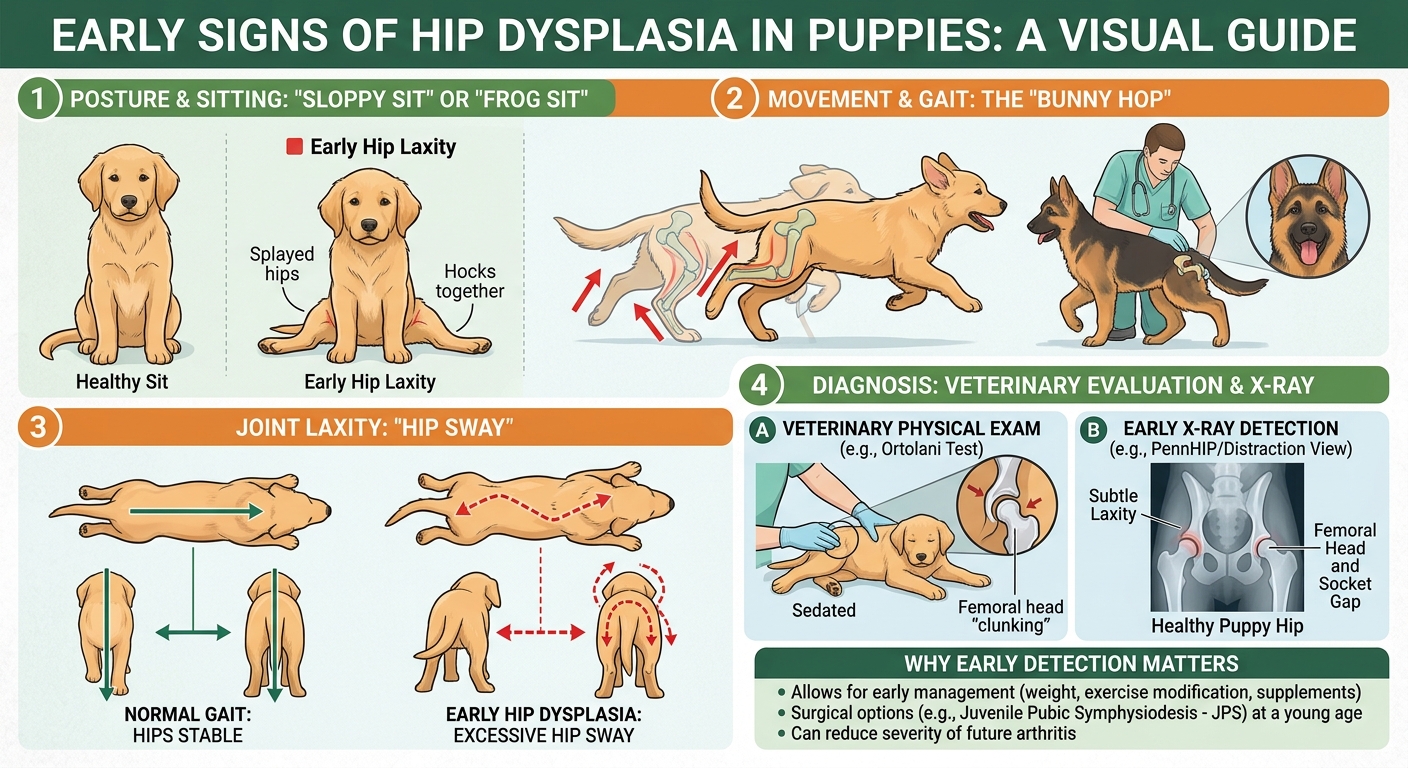
Puppies are expected to be active, curious and sometimes clumsy as they grow. However, repeated stiffness, difficulty getting up, reluctance to jump or changes in the way a puppy uses its hind legs may deserve veterinary attention.
Hip dysplasia is a developmental condition in which looseness within the hip joint affects the relationship between the head of the femur and the hip socket. Over time, abnormal movement within the joint can contribute to cartilage wear and osteoarthritis. The condition begins while a dog is growing, although visible signs do not always appear during early puppyhood.
Recognising changes in movement is useful, but symptoms alone cannot confirm hip dysplasia. A veterinary assessment may involve physical examination, assessment of hip joint laxity and appropriately positioned radiographs.
What Is Hip Dysplasia in Puppies?
The hip is a ball-and-socket joint. The rounded head of the femur sits within the socket of the pelvis and normally moves within that joint as the dog walks, runs, sits and stands.
In canine hip dysplasia, the hip joint develops with abnormal laxity or instability. Repeated abnormal movement can contribute to changes within the joint as the dog grows. Genetics play an important role, while growth and nutritional factors can also influence development of the condition. Hip dysplasia occurs commonly in large-breed dogs.
A puppy can have substantial hip laxity before the owner notices obvious difficulty moving. This means the absence of limping does not necessarily rule out a developing hip problem.
Which Early Changes Should You Discuss With a Vet?
If a puppy repeatedly shows changes in movement or appears uncomfortable during normal activity, discussing the signs with a vet can help determine whether the hips, knees, muscles, spine or another area should be assessed.
Changes worth mentioning include:
- Limping involving a hind leg
- Difficulty getting up after resting
- Reluctance to jump
- Hesitation when climbing stairs
- Hind-limb stiffness
- Reduced interest in running or playing
- Difficulty keeping up during normal walks
- Shifting body weight towards the front limbs
- Reduced muscle development around the hindquarters
- Sensitivity around the hips
- Changes in the way the puppy sits or stands
Lameness, reluctance to rise or jump, weight shifting towards the front limbs, rear-limb muscle loss and hip discomfort are recognised clinical signs associated with canine hip dysplasia.
These signs are not specific to hip dysplasia. Injuries, knee conditions, paw problems, muscle strains and neurological disorders can also affect a puppy’s movement.
Can Hip Dysplasia in Puppies Be Difficult to Notice?
Yes. Some puppies with hip laxity do not display obvious symptoms during early growth. Clinical signs can appear at different stages, and some dogs with canine hip dysplasia remain outwardly comfortable for a period despite changes within the joint.
This can make early recognition difficult if owners are relying on limping alone.
Subtle observations may include a puppy that:
- Takes longer to rise after resting
- Chooses not to jump when it previously did
- Stops playing sooner than usual
- Appears stiff after activity
- Frequently changes position while resting
- Uses the front legs to take additional body weight
- Appears uncomfortable when the hip region is handled
A single awkward movement does not establish a joint problem. Repeated or progressing changes provide a stronger reason to arrange veterinary assessment.
Why Might Certain Puppies Be Discussed for Hip Screening?
Hereditary factors have an important role in canine hip dysplasia, and the condition is seen commonly in large-breed dogs.
Breeds often associated with hip dysplasia risk include:
- Labrador Retrievers
- Golden Retrievers
- German Shepherds
The client’s current PennHIP information specifically identifies these breeds as being susceptible to hip dysplasia.
Breed is not the sole consideration. A veterinarian may also take into account:
- Family history
- Growth pattern
- Body condition
- Existing mobility signs
- Previous hip findings
- Planned physical activity
- Previous imaging
A puppy without obvious symptoms may still be discussed for screening where breed, history or other clinical factors indicate that hip assessment could be useful.
Why Can Early Assessment Matter?
Assessment of hip dysplasia in puppies can be relevant because some forms of hip evaluation can be performed while the dog is still young.
PennHIP is a radiographic method that quantifies passive hip joint laxity. The method can be performed in dogs from 16 weeks of age and provides information used to estimate the risk of osteoarthritis associated with canine hip dysplasia later in life.
Early evaluation can also be relevant because certain management or surgical discussions are age-dependent. Veterinary surgical guidance notes that some procedures intended for immature dogs need to be considered while skeletal growth is still occurring.
This does not mean that every puppy from a susceptible breed needs surgery. Screening and treatment are separate decisions.
What Happens During a Veterinary Hip Assessment?
A veterinary consultation usually begins with the puppy’s history and the changes noticed at home.
The veterinarian may ask:
- When the mobility change began
- Whether it affects one or both hind limbs
- Whether it occurs after exercise
- Whether the puppy appears stiff after resting
- Whether stairs or jumping have become difficult
- Whether there has been a recent injury
- Whether close relatives have known hip problems
- Whether the puppy is receiving medication or supplements
- Whether previous radiographs have been taken
Videos recorded at home can be useful if the puppy moves normally during the consultation but displays an unusual gait at other times.
What Might the Vet Look for During the Physical Examination?
The veterinarian may observe the puppy standing and walking before examining the hind limbs and hips.
The assessment can involve:
- Gait
- Weight bearing
- Muscle development
- Joint movement
- Areas associated with discomfort
- Hip range of motion
- Joint laxity
- Limb position
Hip dysplasia cannot be confirmed solely by watching a puppy walk.
Veterinary surgical guidance describes diagnosis as involving assessment of hip laxity together with appropriately positioned radiographs. Some forms of palpation and hip imaging require sedation so that the muscles surrounding the hips are sufficiently relaxed for assessment.
What Is PennHIP Screening?
PennHIP is a radiographic technique used to assess hip joint laxity in dogs.
Unlike relying solely on visible symptoms, the assessment measures how much movement occurs within the hip joint under controlled positioning.
A PennHIP evaluation typically involves several radiographic views, including distraction, compression and hip-extended images. Sedation or anaesthesia is required so the muscles surrounding the hip joint are relaxed sufficiently for diagnostic positioning.
The resulting measurement can provide information about the dog’s hip laxity and risk of developing osteoarthritis associated with canine hip dysplasia.
PennHIP can be performed from 16 weeks of age.
Does a Puppy Need Symptoms Before PennHIP Screening?
Not necessarily.
Hip dysplasia can exist without obvious clinical signs, particularly during early stages. A young dog may have abnormal hip laxity even when it continues to run and play normally.
A veterinarian may therefore discuss hip screening because of:
- Breed-related risk
- Family history
- Findings during physical examination
- Mobility changes
- Future activity considerations
- Previous concerns about hip laxity
The decision should be based on the individual puppy rather than symptoms alone.
What Happens If Screening Shows Increased Hip Laxity?
A screening result is considered alongside the puppy’s age, examination findings and clinical circumstances.
The veterinarian may discuss:
- Monitoring
- Body condition
- Appropriate activity
- Follow-up assessment
- Repeat imaging where relevant
- Rehabilitation considerations
- Surgical assessment in selected cases
The management pathway is not identical for every puppy.
Some young dogs with abnormal hip laxity may be assessed for procedures that are relevant only during a limited period of skeletal development. Older dogs with established osteoarthritis may require a different management approach.
Does Hip Dysplasia Always Cause Limping?
No.
A dog can have hip dysplasia without obvious lameness. Clinical signs depend on factors such as joint laxity, inflammation, age, activity and changes that have developed within the joint.
This is why owners of puppies considered susceptible to hip dysplasia should not rely solely on whether the puppy limps.
Other changes, such as reluctance to rise, reduced jumping, shifting weight towards the front limbs or loss of rear-limb muscle, can also be relevant.
Can Diet and Growth Affect Hip Dysplasia?
Canine hip dysplasia has a substantial hereditary component, but growth-related factors can also affect its development. Rapid weight gain and growth associated with excessive nutritional intake can complicate canine hip dysplasia.
Puppy owners should therefore discuss suitable feeding quantities and body condition with their veterinarian, particularly for large-breed puppies.
Avoid making major dietary changes or using joint supplements specifically for a suspected hip condition without veterinary guidance.
Should Exercise Be Restricted If Hip Dysplasia Is Suspected?
Do not force a puppy to continue an activity that appears uncomfortable.
If a puppy repeatedly limps, struggles to get up or becomes reluctant to exercise, a veterinarian can advise whether temporary activity modification is appropriate while the problem is investigated.
Exercise recommendations depend on the cause of the mobility problem. A puppy with hip laxity may require different activity guidance from a puppy with a fracture, ligament injury or neurological condition.
Until the cause is known, avoid using strenuous exercise as a way to test whether the puppy can “work through” the problem.
Could Another Condition Look Like Hip Dysplasia?
Yes.
Mobility changes in puppies may involve other parts of the musculoskeletal or nervous system.
Possible causes can include:
- Muscle or soft-tissue injury
- Knee conditions
- Fractures
- Paw injuries
- Other developmental orthopaedic conditions
- Spinal disorders
- Neurological conditions
This is why a veterinary examination is necessary before assuming that hind-limb stiffness or limping is caused by hip dysplasia.
When Should a Puppy Receive Prompt Veterinary Attention?
Hip dysplasia often relates to developmental joint changes rather than a sudden emergency, but certain mobility signs should receive prompt veterinary assessment.
These include:
- Sudden inability to stand
- Sudden inability to use a limb
- Significant trauma
- An obvious limb deformity
- Marked discomfort
- Dragging the hind limbs
- Sudden loss of coordination
- Rapid deterioration in mobility
These signs may be associated with conditions other than hip dysplasia and should not be monitored at home without veterinary advice.
What Should You Bring to a Hip Assessment?
Owners can help the veterinarian by preparing information about the puppy’s movement and health history.
Useful items include:
Videos
Record the puppy walking when it is safe to do so. Side, front and rear views can show different aspects of gait.
Symptom Notes
Write down:
- When the change appeared
- Whether it is constant or intermittent
- Whether exercise affects it
- Which activities are difficult
- Whether stiffness occurs after rest
Breeding or Family Information
If available, bring information relating to the hip health of the puppy’s parents or close relatives.
Existing Medical Records
Previous examinations, imaging and treatment information can provide additional context.
Questions to Ask Your Vet About Puppy Hip Health
Questions owners may wish to discuss include:
- Does my puppy’s gait appear unusual?
- Are the hips showing signs of laxity?
- Should my puppy have hip radiographs?
- Is PennHIP assessment appropriate?
- At what age should hip screening be considered?
- Does breed or family history affect the screening decision?
- Does my puppy need changes to activity?
- Is the current body condition appropriate?
- What happens if hip laxity is identified?
- When should the hips be reassessed?
These discussions can help owners understand the difference between observing symptoms, screening for risk and diagnosing a clinical condition.
Hip dysplasia begins while dogs are growing, but the early signs in puppies can be subtle. Limping, difficulty rising, reluctance to jump, hind-limb stiffness, changes in weight bearing and loss of muscle around the rear limbs can warrant veterinary assessment. Some puppies with substantial hip laxity may show few visible signs.
Breed and family history can also influence whether hip screening is discussed. Large-breed puppies are commonly affected, and owners of breeds associated with hip dysplasia may wish to discuss hip assessment even when their puppy appears active.
Veterinary examination helps distinguish a possible hip problem from other causes of altered movement. Where appropriate, radiographic assessment can provide information about hip joint structure and laxity. PennHIP can be performed from 16 weeks of age and is designed to quantify hip laxity and estimate the risk associated with later osteoarthritis.
For puppy owners, the useful approach is to pay attention to repeated changes in movement, keep relevant videos or notes and raise concerns during veterinary visits. Early assessment can provide information that helps the veterinary team discuss suitable monitoring and management for the individual puppy.
Frequently Asked Questions
How early can puppies show signs of hip dysplasia?
Hip dysplasia begins during growth, and some young dogs can develop clinical signs before adulthood. Signs may include limping, reluctance to rise or jump, hip discomfort and changes in hind-limb muscle development. Other affected dogs may show few obvious symptoms.
What does hip dysplasia look like in a puppy?
Possible signs include hind-limb lameness, stiffness, difficulty rising, reluctance to jump and shifting body weight towards the front limbs. These signs can also occur with other conditions, so veterinary assessment is required.
Are large-breed puppies at risk of hip dysplasia?
Hip dysplasia occurs commonly in large-breed dogs, with hereditary factors playing an important role.
At what age can a puppy have a PennHIP assessment?
PennHIP can be performed in dogs from 16 weeks of age. The technique measures hip joint laxity and provides information about risk of osteoarthritis associated with canine hip dysplasia.
Does a puppy need to be limping before hip screening is discussed?
No. Some dogs with hip dysplasia do not display obvious clinical signs, so breed, family history or examination findings may also prompt a discussion about screening.
Does a positive hip screening result mean my puppy needs surgery?
No. Screening findings need to be considered alongside age, clinical signs, examination findings and other diagnostic information. Management can differ between individual dogs.
This article is for general information only and should not replace medical advice from a qualified healthcare professional.