For heavy-duty machinery, the components are essential to withstand repeated loads, friction, vibrations, and tough operating conditions. However, steel is still a viable option since mechanical properties can be adjusted by the selection of grades and heat treatment. Combined with that material strength, CNC machining provides dimensional control, repeatability, and geometric flexibility. These capabilities combine to provide the reliability of shafts, gears, fixtures, tooling, brackets, and other components.
Why Steel Remains a Strong Choice for Heavy-Duty Parts
Steel is a material that has strength, toughness, wear resistance, and material availability. It is an iron-carbon alloy that can be changed with other elements like chromium, nickel, molybdenum, and vanadium. These additions can enhance the properties of the material for specific application requirements. There are also variations in the machinability, hardness, toughness, and fatigue resistance of different grades. This versatility also makes steel appropriate for mechanical elements which are subjected to significant forces during operation. Many steel grades have the ability to keep their shape under heavy loads and repeated mechanical stress, which is not the case with softer metals.
Match the Steel Grade to the Mechanical Demand
The selection of material should start with the actual requirement of the component and not with the hardest steel available. Low carbon steels like 1018 have good weldability, strength, and machinability for general-purpose applications. Shafts, gears, and mechanical hardware can receive higher strength and toughness from steel 1045. With proper heat treatment, higher-carbon 1095 can have significant hardness and wear resistance. Grades like 4140 and 4340 alloys are used in applications that require higher levels of strength, toughness, and fatigue resistance.
Selecting Between Common Steel Families
The right grade depends on load, wear, hardness, geometry, machining requirements, and post-processing needs.
- Low-carbon steel: Useful for economical shafts, pins, fixtures, and general components.
- Medium-carbon steel: Suitable for gears, bolts, shafts, and parts requiring greater strength.
- Alloy steel: Supports demanding components exposed to heavy loads and fatigue.
- Tool steel: Provides high hardness and wear resistance for dies, molds, and cutting applications.
- Build Complex Components With Controlled CNC Processes
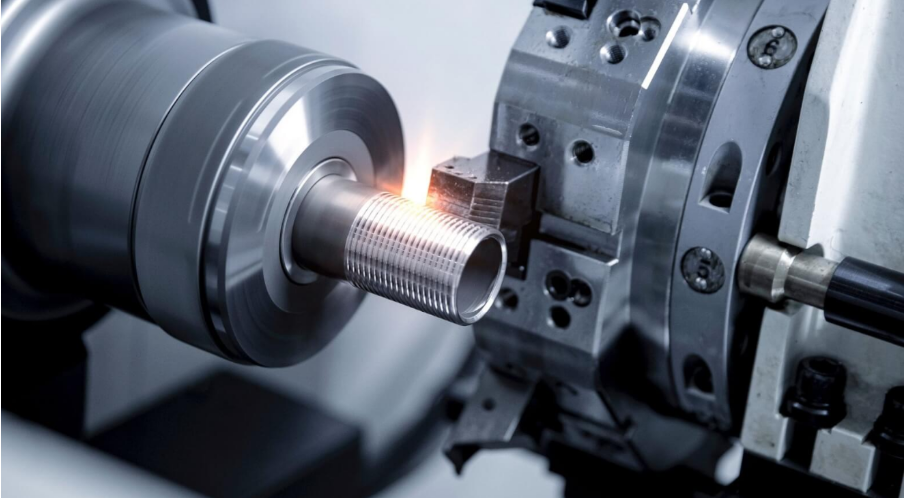
CNC machinery is a process that transforms digital designs into precisely created parts by using programmed cutting operations. Pockets, slots, contours, holes, and complex surfaces can be created in milling. Turning is suitable for cylindrical parts like shafts, pins, and bushings. Small, slender precision parts can be supported by Swiss-type machining, and multi-axis machining can minimize repeated setups for complex geometries.
When suitable machines, tooling, work holding and inspection techniques are employed, modern steel CNC machining can also provide close dimensional tolerances when necessary. Advanced 3-axis, 4-axis and 5-axis equipment enables the manufacturer to access challenging features and control tool positioning. The tolerances must always be as per the functional requirements of the component.
Machine Shafts and Gears for Mechanical Power Transfer
Shafts and gears are basic components of torque and mechanical motion transmitting systems. Their size directly impacts alignment, engagement, rotational balance, and load distribution. Machined shafts can also feature bearing seats, keyways, threads, shoulders, grooves, and exact journals. For gears to function properly, it is necessary that the teeth have the correct geometry and that the gears are concentric.
In these uses, the proper selection of steel and careful machining go hand in hand. Medium-carbon and alloy steels can offer desirable combinations of strength, toughness, and wear resistance. Hardness and mechanical properties can be further adjusted by heat treatment after machining, if required for the application.
Control Wear, Heat, and Tool Pressure During Machining
The greater the hardness and the higher the alloy content, the more difficult it is to machine the steel. Harder materials create higher cutting forces and can increase wear rates of the tool. Too much cutting can also generate unwanted heat and impact surface quality or dimensional stability. The machining strategy should therefore consider the material condition, the geometry of the tool, the cutting parameters, the coolant, and the rigidity of the part.
Managing Difficult Steel Machining
Consistency can be achieved with a controlled production process and tooling, and finished surfaces are protected. Special carbide tooling, coatings, cutting speeds, and chip evacuation may be necessary for hard or heat-treated steels. Deflection can also be a risk with deep cavities and thin walls. Making features accessible and keeping designs simple can make machining more predictable and cost-effective.
Improve Durability Through Post-Machining Treatments
Machining is used to form the geometry of the component, and further processing can be used to enhance the service properties. Depending on the grade of steel and the type of heat treatment, it is possible to improve hardness, strength, or toughness. Some steels are used in such a way that desired mechanical properties are obtained by suitable processes like quenching and tempering.
Surface treatments can offer an additional level of protection. Coatings, spraying, blasting, and other finishing processes may affect the surface condition, appearance, corrosion characteristics, or wear resistance. Treatment of the selected material should be appropriate for the material and environment of operation rather than automatic.
Design Steel Parts for Precision and Cost Control
Manufacturability starts with the first cut. A practical design will include tolerances that are based on the actual functional needs. The tolerances around plus and minus 0.05 mm are often sufficient for simple functional elements, but a closer tolerance will necessitate extra equipment and checks.
Excessively thin walls, complex surfaces, and hard-to-reach internal features can also extend the time required for the machining process. These issues can be detected early by a design-for-manufacturing review. In cases where you do not need the steel to be as hard as possible, you can also find a more machinable steel grade, which can also reduce the difficulty in cutting and the wear of the tool.
Verify Dimensions Before Heavy-Duty Deployment
Accurate machining is not enough for reliable components. Inspection is the process of ensuring that the finished part meets its engineering requirements. Coordinate measuring machines are used to check critical dimensions and geometric relationships versus the drawing and GD&T. Material documentation can also be used to verify the specified steel grade.
An ISO 9001:2015 certified manufacturing process brings an added level of structured quality control and traceability for demanding production work. 3ERP merges accuracy CNC, inspection, and production controls to produce steel parts for diverse industrial needs.
Conclusion
The use of steel offers versatility for components that are under high mechanical load; CNC machining offers controlled geometry and repeatable production. Best results are obtained by correlating the steel grade, machining approach, tolerances, heat treatment, and surface finish with the actual operating conditions of the component. Thoughtful design also minimizes the number of unnecessary machining challenges and does not compromise performance. Whether it’s power-transmission hardware or industrial tooling, correctly designed steel parts can deliver the strength, precision, and durability necessary for the most demanding applications.