Running a successful business requires more than delivering quality products or services. Behind every customer order, supplier shipment, and internal delivery is a process that must operate efficiently to keep the business moving. As companies grow, parcel volumes often increase alongside customer expectations, making it more difficult to manage deliveries using manual methods.
Modern parcel management software helps businesses streamline package receiving, tracking, storage, and collection through automation. By replacing spreadsheets and paper logs with digital workflows, entrepreneurs can reduce delays, improve visibility, and eliminate many of the operational bottlenecks that slow business growth.
Why Parcel Management Matters
Every package entering a business represents an important transaction. It may contain inventory, office equipment, customer returns, supplier materials, or time-sensitive documents. Without a structured process for managing these deliveries, parcels can quickly become misplaced, delayed, or overlooked.
As businesses expand, manual tracking methods become increasingly difficult to maintain. Staff may spend valuable time searching for packages, answering delivery inquiries, or updating multiple records instead of focusing on higher-value work.
An effective parcel management process creates consistency while improving accountability across every stage of the delivery lifecycle.
Efficient parcel management keeps business operations moving by ensuring every delivery is tracked, visible, and accounted for.
Common Operational Bottlenecks
Many growing businesses experience similar delivery challenges as parcel volumes increase.
| Operational Challenge | Business Impact |
| Manual package logging | Slower receiving processes |
| Paper-based records | Increased risk of human error |
| Delayed recipient notifications | Longer parcel storage times |
| Limited delivery visibility | Time spent locating packages |
| No audit trail | Difficult issue resolution |
Although each issue may appear minor on its own, together they can reduce productivity and create unnecessary operational costs.
Businesses that rely on outdated processes often struggle to maintain service quality as delivery demand continues to grow.
How Parcel Management Software Improves Efficiency
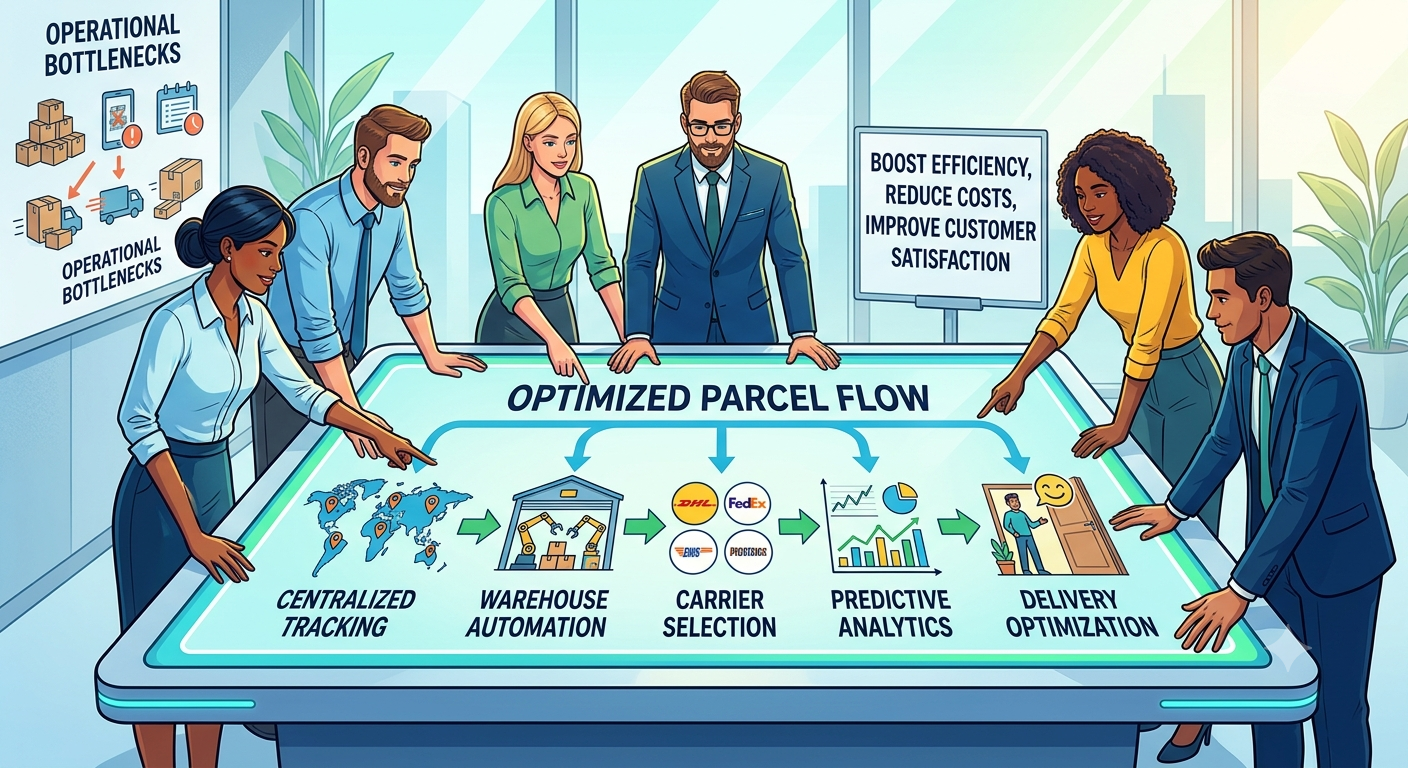
Parcel Management Software centralizes every stage of package handling into a single digital workflow.
Incoming deliveries can be scanned upon arrival, assigned to a storage location, linked to the intended recipient, and monitored until collection. Automated notifications help recipients collect their parcels sooner, reducing storage congestion and minimizing manual follow-up.
Key capabilities typically include:
- Barcode scanning for faster package registration
- Automated recipient notifications
- Real-time parcel tracking
- Digital proof of collection
- Searchable delivery records
- Secure audit trails
- Operational reporting and analytics
These features reduce repetitive administrative tasks while improving the speed and accuracy of parcel handling.
Better Visibility Leads to Better Decisions
Operational bottlenecks often occur because businesses lack visibility into where parcels are located or how efficiently deliveries are being processed.
With centralized parcel tracking, managers can quickly identify:
- Delivery processing times
- Uncollected parcels
- Storage capacity trends
- Peak delivery periods
- Collection performance
- Package movement history
Access to accurate operational data allows businesses to improve workflows, allocate resources more effectively, and respond quickly to changing delivery demands.
Rather than reacting to problems after they occur, teams can identify inefficiencies before they affect customer service or internal operations.
Visibility turns parcel management from a reactive task into a proactive business process.
Supporting Business Growth
Entrepreneurs often focus on sales, marketing, and customer acquisition when scaling their businesses. However, operational efficiency plays an equally important role in sustainable growth.
As order volumes increase, delivery processes that once worked well can quickly become obstacles. Packages accumulate faster, staff spend more time managing deliveries, and manual processes become increasingly difficult to maintain.
Implementing standardized parcel management workflows allows businesses to scale operations without a proportional increase in administrative workload.
Digital tracking also improves collaboration between receiving teams, office staff, and management by ensuring everyone has access to the same delivery information.
Choosing the Right Parcel Management Solution
As delivery demand grows, businesses should look for Parcel Management Software that supports both current operations and future expansion.
Important features include:
| Feature | Business Benefit |
| Barcode scanning | Faster parcel processing |
| Automated notifications | Reduced collection delays |
| Real-time parcel tracking | Improved delivery visibility |
| Digital signatures | Secure proof of collection |
| Reporting dashboards | Better operational insights |
| Multi-site capability | Consistent workflows across locations |
Selecting software with these capabilities helps businesses improve operational efficiency while maintaining accurate delivery records and stronger accountability.
Final Thoughts
Operational bottlenecks rarely result from a single issue. They often develop through small inefficiencies that accumulate over time as delivery volumes increase.
Parcel Management Software helps entrepreneurs eliminate these challenges by creating structured, transparent workflows that improve package visibility, reduce manual administration, and support faster decision-making.
For growing businesses, effective parcel management is more than organizing deliveries. It is about creating reliable operational processes that improve productivity, strengthen accountability, and provide the foundation for long-term business growth.