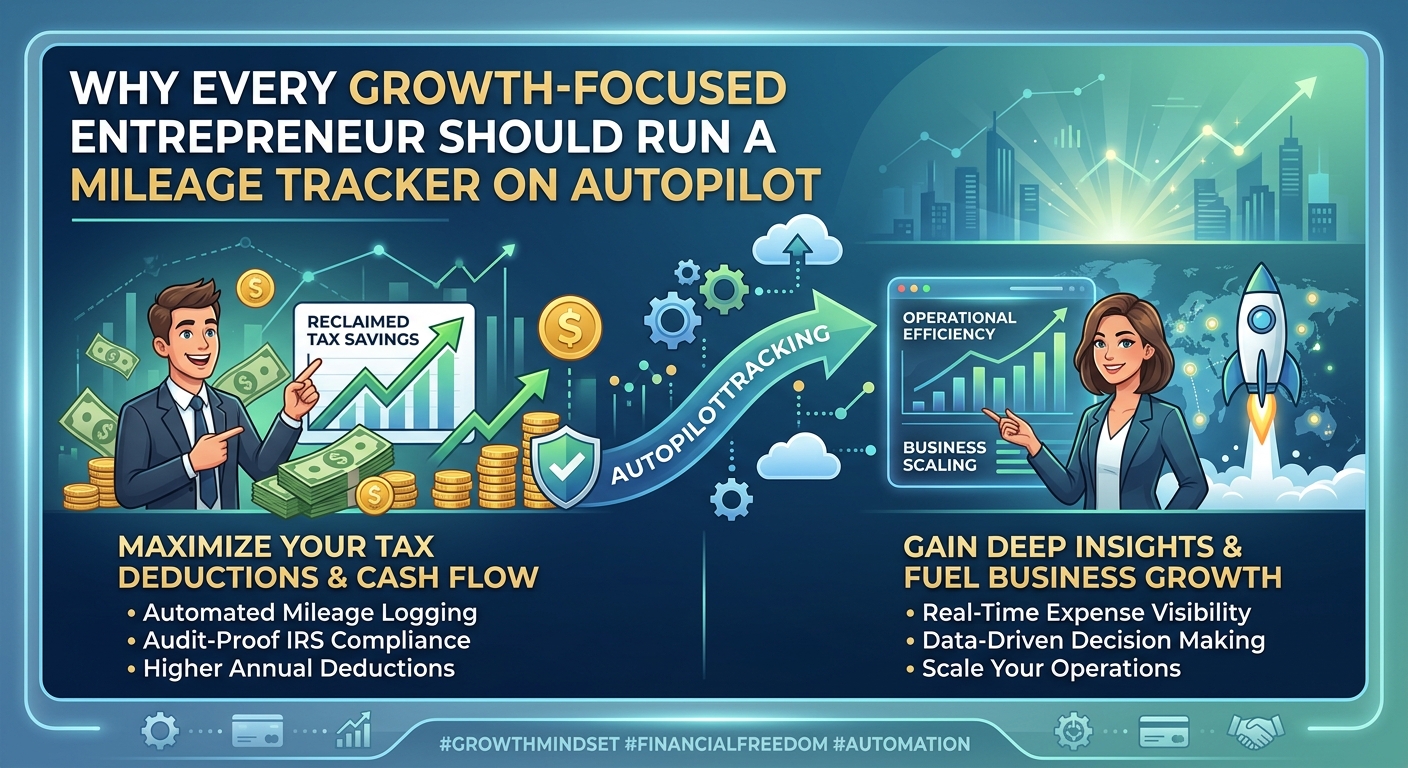
Entrepreneurs obsess over the big levers: revenue, hiring, product, and market position. The small, repeatable systems that quietly protect margin rarely get the same attention. Vehicle expenses are one of those overlooked levers. If you drive for client meetings, site visits, networking events, or supply runs, every one of those miles carries a deductible value, and most founders leave a meaningful chunk of that money on the table simply because they never logged the trips.
The fix is not more discipline or a shoebox full of receipts. It is automation. A modern mileage tracker runs in the background on your phone, records every drive using GPS, and lets you sort business trips from personal ones with a swipe. For a growth-focused operator, that is the difference between a tax deduction you actually capture and one you only talk about capturing. The point is not to become a bookkeeper. The point is to build a system that captures value without demanding your attention, which is the same principle you apply to every other part of a well-run company.
The Real Cost of Not Tracking
Founders tend to underestimate how much they drive for the business. A few client visits a week, a monthly supplier run, the occasional conference, and the recurring drive to a coworking space add up faster than intuition suggests. Consider what those miles are worth at the current IRS standard rate.
| Business miles per month | Annual miles | Deduction value at 76¢/mile |
|---|---|---|
| 200 | 2,400 | $1,824 |
| 500 | 6,000 | $4,560 |
| 850 | 10,200 | $7,752 |
| 1,200 | 14,400 | $10,944 |
These are not exotic numbers. A founder who drives 500 business miles a month is looking at more than $4,500 in deductions per year. Miss those, and you are effectively paying tax on income you could have shielded. The problem is that manual logging fails precisely because entrepreneurs are busy. You forget the odometer reading, you lose the note app entry, and by April the record is a guess. Guesses do not survive an audit, and they do not survive your own scrutiny either when you sit down to reconcile the year.
There is a psychological cost too. Every uncaptured deduction is a small tax on your future decision-making. It teaches you, quietly, that the details do not matter and that the business runs on approximation. That is a dangerous lesson for an operator who wants to scale, because scale amplifies sloppiness just as reliably as it amplifies discipline.
What Automated Tracking Actually Does
The value of automation is not just convenience. It is defensibility. The IRS expects a contemporaneous record, meaning a log created at or near the time of the trip rather than reconstructed months later. Automated tools generate exactly that kind of record without you thinking about it.
Here is what a solid automated system handles for you:
- Detects drives automatically using motion and GPS, so you never start or stop a timer manually.
- Records the essentials the IRS wants: date, distance, start and end points, and purpose.
- Separates business from personal with a simple swipe-left, swipe-right classification.
- Stores a clean, exportable report you can hand to an accountant or attach to a return.
- Calculates the deduction in real time so you always know your running total.
That last point matters more than it seems. When you can see the deduction accumulating, mileage stops feeling like a chore and starts feeling like income you are actively protecting. Behavior follows visibility. A number that goes up every week is a number you will pay attention to, and attention is exactly what manual logging never earns.
Standard Mileage vs. Actual Expenses
There are two ways to deduct vehicle costs, and choosing the right one is worth real money. Under the standard mileage method, you multiply business miles by the IRS rate. Under the actual expense method, you total up gas, insurance, repairs, depreciation, and registration, then deduct the business-use percentage.
| Factor | Standard mileage method | Actual expense method |
|---|---|---|
| Recordkeeping burden | Low (miles only) | High (every receipt) |
| Best for | High-mileage, efficient vehicles | Expensive or heavy vehicles |
| Depreciation | Baked into the rate | Tracked separately |
| Flexibility to switch | Limited after year one | Limited after year one |
For most service-based entrepreneurs driving a normal car, the standard mileage method wins on simplicity and often on total deduction. But you cannot make an informed choice without accurate mileage data in the first place, which loops right back to why tracking is foundational. Even if you eventually decide the actual expense method fits your situation, you still need your business-use percentage, and that percentage comes from your mileage log. There is no version of this where tracking is optional. If you want the official ground truth on how these rates and methods work, the IRS standard mileage rates page is the authoritative source and worth bookmarking.
Building the Habit Into Your Operating System
Charfen readers think in terms of systems and infrastructure, so treat mileage the same way you would treat any other business process. The goal is to remove the human from the loop entirely.
- Install once, classify weekly. Set the app to auto-detect drives, then spend five minutes each Friday swiping trips into the right bucket.
- Standardize your trip purposes. Use consistent labels like “client meeting,” “supplier,” or “networking” so your reports are clean and your accountant does not have to interpret them.
- Reconcile monthly. Glance at the running deduction total once a month. It keeps the system honest and flags any drives that slipped through.
- Export quarterly. If you pay estimated taxes, a quarterly export keeps your projections accurate and avoids surprises.
The beauty of this approach is that it scales with the business. Whether you are driving 200 miles a month or building a small fleet as you grow, the system does not change. You are simply capturing more value as your activity increases. A process that works identically at every stage is exactly the kind of infrastructure worth investing in early, because you never have to rebuild it.
Common Mistakes That Cost Founders Money
Even entrepreneurs who track their mileage often undermine themselves with avoidable errors. A few worth naming:
- Reconstructing logs at year-end. A calendar-based estimate is not a contemporaneous record, and it is the first thing scrutinized in an audit.
- Mixing commuting with business miles. Your regular commute is not deductible, and blending it into business totals invites problems.
- Forgetting to log short trips. The five-minute drives to the post office or the bank add up over a year and are just as deductible as long ones.
- Losing the data when you switch phones. Cloud-backed records prevent a device change from erasing months of history.
Each of these mistakes has the same root cause: relying on memory and manual effort instead of a system. Automation eliminates all four at once, which is why it is the only approach that holds up over time.
Why This Matters More as You Scale
Early on, a few thousand dollars in deductions might feel like a rounding error against your ambitions. But growth-focused operators know that margin compounds. The habits you build at $200k in revenue are the habits that protect you at $2M. A founder who never learned to capture vehicle deductions is often the same founder who leaves other small, systematic wins uncaptured across the business.
There is also a compliance dimension. As your revenue grows, so does your audit exposure. A clean, automated, timestamped mileage log is one of the least glamorous but most reliable forms of documentation you can have. When everything is recorded contemporaneously and exported into a tidy report, a question about vehicle expenses becomes a non-event rather than a scramble. The founders who sleep well during tax season are not the ones with the fanciest accountants. They are the ones whose records were clean all year long.
The Bottom Line
Mileage tracking is a small system with an outsized return. It costs almost nothing to set up, runs without your attention, and quietly protects thousands of dollars a year that would otherwise vanish. For entrepreneurs who already understand that businesses are built on repeatable infrastructure rather than heroics, automating your mileage log is one of the easiest wins available.
The move is simple: put a tracker on autopilot, classify your drives once a week, and let the deduction accumulate. Then redirect your attention to the levers that actually require your genius, knowing that this one is handled. Growth is about doing the small things reliably so the big things have room to work. Mileage is exactly that kind of small thing, and it deserves a permanent place in your operating system.