
Beyond Nicotine: Why Nicotine-Free Disposables Are Taking Over in 2026
Something strange is happening in vape shops across America. Next to the familiar nicotine disposables, a new shelf is growing, devices boldly labeled “nicotine-free” that promise the same throat hit, the same satisfying draw, the same ritual. And customers are buying them faster than anyone in the industry expected.
The driver is a compound most vapers had never heard of two years ago: 6-methylnicotine, sold under the brand name Metatine. This is the story of what it is, whether the devices actually work, what the safety science says so far, and how regulators are responding. If you are curious about the category, start with the hardware: the category leader is the SBX 25K, and the full hands-on breakdown is in this SBX 25K review, which tested the device across all three power modes.
What exactly is Metatine?
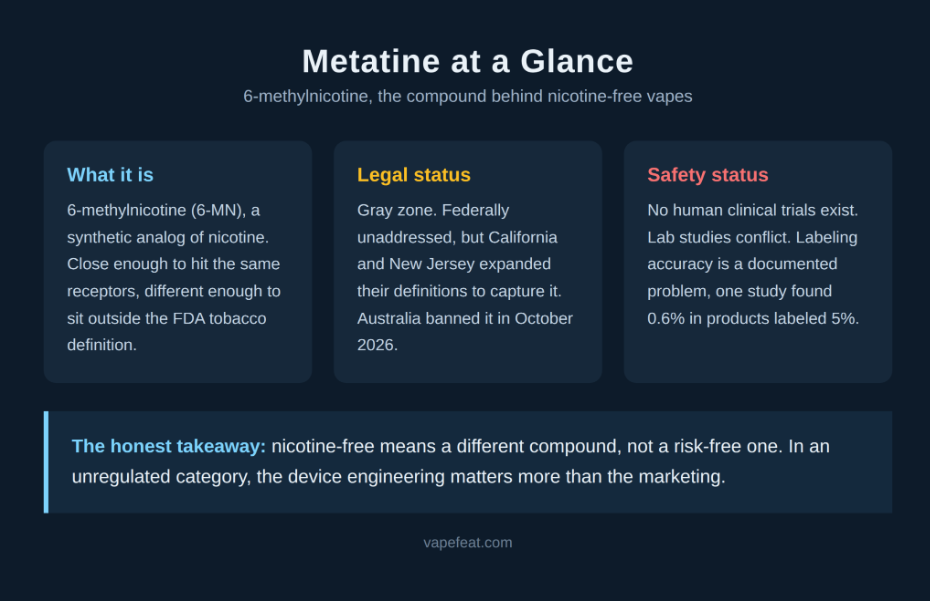
Metatine is 6-methylnicotine (6-MN), a synthetic analog of nicotine. The chemistry is close enough to activate the same nicotinic receptors, but structurally different enough to sit outside the FDA’s legal definition of a tobacco product. That legal distinction is the entire business model: because these devices technically contain no nicotine, makers argue they are exempt from the FDA’s premarket tobacco authorization (PMTA) process that governs every legal nicotine vape in America.
The marketing calls it “nicotine-free.” The chemistry says it is nicotine-adjacent. The regulators say it is a gray zone they are racing to close. All three statements are true at the same time.
To understand the scale, consider the naming trick that preceded it. Elf Bar, facing FDA enforcement, rebranded to EBDesign and then EBCreate while the same devices kept flowing through American shops. Metatine is the chemical version of the same playbook: change just enough to slip the definition, keep everything else the same. Industry watchers have started calling it “the Delta-8 of nicotine,” and the comparison is uncomfortably accurate.
The Delta-8 parallel is worth taking seriously
Delta-8 THC followed an almost identical arc. A compound close enough to the familiar one to deliver the effect, different enough to dodge the existing legal definition, sold in a regulatory vacuum while agencies scrambled. The ending of that story was messy: a patchwork of state bans, inconsistent product quality, and eventually federal attention.
Metatine is currently in the early-middle chapters of the same book. The products are on shelves in states that have not yet acted. The federal definition has not caught up. And the quality variance between brands is exactly what you would expect from an unregulated category: some devices are carefully engineered, others are flavored air with a marketing budget.
This is why the device you choose matters more than the compound. In an unregulated category, engineering is the only quality control that exists.
Do nicotine-free disposables actually satisfy?
This is the question that matters, and the honest answer is: it depends entirely on the device. The first generation of nicotine-free vapes was a joke: flavored vapor with no throat hit, no satisfaction, devices that ended up in drawers after a day. The new generation is genuinely different, because the hardware caught up.
The device that proved the category could work is the SBX 25K. It runs 5% Metatine through three real power modes (ECO at 15W, Boost at 20W, X at 25W), with adjustable airflow from tight MTL to open DTL and a smart display showing battery, e-liquid and mode. Independent testing by VapeFeat put it through full mode-by-mode evaluation: flavor consistency across the wattage range, battery behavior under load, and how long each mode actually lasts in real use.
The short version of those findings: on Boost mode with normal airflow, the SBX 25K genuinely satisfies in a way older zero-nicotine devices never did. The throat hit is there, the flavor holds, the draw feels like a real vape. On X mode it is intense but burns through the puff budget fast. The testers found that mode selection alone changes total device lifespan by roughly 8,000 puffs, a staggering difference that most buyers never learn about.
That is the real story of this category: the compound gets the headlines, but the hardware decides whether you get satisfaction or disappointment. A well-engineered Metatine device with real power control can genuinely replace a nicotine disposable for many users. A cheap one cannot, and the price difference between them is smaller than the experience difference.
The safety question nobody can dodge

Here is where honesty matters more than hype. There are no human clinical trials on inhaled 6-methylnicotine. None. The entire safety conversation is built on lab studies, animal data, and extrapolation, and anyone who tells you the science is settled in either direction is selling something.
What exists so far is conflicting. A 2025 toxicology study found 6-MN aerosols more cytotoxic than nicotine in laboratory cell tests. An industry-linked study claims lower acute toxicity. Both cannot be fully right, and neither is a human trial. The research base is thin, and the honest scientific position is uncertainty.
Labeling accuracy is a separate, documented problem. A 2024 JAMA study found products labeled “5% 6-MN” actually contained around 0.6%, off by nearly a factor of ten. In an unregulated category, what the label says and what is inside the device are two different claims, and only one of them is checked.
“Nicotine-free” does not mean “risk-free.” It means “contains a different compound whose long-term inhalation effects are unstudied.” That distinction matters, and it should be on every product page in the category.
Regulators are moving, state by state
The regulatory gap is closing, just unevenly. Australia moved fastest: 6-methylnicotine went into Schedule 9 (prohibited substances) effective October 1, 2026. In the US, California and New Jersey have expanded their legal definitions of nicotine to capture analogs like 6-MN, effectively pulling Metatine products under existing tobacco regulation in those states.
The FDA’s position is the one to watch. The agency has already shown it will act against definition-dodging: the September 2026 enforcement wave hit 22 retailers with roughly $20,000 in civil money penalties each for selling unauthorized Elf Bars. The same enforcement logic applies to Metatine devices the moment the legal definition catches up. The question is not whether regulation comes, but when, and whether the category’s best manufacturers use the window to build legitimate products or just to sell fast.
For buyers, the practical takeaway is simple: the federal loophole does not override state law. Check your state’s rules before buying, because analog bans are spreading and the map changes monthly.
Who is actually buying these?
The customer base is more interesting than the stereotype. It is not just curious teenagers, though youth access is a real concern regulators cite. Three distinct buyer groups have emerged:
Nicotine steppers-down. Vapers reducing their nicotine intake who want the ritual without the compound. For them, a satisfying Metatine device is a bridge, not a destination.
Social and situational vapers. People who vape in specific contexts: nights out, long drives, work breaks, and do not want a daily nicotine habit attached to it.
The regulation-curious. Buyers in states with flavor bans or heavy restrictions who found the legal nicotine market no longer serves them. This group is the largest and the fastest growing.
All three groups share one trait: they are informed buyers or they become disappointed ones. The category punishes impulse purchases and rewards research.
What to check before buying
If you are considering a nicotine-free disposable, here is the checklist that separates good purchases from drawer-fillers:
- Real mode control. Single-output disposables waste e-liquid and give you no say in the experience. Adjustable wattage with distinct modes is the difference between a device that lasts and one that dies early.
- Adjustable airflow. MTL versus DTL is not a gimmick. It changes flavor intensity, throat hit and consumption rate dramatically. Fixed-airflow devices lock you into one experience.
- A real display. Battery and e-liquid indicators sound trivial until your device dies mid-day with juice still inside. The display is the difference between managing your device and guessing.
- Brand accountability. In an unregulated category, buy from makers with real testing, real reviews and a real reputation. Anonymous white-label devices are where the labeling problems live.
- Your state’s rules. The federal gap does not protect you from state analog bans. Check before you buy.
The economics nobody talks about
There is a quiet economic argument for the category’s best devices. A well-made 25,000-puff Metatine disposable at typical retail prices costs less per week than a pack-a-day cigarette habit by an enormous margin, and less than churning through small disposables. The adjustable modes are the key: running ECO mode when you want longevity and Boost when you want satisfaction stretches one device across weeks instead of days. Buyers who learn their device’s modes spend meaningfully less than buyers who do not, which is another reason the testing data matters more than the marketing. More device breakdowns in this style are published regularly at VapeFeat.
The bottom line
Nicotine-free disposables are not a fad. They are a structural response to regulation, and the best of them are genuinely good devices that satisfy in ways the first generation never could. But the category is two markets wearing one label: engineered products from accountable makers, and opportunistic products riding a legal gap.
The difference between those two markets is information. Know what Metatine is and what it is not. Know that no human safety trials exist. Know your state’s laws. Learn your device’s modes. And do not confuse “no nicotine” with “no risk”: the honest version of that sentence is the whole story.
For the full hands-on test data behind this article: mode-by-mode puff counts, flavor notes across the wattage range, and battery behavior, see the SBX 25K review from the VapeFeat testing team.
Frequently asked questions
What is Metatine?
Metatine is the brand name for 6-methylnicotine (6-MN), a synthetic analog of nicotine that activates the same receptors but sits outside the FDA’s legal definition of a tobacco product.
Is Metatine legal?
It exists in a gray zone. Federally unaddressed for now, but states like California and New Jersey have expanded their definitions to capture it, and Australia banned it outright in October 2026. Check your state.
Is Metatine safer than nicotine?
Unknown. There are no human clinical trials. Lab studies conflict, with one finding higher cytotoxicity than nicotine and an industry-linked one claiming lower acute toxicity. Treat “nicotine-free” as a chemistry claim, not a safety claim.
Do Metatine disposables actually satisfy?
The good ones do. Devices with real power modes, adjustable airflow and proper coils deliver a genuine throat hit and flavor. Cheap single-output devices generally do not.
Will Metatine show up on a nicotine test?
Standard nicotine tests look for nicotine and cotinine, not 6-MN, so it will likely not trigger them. But testing panels vary, and this is not medical advice.
Which device should I look at first?
The SBX 25K is the best-documented device in the category, with full third-party mode-by-mode test data available.