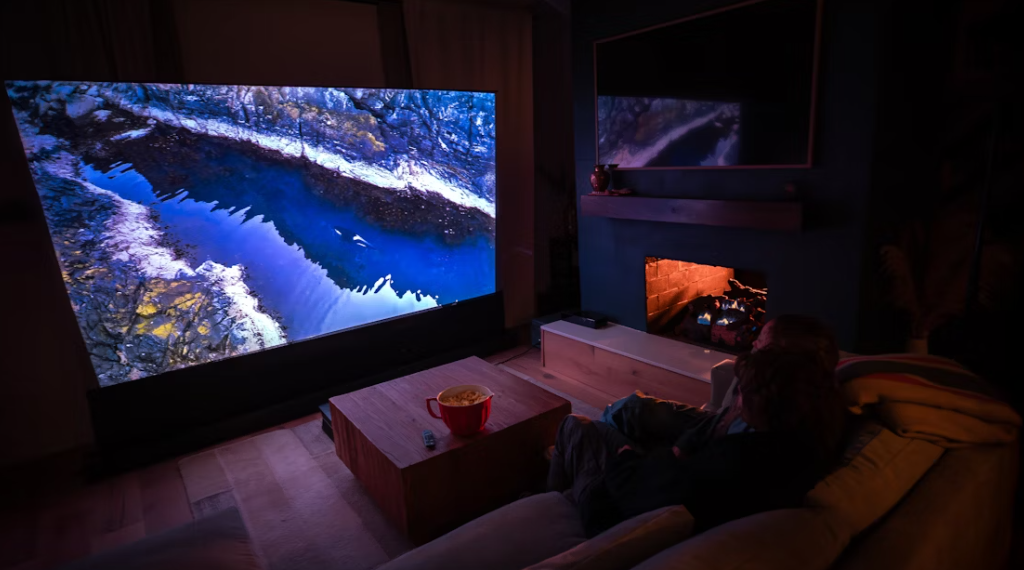
The quintessential British home is celebrated worldwide for its enduring character and period charm. From Victorian terraces with ornate fireplaces to cosy, post-war semi-detached houses, our domestic architecture heavily prioritises traditional comfort. However, this historical charm often clashes dramatically with our modern entertainment demands. As our appetite for cinematic, larger-than-life media grows, we find ourselves trying to force massive pieces of technology into spaces that were simply never designed to hold them.
For the modern UK homeowner, achieving a premium home cinema experience usually involves an impossible compromise: you either settle for a modestly sized television that fails to do justice to modern films, or you allow a gargantuan screen to completely swallow your living room. Fortunately, a breakthrough in optical technology is finally offering a way out of this dilemma, allowing us to maximise our living spaces without sacrificing our entertainment.
The Problem with the Chimney Breast
To understand the challenge, we have to look at the layout of a typical British lounge. Unlike the sprawling, open-plan American basements often featured in home theatre magazines, UK living rooms are generally more compact. Historically, the architectural focal point of these rooms has almost always been the fireplace and the chimney breast.
When homeowners attempt to upgrade to 75-inch, 85-inch, or even larger televisions, they quickly run out of usable wall space. Mounting a screen of this magnitude above a fireplace often places it at an uncomfortably high viewing angle, leading to physical neck strain. Alternatively, trying to squeeze a massive display into an adjacent alcove creates a cramped, cluttered aesthetic.
Worse still is the visual impact when the television is turned off. An 85-inch screen becomes an enormous black mirror that dominates the room, throwing off the carefully curated decor and making the space feel like an electronics showroom rather than a relaxing family sanctuary. It is a heavy, dominating presence that dictates the flow of the entire room.
The Elegant Alternative: Ultra Short Throw Optics
The solution to this spatial puzzle lies in abandoning the traditional flat-panel television entirely and embracing the latest generation of projection technology. While older projectors required permanent ceiling mounts, long, unsightly cable runs, and large, darkened rooms to function properly, modern optical engineering has completely rewritten the rulebook.
The integration of a UST laser projector into a UK home solves the space issue instantly. Rather than sitting at the back of the room behind the sofa, a UST projector sits elegantly on a standard media unit, mere inches away from the wall it is projecting onto. It is entirely unobtrusive, requires absolutely no structural modifications to your home, and completely eliminates the nightmare of running HDMI cables through your ceiling cavity.
This technology delivers a staggering 100-inch to 120-inch display—a size that would be physically impossible, prohibitively expensive, and aesthetically disastrous to achieve with a glass television in a standard British home. The laser light source provides immediate start-up times and a colour gamut that rivals commercial cinemas, turning a modest lounge into a world-class viewing environment in seconds.
For homeowners who want fewer compatibility concerns when choosing the projector, screen, and media unit together, an all-in-one home cinema setup can make the transition from television to projection much smoother.
Reclaiming Your Decor with the Right Surface
Of course, the magical illusion of a disappearing cinema relies on more than just the projector itself. A common mistake made by enthusiastic buyers is projecting a high-definition image onto standard British anaglypta wallpaper or a freshly painted plaster wall. The microscopic textures of the wall will distort the pixels, and standard paint cannot handle ambient light, instantly ruining the visual fidelity.
To truly replace a television and maintain the pristine look of your room, the light engine must be paired with a dedicated ALR projector screen. For living rooms that receive natural daylight, Ambient Light Rejecting screen technology is an absolute necessity.
These incredibly slim, fixed-frame screens look like a piece of minimalist canvas when not in use. They feature a microscopic, sawtooth-like optical structure that physically deflects light coming from your windows and ceiling pendants, whilst perfectly reflecting the light from the projector below it straight back to the sofa. This ensures that you can watch a Saturday afternoon football match or a morning news programme with the curtains wide open, enjoying the deep blacks and vibrant colours you would expect from a high-end OLED TV, but on a monumental scale.
A Healthier Way to Binge-Watch
Beyond spatial and aesthetic benefits, transitioning to a projection setup also offers notable advantages for your comfort. Traditional LED and OLED televisions emit light directly into your eyes. During a long weekend of binge-watching a new series or playing a sprawling video game, this direct exposure can lead to digital eye strain and fatigue.
Projection, by its very design, relies on reflected light. The image bounces off the ALR screen before reaching your eyes, mimicking how we perceive natural light in the real world. This makes viewing massive, 100-inch images incredibly comfortable for extended periods, allowing you to enjoy your media without the harsh glare associated with giant glass panels.
Conclusion: A Smarter Use of Space
We are no longer bound by the physical and aesthetic limitations of heavy glass panels. By transitioning to laser projection and ALR screen technology, British homeowners can finally have their cake and eat it too. You can maintain the cosy, traditional charm of your living room, preserving your wall space and your interior design, while simultaneously housing a world-class cinematic display that comes to life only when you want it to. It is the ultimate spatial hack for the modern, design-conscious home.