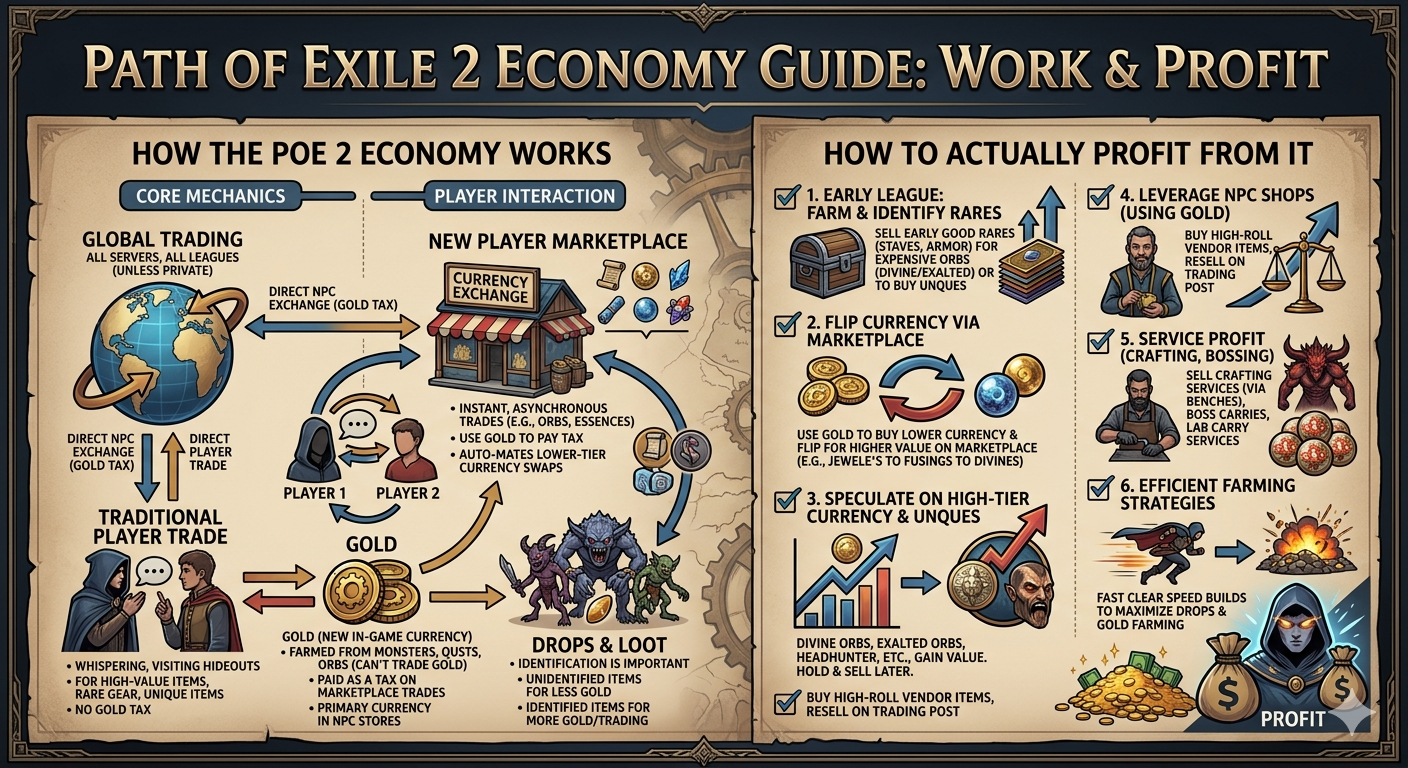
Path of Exile 2 has one of the most genuinely interesting player-driven economies in modern gaming. Unlike titles that funnel all buying and selling through a developer-controlled auction house with fixed prices and transaction fees, POE 2 hands the entire system to its players. Supply, demand, pricing, and negotiation all emerge from millions of individual decisions made by real people, and the result is an economy that rewards understanding it almost as much as the game rewards skill.
If you have ever sold an item for a fraction of what it was worth, or sat on currency without knowing how to grow it, this breakdown is for you.
The Foundation: What Currency Actually Does
To understand the economy, you first need to understand what makes POE 2’s currency system different. Every orb and shard in the game has a dual function — it is both a crafting material and a medium of exchange. There is no separate gold. When players pay each other for items, they pay in Chaos Orbs, Exalted Orbs, Divines, and other materials that also have direct uses in modifying gear.
This creates a market where the value of currency is tied to its utility in crafting, not just its scarcity. A Chaos Orb is worth what it is because players constantly consume them to reroll rare item modifiers. An Exalted Orb holds its value because it adds a modifier to a rare item that already has good affixes — a high-stakes, frequently desired operation. When demand for certain crafting operations rises, the currencies tied to those operations rise with them.
Understanding this connection between crafting demand and currency value gives you a framework for thinking about the economy that goes beyond memorizing price lists.
How Prices Form
POE 2’s trade ecosystem runs primarily through the official trade site, where players list items with price tags denominated in currency. Because there is no centralized auction system, prices are not set by an algorithm — they emerge from what sellers choose to list and what buyers are willing to pay.
This means the market is inefficient in ways you can take advantage of. Items get underpriced constantly, either because the seller does not know their true value or because they want a fast sale. Items also get dramatically overpriced by sellers who have an inflated sense of what they are holding. Learning to tell the difference is one of the most practical skills the economy rewards.
The starting point is simply checking the trade site regularly. When you find an item you want to sell, search for comparable items before setting a price. Look at the realistic lower end of current listings — the items that would actually sell today, not the aspirationally priced outliers sitting unsold for weeks. Price your item competitively within that range and it moves. Price it above that range without a compelling reason and it sits.
Three Reliable Ways to Generate Currency
Farming efficiently in your current tier
The most consistent currency generation for most players comes from farming content they can clear fast and safely, rather than content that barely allows them to survive. A player running red maps at comfortable pace — picking up all relevant currency drops, selling valuable items promptly, and not dying repeatedly — will accumulate more wealth over time than one who struggles through harder content for theoretically better drops.
Identifying which map layouts you clear fastest and which monster types drop the currency and items your build can actually sell is the first step in moving from passive accumulation to deliberate farming.
Understanding what your build produces that others want
Different farming strategies produce different currencies and items. Builds that excel at killing rare monsters in high-density areas tend to produce more Chaos Orbs and mid-tier gear. Builds oriented toward boss farming produce high-value unique items and top-tier orbs less frequently but with greater individual value per drop. Players who lean into what their build naturally does well — rather than trying to copy a farming strategy that suits a different character — tend to profit more consistently.
Buying underpriced items and reselling them
This approach requires the most market knowledge but offers real returns for players willing to invest the time. The basic mechanic is straightforward: find items listed below their actual market value, buy them, and relist them accurately. The challenge is developing the eye to spot underpriced items quickly enough that other players who do the same thing have not already bought them.
This works best in specific niches rather than trying to cover the entire market. Picking one category — a specific base type, a particular modifier combination, a class of unique items — and learning that niche deeply tends to be more profitable than broad, shallow attention across everything.
The Role of Currency Liquidity
One concept that matters practically but rarely gets discussed is liquidity — how quickly a given item or currency type converts to something else you want. Chaos Orbs are the most liquid item in the economy, accepted as payment for almost anything and easy to exchange for other currencies. Exalted Orbs and Divines are liquid at higher price points. Rarer items and unusual currencies can take longer to sell, even at fair prices, simply because fewer players are looking for them at any given moment.
This matters when planning your farming strategy. Holding a large stack of a niche currency feels like wealth until you realize it takes three times as long to convert to something useful as Chaos Orbs would. Building toward liquid currencies rather than obscure ones makes the economy feel smoother to navigate day to day.
For players who want to shortcut specific gaps — arriving at a build-enabling item tier faster than organic farming allows — the broader ecosystem around poe 2 currency provides options for sourcing specific orbs or stacks directly. It is a practical route for players who have a clear picture of what they need and want to spend their time in the game rather than farming prerequisites.
Thinking in Systems, Not Single Transactions
The players who do best in POE 2’s economy are the ones who think at a systems level rather than fixating on individual trades. Any single transaction is small. The pattern of decisions made across dozens of sessions — what to farm, what to sell immediately, what to hold, how to price things, when to reinvest — is where real wealth accumulates.
Treating every map run as both a gameplay experience and an economic opportunity, without letting either crowd out the other, is the balance that makes the whole thing sustainable. The economy rewards patience, attention, and consistency more than any single clever trade, and the players who internalize that tend to find it one of the most engaging layers the game has to offer.