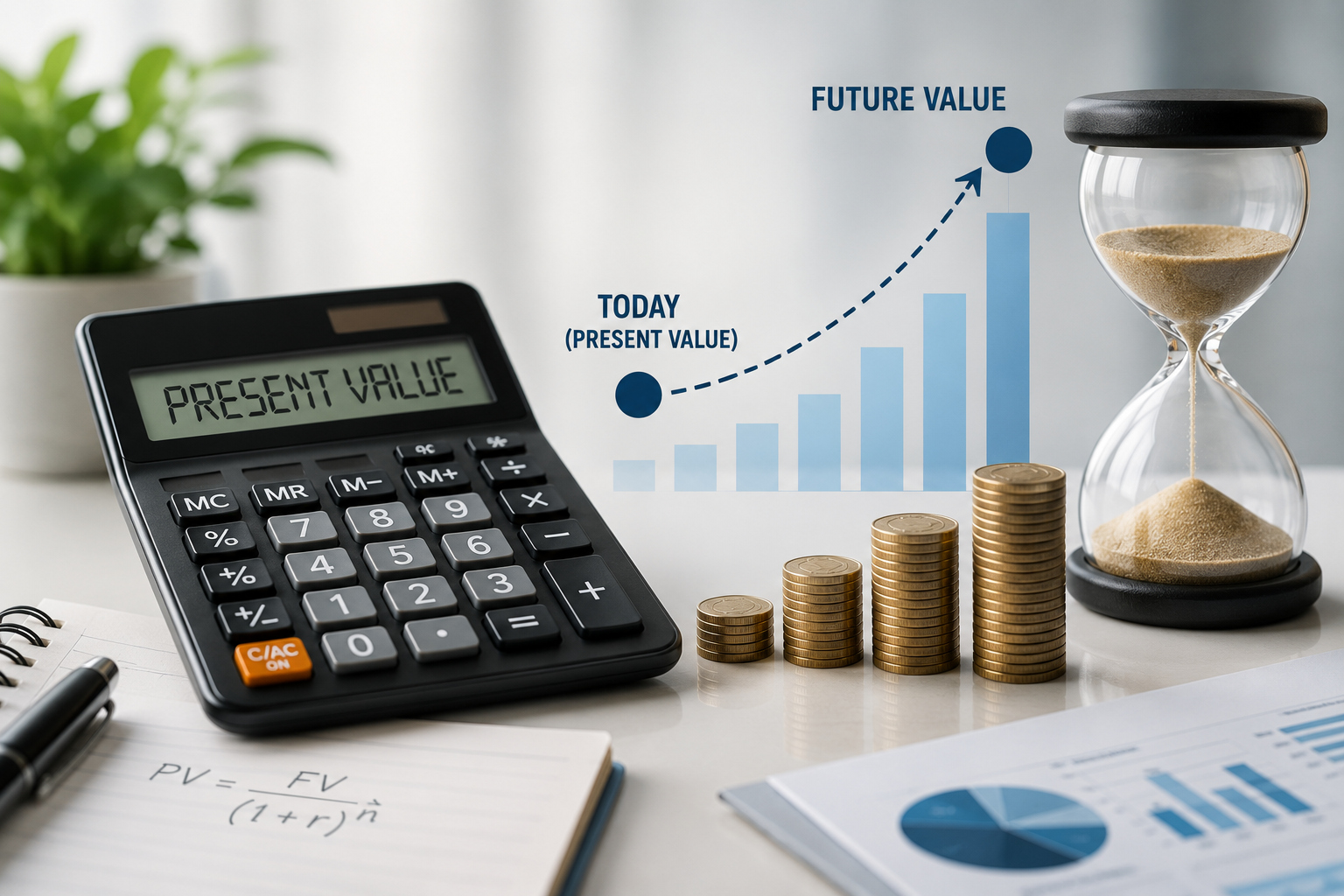
A Future Value Calculator is a useful financial tool that helps you determine how much a current amount of money may be worth in the future. Whether you are planning for retirement, evaluating an investment, estimating savings growth, or comparing financial opportunities, understanding future value can help you make better financial decisions.
Money available today can potentially grow over time through interest, investment returns, or compound growth. A future value calculator estimates this growth by considering factors such as your starting amount, interest rate, investment period, and contribution frequency.
Instead of performing complex financial calculations manually, you can use a future value calculator to quickly estimate the potential value of money at a future date.
What Is Future Value?
Future value (FV) is the amount that an investment or savings balance is expected to grow to over a specific period when it earns a particular rate of return.
For example, if you invest $10,000 today and earn a fixed annual return, the investment could be worth considerably more after 10, 20, or 30 years.
Future value is important because the value of money changes over time. Through compound growth, your original investment can generate returns, and those returns can potentially generate additional returns.
A future value calculator makes it easier to estimate this growth.
What Is a Future Value Calculator?
A Future Value Calculator is an online financial calculator designed to estimate the future value of an investment or savings amount.
Depending on the calculator, you may enter:
- Present value or initial investment
- Annual interest rate
- Investment period
- Number of compounding periods
- Regular contributions
- Contribution frequency
- Expected rate of return
The calculator then estimates how much your money could be worth in the future.
A future value calculator can be used for many financial situations, including savings accounts, investments, retirement planning, education savings, and long-term financial goals.
How Does a Future Value Calculator Work?
A future value calculator uses a mathematical formula to determine how an amount of money can grow over time.
For a single initial investment with compound interest, the basic future value formula is:
Where:
- FV = Future Value
- PV = Present Value
- r = Interest or annual return rate
- n = Number of periods
For example, if you invest $10,000 at an annual return of 7% for 20 years, the future value will be substantially higher than the original investment because of compound growth.
The actual result will depend on how frequently interest is compounded and whether additional contributions are made.
Future Value Formula
The standard future value formula for compound growth is:
FV = PV × (1 + r)ⁿ
Here:
FV represents the future value of the investment.
PV represents the present value, or the amount invested today.
r represents the rate of return per period.
n represents the total number of periods.
For example, suppose you have $5,000 and expect to earn 6% annually for 10 years. The future value calculation would estimate how much the $5,000 could grow during that period.
A future value calculator performs this calculation automatically.
Future Value With Regular Contributions
Many people do not make just one investment. Instead, they contribute money regularly to a savings or investment account.
For example, you might contribute:
- $100 per month
- $500 per month
- $1,000 per month
- $5,000 per year
A future value calculator that supports recurring contributions can estimate both the original investment and the growth from additional deposits.
The future value of regular contributions depends on factors such as:
- Contribution amount
- Contribution frequency
- Interest rate
- Investment duration
- Compounding frequency
Regular contributions can significantly increase the final balance because each contribution has the opportunity to grow over time.
Why Compound Interest Matters
One of the most important concepts behind future value calculations is compound interest.
Compound interest means that your investment earns returns on both the original principal and previously accumulated returns.
For example, suppose an investment earns interest during the first year. During the following year, the investment may earn returns on the original amount plus the previous year’s earnings.
Over long periods, this compounding effect can become significant.
This is why starting to save or invest earlier can make a major difference.
Future Value vs Present Value
Present value and future value are closely related but represent different concepts.
Present value asks:
“What is a future amount worth today?”
Future value asks:
“What could today’s money be worth in the future?”
For example, if you have $20,000 today and want to know what it might become after 15 years, you would use a future value calculator.
If you know you need $50,000 in 15 years and want to determine how much that future amount is worth today, you would use a present value calculation.
Factors That Affect Future Value
Several factors can influence the result produced by a future value calculator.
- Initial Investment
The larger your starting investment, the greater the potential future value, assuming the same return rate and investment period.
For example, $20,000 invested for a particular period will generally produce a larger future balance than $5,000 under the same conditions.
- Interest Rate or Investment Return
The expected rate of return is one of the most important inputs.
A higher rate can produce faster growth, while a lower rate generally results in a smaller future value.
However, investment returns are not guaranteed. A calculator’s projected return should be treated as an estimate rather than a promise.
- Investment Period
Time has a major effect on compound growth.
An investment held for 30 years has more opportunity to compound than one held for five years.
This is one reason long-term investing and early saving can be powerful financial strategies.
- Compounding Frequency
Interest may be compounded:
- Annually
- Semi-annually
- Quarterly
- Monthly
- Daily
More frequent compounding can affect the final result, depending on the rate and calculation method.
- Regular Contributions
Adding money regularly can substantially increase the future value of an account.
For example, someone who invests an initial $5,000 and contributes $300 every month may accumulate considerably more than someone who only invests the initial $5,000.
Future Value Calculator for Investments
Investors can use a future value investment calculator to estimate how an investment may grow over time.
You can enter an estimated annual return and investment period to create a projection.
For example, you may want to compare:
- A 5% annual return
- A 7% annual return
- A 9% annual return
The results can demonstrate how relatively small differences in expected returns may produce significant differences over long periods.
However, actual investment performance can fluctuate. Historical returns do not guarantee future results.
Future Value Calculator for Savings
A future value savings calculator can help people estimate how much they may accumulate by regularly saving money.
This can be useful when planning for:
- Emergency funds
- Major purchases
- Education
- Home purchases
- Retirement
- Travel
- Business goals
By entering a starting balance, regular contribution, expected interest rate, and time period, you can estimate a potential future savings balance.
Future Value Calculator for Retirement Planning
Retirement planning is another important application of future value calculations.
Suppose you are currently 30 years old and want to estimate your retirement savings at age 65. A future value calculator can help estimate how your current savings and future contributions might grow.
You can experiment with different assumptions, such as:
- Current retirement savings
- Monthly contribution
- Annual return
- Years until retirement
- Contribution increases
This can help you understand how changing your savings rate or investment horizon could affect your projected retirement balance.
A future value calculation is only one part of retirement planning. Inflation, taxes, investment fees, withdrawals, and changing returns can also affect the amount you eventually have available.
Future Value and Inflation
A future value calculation based only on investment growth does not necessarily show how much purchasing power the money will have.
Inflation can reduce the purchasing power of money over time.
For example, $100,000 in the future may not buy the same amount of goods and services as $100,000 does today.
Therefore, when planning long-term financial goals, it can be useful to consider both:
- Nominal future value
- Future value adjusted for inflation
An inflation-adjusted calculation provides a better understanding of potential future purchasing power.
Future Value of Annuity
A future value of an annuity calculator is useful when you make equal payments or contributions at regular intervals.
Examples include:
- Monthly retirement contributions
- Regular savings deposits
- Annual investments
- Recurring deposits
For an ordinary annuity, where payments occur at the end of each period, the formula is:
FV = PMT × [((1 + r)ⁿ − 1) / r]
Where:
- FV = Future value
- PMT = Regular payment
- r = Rate per period
- n = Number of payments
This type of calculation is especially useful for understanding how regular contributions can accumulate over time.
Future Value of a Lump Sum
A lump-sum future value calculator calculates how a single amount could grow over time.
For example, you might receive:
- A bonus
- An inheritance
- A business payment
- A tax refund
- A large savings balance
Instead of making regular contributions, you invest one amount and allow it to grow.
The future value depends primarily on the starting amount, expected return, and investment period.
How to Use a Future Value Calculator
Using a future value calculator is generally straightforward.
Step 1: Enter the Present Value
Enter the amount you currently have available to invest or save.
Step 2: Enter the Interest Rate
Enter your expected annual interest rate or investment return.
Step 3: Enter the Investment Period
Specify how long you expect the money to remain invested.
This could be several months, years, or decades.
Step 4: Add Contributions
If you plan to make regular deposits, enter the contribution amount and frequency.
Step 5: Select Compounding Frequency
If the calculator provides this option, select how frequently the return is compounded.
Step 6: Calculate
The calculator will estimate the potential future value based on your inputs.
You can then change individual assumptions to see how different scenarios affect the result.
Benefits of Using a Future Value Calculator
A future value calculator can provide several benefits.
Easy Financial Planning
You can quickly estimate potential future balances without manually performing complicated calculations.
Better Understanding of Compound Growth
The calculator can demonstrate how money may grow over extended periods.
Compare Different Scenarios
You can compare different interest rates, contribution amounts, and investment periods.
Set Financial Goals
Future value projections can help you determine how much you may need to save to reach a particular goal.
Save Time
Instead of repeatedly calculating compound interest manually, a calculator can provide an estimate almost instantly.
Future Value Calculator vs Compound Interest Calculator
A future value calculator and a compound interest calculator often perform similar calculations, but their focus can be different.
A compound interest calculator generally emphasizes the growth of money through compounding.
A future value calculator focuses on determining what an investment or series of payments could be worth at a future date.
Many modern financial calculators combine both functions.
Common Uses of a Future Value Calculator
People use future value calculations for many different financial purposes.
Personal Savings
Estimate how savings may grow over several years.
Investment Planning
Estimate the potential future value of an investment.
Retirement Planning
Project potential retirement savings.
Education Planning
Estimate how much money could be available for future education expenses.
Business Planning
Businesses can use future value calculations when evaluating investments and financial projects.
Loan and Finance Analysis
Future value concepts can also be used in financial analysis involving payments and balances.
Example of a Future Value Calculation
Imagine you invest $10,000 today at an assumed annual return of 6% for 15 years.
Using the compound future value formula, the projected balance can be calculated based on the starting investment, return rate, and number of years.
If you then add regular monthly contributions, the potential future value can become significantly higher.
This example demonstrates an important principle: both time and consistent contributions can have a major impact on long-term financial growth.
How to Get More Accurate Future Value Estimates
A calculator can only be as useful as the assumptions entered into it.
For better estimates:
- Use realistic return assumptions.
- Consider inflation.
- Include investment fees when appropriate.
- Account for taxes where relevant.
- Consider regular contributions.
- Use an appropriate investment period.
- Run several scenarios instead of relying on one projection.
For investments with uncertain returns, consider calculating conservative, moderate, and optimistic scenarios.
Limitations of a Future Value Calculator
A future value calculator provides an estimate, not a guarantee.
Actual results may differ because:
- Investment returns can fluctuate.
- Interest rates may change.
- Inflation can vary.
- Taxes can affect returns.
- Fees can reduce investment growth.
- Contributions may change.
- Withdrawals can reduce the final balance.
Therefore, future value calculations should be viewed as planning tools rather than predictions of guaranteed investment performance.
Future Value Calculator for Long-Term Financial Planning
Long-term financial planning often requires understanding how today’s decisions can affect future wealth.
A future value calculator allows you to test different scenarios before making financial decisions.
For example, you could calculate what happens if you:
- Increase monthly savings by $100.
- Start investing five years earlier.
- Increase the expected return.
- Extend the investment period.
- Make an additional annual contribution.
These comparisons can help illustrate the potential impact of saving consistently and allowing investments more time to grow.
Frequently Asked Questions About Future Value Calculator
What is a Future Value Calculator?
A Future Value Calculator is a financial tool that estimates how much an investment or savings amount could be worth at a future date based on factors such as the starting balance, return rate, time period, and contributions.
How is future value calculated?
Future value can be calculated using a compound growth formula such as FV = PV × (1 + r)ⁿ for a single lump-sum investment.
What is the difference between present value and future value?
Present value represents what a future amount is worth today, while future value represents what a current amount could be worth at a future date after accounting for growth.
Does a Future Value Calculator include compound interest?
Many future value calculators use compound growth. The exact calculation depends on the calculator and the inputs provided.
Can I calculate future value with monthly contributions?
Yes. A calculator that supports recurring contributions can estimate the future value of regular monthly, quarterly, or annual deposits.
Can a Future Value Calculator be used for retirement planning?
Yes. It can help estimate how current savings and regular contributions might grow by the time you reach retirement.
Does inflation affect future value?
Inflation does not necessarily change the mathematical future value of an investment, but it affects purchasing power. For long-term planning, it is useful to consider inflation separately.
What happens if I increase my investment return?
A higher assumed return generally produces a higher projected future value. However, higher potential returns may also involve greater investment risk.
Why does time matter so much in future value calculations?
More time allows compound growth to occur over additional periods. This can make a significant difference to the final balance.
Is future value guaranteed?
No. A future value calculation is an estimate based on assumptions. Actual investment performance, interest rates, inflation, taxes, and fees can cause real results to differ.
Can I use a Future Value Calculator for savings accounts?
Yes. You can use a future value calculator to estimate how a savings balance could grow based on an assumed interest rate and savings period.
What is the future value of a lump sum?
The future value of a lump sum is the amount that a single investment could grow to after a specified period at a particular rate of return.
What is the future value of an annuity?
The future value of an annuity is the accumulated value of a series of equal payments made at regular intervals, including the growth generated by those payments.
How does compound interest increase future value?
Compound interest allows accumulated earnings to generate additional earnings. Over longer periods, this compounding effect can significantly increase the future value of an investment.
Should I use one expected return when calculating future value?
For planning purposes, it can be better to test multiple assumptions. For example, you could calculate conservative, moderate, and optimistic return scenarios instead of relying on one projected rate.
Conclusion
A Future Value Calculator is a practical tool for understanding how money could grow over time. By considering your starting investment, expected rate of return, investment period, compounding, and regular contributions, you can estimate the potential future value of your savings or investments.
Whether you are planning for retirement, building savings, investing a lump sum, or working toward another long-term financial goal, future value calculations can provide useful insight into how today’s financial decisions may affect tomorrow’s wealth.
Remember that calculator results are estimates based on assumptions. Actual outcomes can vary because of market performance, interest rates, inflation, taxes, fees, and other factors. Using multiple scenarios and realistic assumptions can make future value calculations more useful for financial planning.
Restore the missing formula displayAdd a worked numerical example