The story of the US Navy tartan begins in an unlikely place: a Scottish farming county where American sailors spent decades listening to the Soviet Union. For nearly forty years, if you drove north from Brechin on the road towards Edzell, you passed a thing that did not belong in a Scottish farming county.
It stood in a flat field a mile from the village: a great circle of steel masts, hundreds of feet across, joined by wire screens, with an inner ring of taller masts and a building at the centre. From the road it looked like the skeleton of a circus tent. The people of Angus called it the Elephant Cage. Inside it, in shifts around the clock, young men and women of the United States Navy sat at consoles listening to the Soviet Union.
A listening post in a field
The base had begun life as RAF Edzell, a wartime airfield. In 1960 the US Navy took it over, and it became Naval Security Group Activity Edzell, one of a chain of stations around the world that intercepted Russian naval radio traffic and fixed the positions of Soviet ships and submarines by direction finding. The Elephant Cage was the antenna. Its official name was an AN/FLR-9, and it could pick up a transmission from thousands of miles away and tell you which way to look.
None of this was secret in the sense that the neighbours did not know. Everyone in Angus knew the Americans were listening to the Russians. What went on inside was classified, and the sailors did not talk about it, and the locals did not ask. What they did talk about was everything else.
The work was tedious, exacting and, in its way, important. A submarine that broke radio silence in the Barents Sea for thirty seconds could be placed on a chart by the bearings from Edzell and two other stations, and every such fix was one more piece of a picture that the Navy spent the whole Cold War assembling. The men and women who did it were mostly nineteen or twenty, mostly from the American Midwest and South, and mostly astonished to find themselves in Angus.
Because the base was not a fortress. It was a small American town dropped into a corner of rural Scotland, with a bowling alley, a baseball diamond, a commissary selling peanut butter, and at any one time a couple of thousand sailors and their families who lived, many of them, not on the base but in rented houses in Brechin and Montrose and Edzell itself. Their children went to Scottish schools. The men joined the local golf clubs and the Rotary and, in a surprising number of cases, the pipe band. They fell in love with local girls, and a great many of them married. There are people all over the United States today whose mothers came from Brechin.
The Cold War ended, the Russians stopped being the enemy, and in 1997 the Navy closed Edzell and went home. The Elephant Cage was dismantled. The airfield is a business park. But every year, somewhere in America, former Edzell sailors hold reunions, and every year a few of them come back to Angus to look at a field, and to walk through Edzell village, with its red sandstone arch across the road and its one hotel, where so many of them drank their first pint of Scottish beer at nineteen and could not understand a word the barman said.
A tartan for the men who listened
Arthur Mackie of Strathmore Woollens in Forfar, a dozen miles away, designed a tartan for them.
The tartan archives record that it was made for US Navy personnel at the Edzell base, and that it dates from the 1980s. It is a naval cloth through and through: broad bands of navy blue and a paler blue-grey, with narrow lines of white and a single fine line of red. Blue and white for the ocean and the uniform, red for the flag. Neckties were made in it, and kilts, and sailors wore it at Highland games across the United States when they went home.
The archives add a warning, in the careful way of tartan scholars. There has been an effort, they say, to call this “the” US Navy tartan, but it has no official sanction. The Department of the Navy has never adopted a tartan. What exists is a cloth designed in Angus for the sailors of one base, which they took home and made their own, and which has since been worn by Navy veterans who never set foot in Edzell because it is the closest thing the service has.
Retailers offer US Navy tartan made to order as kilts, scarves, ties and sashes, or by the yard, and it turns up at veterans’ events, retirement ceremonies and Scottish games from Virginia to San Diego, generally on men who know exactly which field in Scotland it came from.
Norfolk, Virginia, a Sunday in December
Master Chief Dale Reynolds, retired, is sixty-two, and he spent 1985 to 1988 in a windowless room inside the Elephant Cage listening to the Northern Fleet. He met his wife Morag at a dance in the Mechanics’ Institute in Brechin in the spring of 1986. She was a nurse at Stracathro Hospital. They were married at Brechin Cathedral in 1987, with a piper, and half his division in dress whites, and her family in a state of polite alarm.
Thirty-eight years and four duty stations later they live in Norfolk, Virginia, three miles from the biggest naval base in the world, and their daughter Fiona, who is thirty and was born in Rota, Spain, has been trying for a month to think of a Christmas present for a man who has everything, wants nothing, and still carries the same wallet he bought at the Navy Exchange in 1994.
The wallet is the problem, and the wallet is the answer.
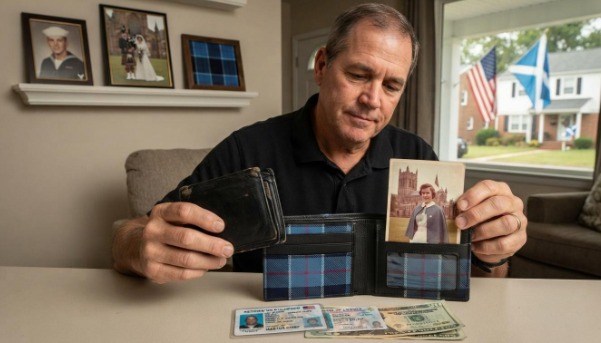
It is a plain black leather billfold, worn to grey at the corners, held together at the spine with a strip of tape that Dale considers a perfectly good repair. It contains his retired ID, his driver’s licence, a Virginia fishing licence, forty dollars, and a photograph of a young woman in a nurse’s cape standing in front of a cathedral in a Scottish town. He will not replace it because, he says, he has never seen one he liked better.
Fiona finds one. Scottish Kilt, where her mother has ordered tartan sashes for years, makes a plaid wallet in any of its five thousand setts, and the description addresses exactly the problem her father’s has: tartan wallets and card holders with full-grain leather at the spine fold and the card slots, which is where fabric-only wallets split first. The body is woven tartan. The parts that take the wear are leather. There is a billfold and a larger travel wallet with a place for a passport, which Fiona notes for next year, since her parents have started talking about going back to Brechin.
She orders the billfold in the US Navy tartan. Navy blue, blue-grey, white lines, one red thread, with black leather at the fold. It comes in three weeks and she wraps it herself.
On Christmas morning her father opens it, looks at it for a while, and says nothing, which is how her father says a great deal.
“It’s the Edzell one,” says Morag, who has been told. “The one Arthur Mackie made. From Forfar.”
“I know what it is.”
“Dad,” says Fiona, “you have to promise you’ll use it. You have to move the stuff over. The picture too.”
He takes the old wallet out of his back pocket, opens it, and begins, one card at a time. The retired ID. The licence. The fishing licence. The forty dollars. Last, from behind the cards, the photograph, which he looks at for a moment and slides into the new wallet behind the leather.
“There,” he says. He turns the tartan over in his hands. “Blue-grey. That’s the colour the sky was over that cage every morning of my life for three years. Never saw the sun till I met your mother.”
“You met me in March,” says Morag. “It was raining.”
“It was raining,” he agrees. “I didn’t notice.”
A field in Angus
The Elephant Cage is gone, and the Northern Fleet it listened to is a different navy in a different world. What is left is a business park, a set of reunion photographs, and a great many American families with a Scottish grandmother.
The tartan has no official standing and never will, and the sailors who wear it do not care. It is blue and grey and white with a red thread, it was made in Forfar for the men in a field near Brechin, and it is exactly right for a wallet that a retired master chief will carry for the next thirty years, with a photograph of a nurse behind the leather.