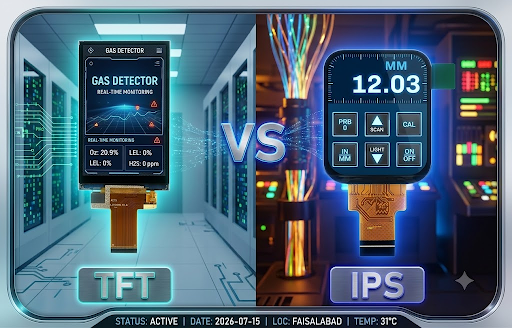
Screens are everywhere, from phones to monitors to car dashboards. Two display types dominate the market, TFT and IPS. Both use LCD technology, but they work differently and offer different results. If you are shopping for a new device, or trying to understand your options, this guide breaks down everything you need to know.
1. What Is a TFT Display?
TFT stands for Thin Film Transistor. It is a type of LCD screen that uses a transistor for each pixel, allowing for sharper images and faster response times than older LCD technology. TFT screens are common in budget phones, calculators, and simple electronics. They are affordable to produce, which is why many low cost devices use them. If you want a deeper look at how these panels compare to their more advanced cousin, this comparison of TFT vs IPS Display covers the basics clearly. TFT panels do have some drawbacks, though, including narrower viewing angles and less accurate colors.
2. What Is an IPS Display?
IPS stands for In Plane Switching. It is an advanced version of LCD technology, designed to fix many of the problems found in older TFT panels. IPS screens offer wider viewing angles, better color accuracy, and improved contrast. You will find IPS panels in premium phones, high end monitors, and modern televisions. They cost more to manufacture, but the improved visual experience often justifies the price for many users.
3. How TFT and IPS Panels Work
Both TFT and IPS displays rely on liquid crystals to control light and color. The main difference lies in how the crystals are arranged. In a TFT panel, the crystals move vertically, which limits how light passes through at different angles. In an IPS panel, the crystals move in a plane parallel to the screen. This alignment allows light to pass more evenly, resulting in better colors and clearer images when viewed from the side.
4. Key Differences Between TFT and IPS Displays
The differences between these two technologies affect how a screen looks and performs. Color accuracy is one major factor, since IPS panels reproduce colors more faithfully. Viewing angles matter too, as TFT screens can look washed out when viewed from an angle. Many buyers researching these differences turn to resources like IPS TFT LCD Display – HYS Display to compare specifications side by side before choosing a panel for their project. Power consumption, refresh rate, and manufacturing cost also separate the two, and we will explore each of these points in the sections below.
5. Picture Quality and Viewing Angles
Picture quality is where IPS truly shines. Colors appear richer, and details stay sharp even in bright rooms. Viewing angles are wide, often reaching up to 178 degrees without much color shift. TFT screens, on the other hand, tend to lose contrast and color accuracy when viewed from the side. If you plan to share your screen with others, or watch content in a group, IPS is the better choice. For personal use where the screen faces you directly, TFT may be good enough.
6. Power Consumption and Battery Life
Power usage is an important factor for portable devices. TFT panels generally use more power than IPS screens, which can shorten battery life in phones and laptops. IPS technology, despite its higher image quality, tends to be more efficient. This is one reason many modern smartphones have shifted toward IPS or OLED screens instead of relying on older TFT designs. If battery life matters to you, this is worth keeping in mind.
7. Response Time and Refresh Rate
Response time refers to how quickly a pixel can change color. TFT panels often have faster response times, which made them popular in early gaming monitors. IPS panels have improved a great deal in recent years, though, and many now offer response times competitive with TFT. Refresh rate, which measures how many times a screen updates per second, depends more on the specific model than the underlying technology. Both TFT and IPS displays can be built with high refresh rates today.
8. Cost and Manufacturing
Manufacturing cost plays a big role in which technology a company chooses. TFT panels are cheaper to produce, which keeps device prices low. This makes them common in budget smartphones, basic monitors, and children’s electronics. IPS panels require more complex manufacturing processes, which raises their cost. That said, prices for IPS technology have dropped significantly over the years, making it more accessible in mid range devices as well.
9. Common Applications
TFT displays are often found in devices where cost matters more than visual quality, such as basic phones, digital clocks, and simple control panels. IPS displays are used in products where image quality is a priority, including smartphones, tablets, professional monitors, and televisions. Some devices even combine both technologies in different components, depending on the need for cost savings versus visual performance.
10. Which Should You Choose?
The right choice depends on your priorities. If you need an affordable screen and do not mind average color accuracy, TFT is a solid option. If you want better colors, wider viewing angles, and lower power consumption, IPS is worth the extra cost. Consider how you will use the device, your budget, and whether image quality is important for your daily tasks.
Conclusion
TFT and IPS displays each have their place in today’s market. TFT offers affordability and simplicity, making it ideal for basic electronics. IPS delivers superior image quality, wider viewing angles, and better efficiency, which suits modern smartphones and monitors. Understanding these differences helps you make an informed decision the next time you shop for a new screen. Whether you prioritize cost or quality, knowing how each technology works puts you in a better position to choose wisely.