



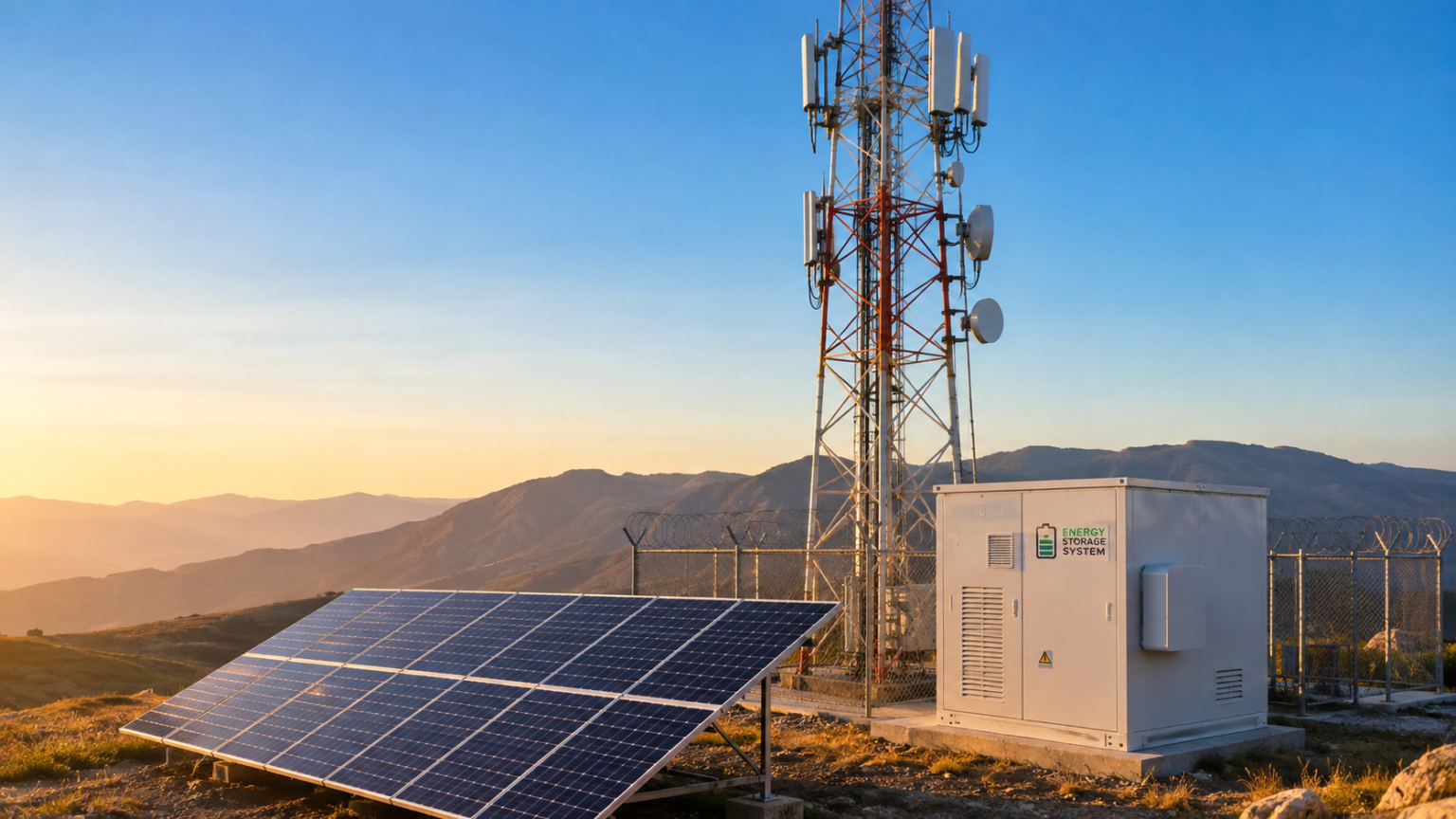
A cell tower does not care about your excuses. If the grid drops for even a few seconds and the backup power fails, calls drop, data stops, and somewhere a customer files a complaint. That single moment is why telecom energy systems exist in the first place.
Most people never think about what keeps a tower running. They just expect five bars of signal, all day, every day, rain or shutdown. Behind that expectation sits a stack of rectifiers, batteries, generators, and increasingly, solar panels, all working together so the network never blinks.
This guide breaks down what telecom energy systems actually include, why the old diesel and lead-acid model is losing ground, and how telecom solar solutions are reshaping the way operators power their sites in 2026. We will also cover sizing, common mistakes, and where this technology is headed next.
What Telecom Energy Systems Actually Do
A telecom energy system is the combination of equipment that converts, stores, and distributes power to keep base stations, switching centres, and network cabinets running without interruption. It is not one product. It is an entire chain.
At a typical macro cell site, that chain includes:
- An AC input feed from the utility grid
- Rectifiers that convert AC power into stable -48V DC, the standard voltage for most telecom equipment
- Battery banks that hold enough charge to bridge short outages or, in remote areas, run the site for hours
- A generator or fuel cell for extended outages
- Monitoring software that tracks battery health, load, and fuel levels remotely
According to industry tracking cited by Emergen Research, more than 60 per cent of new telecom power deployments in 2024 and 2025 used lithium-ion storage or hybrid battery-solar setups rather than the older lead-acid and diesel-only model. That shift is not cosmetic. It is driven by cost, reliability, and the sheer amount of extra power that 5G equipment demands.
Why Telecom Towers Need More Than a Backup Battery
A battery bank alone buys you time. It does not solve the underlying problem, which is that grid power in many regions is unreliable, expensive, or simply not there.
The Real Cost of Downtime
Every minute a base station is offline is a minute of lost revenue, lost customer trust, and in some markets, regulatory penalties. Operators running large tower portfolios treat uptime as a hard business metric, not an aspiration.
American Tower Corporation reported expanding its energy storage capacity to roughly one gigawatt-hour across 24,500 sites, a scale that shows just how seriously major tower companies now treat backup power as core infrastructure rather than an afterthought.
5G Has Changed the Power Equation
Older 3G and 4G radios were relatively power-light. 5G equipment, especially active antenna systems and massive MIMO arrays, draws noticeably more energy per site. A traditional cell site typically pulls somewhere between 2 and 5 kilowatts continuously, and 5G upgrades push that number higher at many locations.
Huawei and China Tower jointly developed a solution called 5G Power, designed specifically to handle this jump without ripping out existing electrical infrastructure. Deployment data from sites in Hangzhou, China showed fuel savings of about 4,130 kilowatt-hours per site each year, along with a meaningful cut in carbon emissions per site. That is the scale of savings operators are chasing globally.
Core Components of a Modern Telecom Energy System
Understanding the pieces helps when you are evaluating vendors or planning a site upgrade.
Rectifiers and DC Power Distribution
Rectifiers sit at the front of the system. They take incoming AC power and convert it to the DC voltage telecom equipment actually runs on. Modern rectifier modules are hot-swappable, meaning a technician can replace a failed unit without shutting the site down.
Battery Backup, Lithium vs Lead Acid
This is where the biggest shift has happened. Lead-acid batteries are cheaper up front but degrade faster, need more maintenance, and take up more physical space. Lithium iron phosphate batteries, often called LFP, cost more initially but last through thousands more charge cycles, tolerate wider temperature ranges, and shrink the footprint of the cabinet.
A well-designed telecom energy systems setup built around modern battery storage can bridge outages of several hours without a generator ever needing to start, which matters enormously at sites where diesel delivery is expensive or unreliable.
Generators and Fuel Cells
Diesel generators remain common as the last line of defence during extended outages. They are proven and widely serviced, but fuel cost and maintenance add up fast, especially at remote sites where fuel has to be trucked in.
Hydrogen fuel cells are starting to appear as an alternative for long-duration backup. They run quieter, produce fewer emissions, and need less mechanical maintenance than combustion engines, though upfront cost and hydrogen supply logistics still limit widespread adoption.
Energy Management Software
Smart monitoring platforms track battery state of health, predict failures before they happen, and let operators shift sites into lower power modes during quiet traffic periods. Telefonica reported that AI-driven traffic prediction and autonomous power management enabled energy savings of up to 30 per cent across its optimised sites. That is a substantial number for a network the size of a major carrier.
Telecom Solar Solutions Are Becoming the Default, Not the Exception
For decades, diesel was the default answer for powering remote towers. That is changing fast.
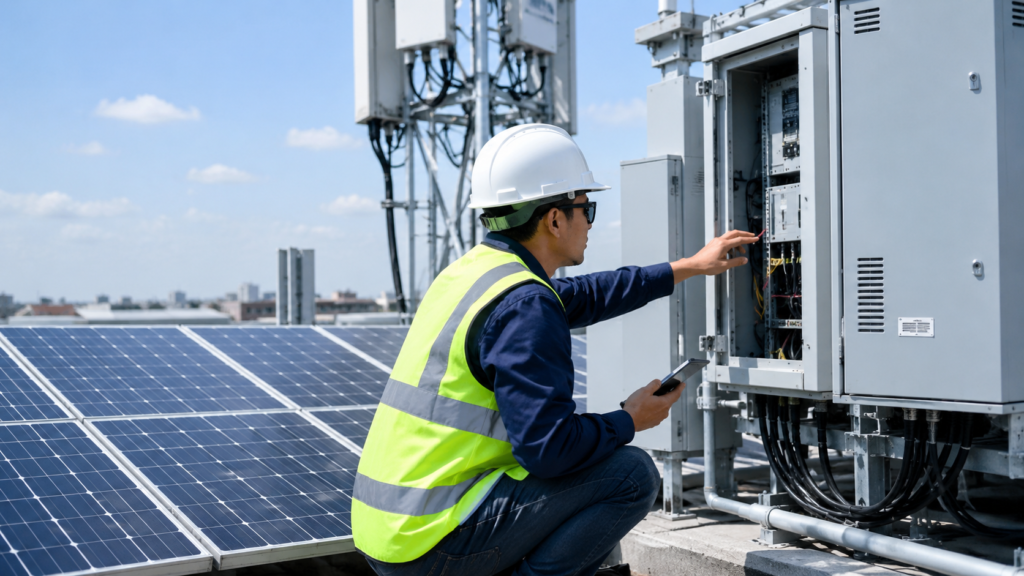
The math has simply shifted. Renewable power sources have brought average tower energy costs down from roughly 14 to 18 cents per kilowatt-hour with diesel fuel, to somewhere between 6 and 10 cents per kilowatt-hour with hybrid renewable configurations. That is not a marginal improvement. Over the life of a site, it is the difference between a location that barely breaks even and one that turns a healthy profit.
The scale of adoption backs this up. The number of telecom sites using solar and hybrid power has grown substantially in recent years, particularly in regions with unreliable grids or high diesel costs. Solar photovoltaic installations now make up the overwhelming majority of renewable tower capacity worldwide, mostly because panels are easier to deploy and cheaper to maintain than wind turbines or biomass systems at a small site footprint.
How Solar Hybrid Systems Work at a Cell Site
A typical hybrid setup pairs a solar array with a battery bank and keeps a diesel generator on standby purely as backup. During daylight hours, solar panels charge the batteries and power the site directly. Once the sun goes down, stored battery capacity carries the load. The generator only fires up if battery reserves run low, which in a properly sized system should be rare.
Operators evaluating telecom solar solutions for a portfolio of remote sites typically start with a pilot deployment at a handful of high fuel cost locations before rolling the design out further, since site conditions like sun hours, shading, and load profile vary a lot from region to region.
A Real World Example
India offers a clear before-and-after picture. Decades ago, the country’s cell tower estate consumed billions of litres of diesel annually, generating millions of tons of carbon emissions in the process, according to research published by the Maharashtra Energy Development Agency. Today, solar-dominant hybrid installations are standard practice across high-insolation regions including India, sub-Saharan Africa, and parts of the Middle East, where sun exposure makes the payback period on panels especially short.
How to Choose a Telecom Energy System for Your Sites
There is no single correct setup. The right telecom energy system depends heavily on the site’s location, grid reliability, and load profile.
Site Assessment Questions to Ask First
Before choosing equipment, walk through these questions for each site or site cluster:
- How many hours per day does the grid actually stay up
- What is the average and peak power draw of the installed radio equipment
- Is diesel fuel delivery reliable and affordable at this location
- How much roof or ground space is available for solar panels
- What is the ambient temperature range the battery system needs to tolerate
Sizing the System Correctly
Undersizing a battery bank is one of the fastest ways to end up with an unreliable site. A good rule of thumb is to size storage for at least the average expected outage duration plus a safety margin, then validate that assumption against a full year of local grid outage data rather than a single bad month.
Common Mistakes
Even experienced teams fall into a few predictable traps.
- Treating backup power as a one-time purchase. Batteries degrade. Solar panels get dusty. A system that worked perfectly at installation can quietly underperform two years later if nobody is monitoring it.
- Ignoring temperature extremes. Lithium batteries perform very differently in a hot equipment cabinet in Arizona than in a temperate climate. Specifications need to match the actual site environment, not a generic average.
- Underestimating 5G load growth. Sites designed around 4G power draw sometimes get overwhelmed once 5G radios go live, leading to more frequent generator cycling than planned.
- Skipping remote monitoring. Without visibility into battery health and fuel levels, operators often find out about a failing system only after a site has already gone dark.
AI-Powered Energy Management and Hydrogen Backup
The next wave of innovation is less about the hardware itself and more about how intelligently it gets managed. Machine learning models are increasingly used to predict load patterns and shift power sourcing between grid, solar, and battery storage in real time. According to Dataintelo’s market research, this kind of optimisation has pushed renewable energy utilisation rates as high as 75 to 85 per cent at advanced sites, compared with 50 to 60 per cent under older static hybrid designs.
Hydrogen fuel cells are also gaining ground as a genuine alternative for long-duration backup, particularly at sites where diesel logistics are the biggest pain point. As highlighted in a broader overview of uninterruptible power supply technology, the core goal across every generation of backup power design remains the same: keep critical systems running without a noticeable gap, no matter what the grid does.
Frequently Asked Questions
What voltage do most telecom power systems run on?
Most telecom equipment runs on -48V DC, which is why rectifiers are a core part of nearly every base station power system.
How long can a telecom battery backup last during an outage?
It depends entirely on system size and load, but a well-sized lithium battery bank can typically carry a site for several hours before a generator needs to start.
Are telecom solar solutions reliable enough for critical infrastructure?
Yes, when properly sized with adequate battery storage as a buffer. Solar rarely runs a site alone. It works best paired with storage and, in many cases, a generator kept as a final backup.
Why are operators moving away from lead-acid batteries?
Lithium iron phosphate batteries last through far more charge cycles, handle wider temperature swings, and take up less physical space, which lowers long-term maintenance and replacement costs even though the upfront price is higher.
Does 5G really use more power than 4G?
Generally yes. Active antenna systems and massive MIMO hardware used in many 5G deployments draw more continuous power than older 4G radio equipment, which is one reason energy management software has become such a priority.
Conclusion
Telecom energy systems used to be a simple story: a generator, a battery bank, and a fuel truck on standby. That story has gotten a lot more interesting. Lithium storage, solar hybrid designs, and AI-driven energy management are turning what used to be a maintenance headache into a genuine competitive advantage for operators willing to invest in it properly.
If you are planning an upgrade, start with the site assessment questions above before you shop for equipment. The right telecom energy system is the one built around your actual grid conditions and load profile, not a generic spec sheet.