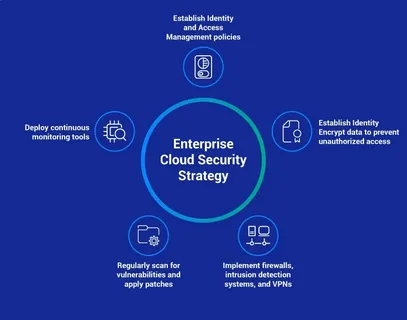
With cloud computing now a crucial aspect of doing business in the modern world, many companies use this technology for data storage, application running, collaboration, and other online services. With the increasing adoption of cloud services for storing company assets, it becomes critical to protect these assets against any security issues and any unauthorized access.
The understanding of basic principles of cloud security will be helpful for companies to understand possible risks, protect themselves, and take necessary security measures. This guide provides the basic concepts of cloud security.
What Is Cloud Security?
Cloud security is the method by which cloud resources are protected against any possible security risk through the use of various techniques and technologies. For businesses looking to understand what is cloud security for businesses, the concept primarily involves protecting cloud resources from unauthorized access, malicious activity, data exposure, and other potential risks.
Whereas physical or on-premises security is more concerned with securing infrastructure, cloud security involves securing the resources within cloud infrastructures by securing the systems, users, applications, data, and connections associated with the access of the resources.
Why Cloud Security Matters for Businesses
With the increased usage of cloud technologies by organizations in conducting their core operations, security becomes an essential element of the use of the cloud. Security problems within cloud accounts, applications, and data resources may affect the operations of an organization or compromise any information.
Cloud security enables organizations to exercise control of their digital resources while facilitating remote access and collaboration and scaling up and down.
Key Concepts Every Business Should Understand
Identity and Access Management
Identity and access management defines who accesses cloud resources and the actions that are allowed for them. Organizations may utilize role-based access, least privilege, and strong authentication in order to minimize unnecessary access. Also, the review of permissions assigned to users may assist in minimizing out-of-date and unnecessary access.
Data Protection
Cloud computing environments include business-critical, customer-related, financial, and other sensitive information of the organization. It is possible to protect such information from any form of unauthorized access through the use of encryption, access control, data classification, and the right data storage policies. Businesses need to evaluate their data storage, sharing, and transferring processes across cloud environments.
Network Security
The security of cloud networks controls the interaction between resources and communication with third-party systems. Segmentation, firewalls, secure connections, and traffic monitoring are measures that may limit unwanted communication and exposure of sensitive information. Correct network controls may assist in separating critical resources from less-trusted environments.
Security Monitoring
Continuous monitoring enables an organization to monitor cloud computing activities, which involve user access, system access, and network access. Continuous monitoring may enable the security experts to spot any abnormalities and any threat that is posed by the use of cloud computing. Continuous monitoring is something that organizations should consider when it comes to their critical assets.
Cloud Configuration Management
Incorrectly configured clouds may pose security risks as well as expose resources. Conducting regular assessments of permissions, storage configuration, network configuration, and many more will assist organizations in identifying possible risks. Automated assessments will also play a role in cloud configuration management.
Workload Protection
The cloud workloads are made up of virtual machines, containers, and applications and require enough security measures all along the way of their lifecycle. It is the responsibility of organizations to keep an eye on workloads, make necessary security updates, manage vulnerabilities, and control access. Effective security of cloud workloads ensures no chance of attacks.
Compliance and Governance
An organization can be subjected to legal and regulatory obligations related to the security of its data and cloud resource management. The cloud security policy should ensure that the organization complies with all such obligations through effective policies and monitoring.
Common Cloud Security Risks Businesses Need to Address
With the increasing usage of cloud technologies by businesses, various cloud security threats may arise, which have impacts on the information, applications, and user access. This knowledge is critical for business organizations to be aware of any weaknesses that may arise.
| Risk | Potential Impact |
| Misconfigured Resources | Can unintentionally expose data or cloud services. |
| Compromised Accounts | May allow unauthorized users to access sensitive resources. |
| Insecure APIs | Can create entry points for unauthorized activity. |
| Data Exposure | May result in the loss or unauthorized disclosure of sensitive information. |
| Excessive Permissions | Can provide users or applications with more access than necessary. |
| Unpatched Workloads | May leave applications and systems vulnerable to known security weaknesses. |
How Businesses Can Build Stronger Cloud Security
An improved approach in terms of cloud security will involve having clear policies, assessment practices and security controls that will be adjusted to the evolving cloud environment. Companies may implement the following steps:
Step 1: Develop Security Policies
Develop security policies that relate to access control, data security, surveillance, configuration management, and incident management.
Step 2: Conduct Cloud Resources Assessment
Perform assessment of cloud resources periodically to determine security risks.
Step 3: Deployment of Appropriate Security Controls
Apply controls as per the needs of your business organization that consist of access controls, data protection and monitoring.
Step 4: Review Existing Controls
Determine whether current controls will still satisfy your needs.
Step 5: Adjust to the Evolving Cloud Environment
Make adjustments in your security policies and permissions as your applications and users evolve.
Practical Cloud Security Best Practices
Cloud security can be achieved by ensuring that there is constant security in terms of users, data, application, and infrastructure. Multi-factor authentication, least privilege access, encryption, monitoring, configuration management, workload management, backup, and security controls testing are some of the measures that businesses should take to ensure minimum security threats.
- Multi-Factor Authentication Implementation: Introduce additional methods of verifying user accounts.
- Least-Privilege Access Implementation: Ensure that users have minimum access rights possible.
- Data Encryption: Protect important data while it is being transferred and stored.
- Cloud Activity Monitoring: Search for suspicious activities and accesses.
- Configuration Review: Detects any configuration that can harm security.
- Update Workloads: Apply patches and updates to protect workloads.
- Backups Creation: Make sure to back up the most important data for future needs.
- Security Control Testing: Test the efficiency of implemented security controls.
What Organizations Need to Consider Before Increasing Their Use of Cloud Services
In order to move further workloads and data to the cloud, organizations need to know their security needs and to determine their key resources. Organizations have to consider their access needs, their data sensitivity, compliance needs, application dependencies and connectivity with other infrastructure.
Organizations also need to consider the possible risks that will occur due to using new cloud services and to define how sensitive workloads will be secured. It will help organizations to avoid any security holes that may appear during the expansion.
It is also necessary to review the security of the cloud environment continuously as new users and new services appear.
Final Thoughts
Security in cloud computing can be termed as a combination of technologies, policies, processes, and procedures that could assist in securing cloud enterprise assets. It is important to gain knowledge on various terminologies such as identity management, data protection, network security, monitoring, configuration management, and shared responsibility to give organizations a good platform to manage their cloud risks. This is because many organizations continue to use cloud computing platforms in their operations.
FAQs
1. What is cloud security in simple terms?
The idea of cloud security can be viewed as a group of procedures, tools, and policies that provide for the safety of cloud-based data, applications, users, and infrastructure. This can help eliminate all chances of any sort of data leakage.
2. Why is cloud security necessary for organizations?
Businesses store confidential data in the cloud and use certain applications. Hence, businesses need security measures.
3. What are the main concepts of cloud security?
Identity and Access Management, Data Security, Network Security, Security Monitoring, Configuration Management, Workload Security, and Compliance are some of the key concepts.
4. Is cloud security a cloud provider’s responsibility?
It is not solely the responsibility of the cloud provider as both the provider and the customer share responsibilities for cloud security. However, depending on the type of cloud service, customers are usually responsible for their own data, users, and configurations.