Diesel just hit a record. The U.S. average price of on-highway diesel reached $6.285 a gallon in the week of September 14, 2026, the highest reading in the EIA weekly series, which starts in 1994. If a generator keeps your remote site running, that number stings.
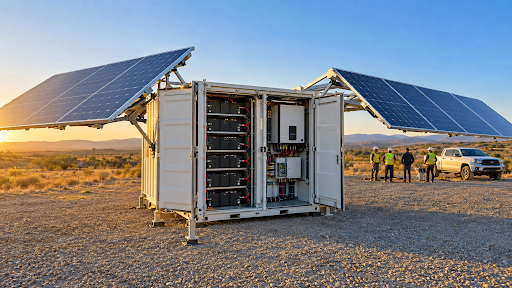
That is why the solar container is moving from niche equipment to a real option for ranches, job sites, telecom sites, and emergency planners. A solar container packs panels, batteries, an inverter, and controls into a transportable steel unit. You haul it in, level it, connect your loads, and start making power.
This guide covers real prices, U.S. fire and electrical rules, 2026 tax and tariff changes, and the mistakes that cost buyers the most. To see a production lineup while you read, browse the Solar Container range from Highjoule.
What Is a Solar Container and How Does It Work
Market researchers describe these systems as self-contained power units that combine solar panels, battery storage, and power management inside a transportable structure. Picture a small power plant that ships like cargo.
The energy path is straightforward. Panels turn sunlight into direct current, a charge controller regulates what enters the battery bank, and an inverter converts stored energy into alternating current for tools, lights, and appliances. Better designs add an energy management system (EMS) that decides when to charge, discharge, or start a backup generator
Three designs you will find on the market
| Design | Typical solar size | Best for | Example makers |
| Roof-mounted | 3 kW to 12 kW | Farm and ranch power, field offices, small worksites | RPS Solar Pumps, Higher Wire |
| Foldable array | 9 kWp to 226 kWp | Construction, mining, events, emergency power | Highjoule, ZN MEOX, SolarCont |
| Microgrid container | 6 kW to multi-megawatt | Utilities, critical facilities, remote communities | BoxPower |
The ranges come from the maker listings cited throughout this guide. Roof-mounted units are the simplest and cheapest place to start. Foldable units cost more but put far more solar in the same footprint. Microgrid boxes add utility-grade controls and are built to be copied from site to site.
The steel box also works as a shipping crate and a security cage. Austrian maker SolarCont builds around ISO 668 dimensions with a CSC plate, so its 20-foot high cube unit can travel by truck, train, or ship and then unfold up to 140 kWp of panels in about five hours.
The Solar Container Market Is Growing Fast
The MarketsandMarkets report values the global solar container market at $0.29 billion in 2025 and projects $0.83 billion by 2030, a 23.8 percent annual growth rate. That is small next to utility solar, which means buyers still have room to shape what manufacturers build.
A few details from the same report help you read the numbers.
- Portable units held 61.5 percent of market value in 2024, so mobility is what most buyers are paying for.
- The 10 kW to 50 kW range is expected to hold 42.9 percent of the 2025 market.
- Asia Pacific leads with a 41.3 percent share, and batteries are the fastest-growing component at 26.9 percent a year.
The report names high upfront cost as a key restraint and lists Yangzhou CIMC New Energy, Ecosun Innovations, Faber Infrastructure, BoxPower, and Hacon Containers among the leading players. In the U.S., BoxPower received close to $3 million from the California Energy Commission to scale its SolarContainer microgrid, which targets wildfire risk, grid reliability, and rural EV charging.
Solar Container Price and What Drives It
There is no single sticker price, because kilowatts, kilowatt-hours, and finish level change everything. Public listings still give you useful anchors. RPS Solar Pumps lists a 3,000-watt kit for your own container at $9,990, a bare-bones 20-foot unit with 3,000 watts of solar at $18,990, and a fully built 40-foot unit with a 12,000-watt array at $67,990, with delivery quoted separately.
| Offer | What you get | Price signal |
| RPS bring-your-own-container kit | 3,000 W solar, inverter, batteries, roof mounting | $9,990 |
| RPS 20-foot bare bones | Container plus 3,000 W system and basic wiring | $18,990 |
| RPS 20-foot fully built out | 6,000 W solar with interior finish | $43,990 |
| RPS 40-foot fully built out | 12,000 W solar with interior finish | $67,990 |
| BoxPower microgrid class | About 16 kW solar with 150 to 250 kWh storage, installed | $80,000 to $90,000 |
| ZN MEOX range (vendor claim) | Fully equipped units | $28,000 to $150,000 |
BoxPower said in 2024 that a mid-range off-grid microgrid with about 16 kW of solar typically costs $80,000 to $90,000 installed, permitting included. ZN MEOX gives a $28,000 to $150,000 range for fully equipped units on its own site. Highjoule publishes specifications for the HJ-FBESS but asks buyers to request a quote.
What moves the price most? Battery kilowatt-hours come first, followed by solar kilowatts, inverter size, cooling method, and certifications. Battery chemistry matters too. Lithium iron phosphate (LFP, or LiFePO4) is common in these systems. RPS rates its lithium iron phosphate batteries at 6,000 cycles at 80 percent depth of discharge, against roughly 1,350 to 1,550 cycles at 50 percent for its sealed gel lead-acid option.
Container price is the small part
Searching for a container for sale is a fine way to find a steel shell, but a bare box is not a solar container for sale. A used wind-and-watertight 20-foot box runs about $1,250 to $2,000 at the depot, and a one-trip 20-footer runs about $2,500 to $3,500. Delivery usually adds $300 to $3,500. Compare that with the $18,990 RPS asks for its bare-bones 20-foot unit, and you can see where the money goes. Panels, batteries, the inverter, wiring, mounting, and engineering make up the rest. For current box prices, see this 2026 container price guide.
Costs that never show up on the product page
- A crane or tilt-bed truck, plus a level gravel or concrete pad
- Permits, fire-code review, and inspections
- Commissioning and operator training
- Insurance
- Customs duties and brokerage fees on imported units
- Grid interconnection if you plan to feed a utility
Tariffs on Chinese equipment in 2026
A Section 301 tariff on Chinese lithium-ion energy storage batteries rose to 25 percent on January 1, 2026. A July 2026 company filing also lists 50 percent on Chinese solar cells and modules, added on top of separate Section 122 tariffs, and notes the Supreme Court struck down the IEEPA tariffs on February 20, 2026, with refund timing still uncertain.
Rates keep shifting. Ask every seller who acts as importer of record whether the quote is delivered duty paid, and what happens if duties change before shipment. Trade data for solar cells and modules is reported under HS code 8541, so have a customs broker confirm how your complete unit gets classified.
HJ-FBESS Solar Container Specs Explained
The HJ-FBESS Solar Container is a handy case study because Highjoule publishes actual configurations. The range has eight reference designs, from a modular rooftop unit to 8-, 10-, 20-, and 40-foot containers, including high cube versions, with 9 kWp to 136 kWp of solar and 15 kWh to 482 kWh of storage.
| Model | Container | Solar | Storage | Power electronics |
| HJ-08G-P018E030 | 8 ft | 18 kWp | 30 kWh | 15 kW PV-storage unit |
| HJ-10G-P024E040 | 10 ft | 24 kWp | 40 kWh | 20 kW PV-storage unit |
| HJ-20G-P057E241 | 20 ft | 57 kWp | 241 kWh | 50 kW inverter plus 100 kW PCS |
| HJ-20H-P068E241 | 20 ft high cube | 68 kWp | 241 kWh | 60 kW inverter plus 100 kW PCS |
| HJ-40H-P136E482 | 40 ft high cube | 136 kWp | 482 kWh | Two 60 kW inverters plus two 100 kW PCS |
Highjoule describes several design choices worth understanding. It uses a DC-coupled layout that skips extra AC-to-DC conversion steps, claims 1 to 2 percent higher efficiency than AC-coupled systems, and quotes 88 to 95 percent round-trip efficiency. Its power conversion system (PCS) is rated at 98.5 percent efficiency and supports black start and off-grid microgrid formation.
The panels are N-type TOPCon modules rated above 22.5 percent efficiency with a temperature coefficient of minus 0.29 percent per degree Celsius. That matters in hot climates because output drops less as panels heat up. The battery cells are liquid-cooled lithium, and the container carries an IP55 rating. The company FAQ puts deployment of a 100 kW, 20-foot unit at about 120 minutes with six workers.
There is a U.S. track record to check. Highjoule lists a 91 kW, 20-foot foldable unit delivered to a remote off-grid site in the United States. A June 2026 press release adds that a foldable unit with a 5 kWp framed array and a ground-anchor system, tested for wind resistance, was being prepared for shipment to a U.S. customer. Treat both as company statements and ask for references you can call.
What to verify before you sign
Specs are only the start, and this applies to any brand. Match your project to a specific row in the table, because storage size varies enormously from model to model. The HJ-FBESS page shows UN 38.3, ISO 9001, RoHS, CCC, and CE badges and mentions NFPA 855 and UL 9540A in its feature text. Your inspector will want the actual UL 9540 listing and UL 9540A test report for the exact model, not a summary. Also ask about battery warranty terms, U.S. spare parts, and winter performance.
How to Size a Solar Container Without Guessing
Sizing takes five steps.
- List every load in watts and hours, then add up daily kilowatt-hours.
- Find your local sun hours with the NREL PVWatts calculator, which uses NREL solar radiation data to estimate the energy production of a photovoltaic system.
- Divide daily use by sun hours times 0.8. The 0.8 is a common planning allowance for wiring, heat, dust, and inverter losses.
- Size batteries for the share of your load that happens after dark, plus a cushion for cloudy days.
- Size the inverter for surge loads such as pumps and compressors.
Here is a worked example. Say a remote site uses 100 kWh a day. A diesel generator burns roughly 0.07 gallons per kWh at full load. At $6.285 a gallon, that is about $0.44 per kWh, or roughly $44 a day and $16,000 a year in fuel alone. Real numbers run higher because lightly loaded diesel engines are less efficient per kWh. A 100 kWh day averages only about 4 kW, so even a 20 kW generator would idle at a fifth of its capacity most of the time.
On the solar side, five sun hours and the 0.8 factor give about 4 kWh per installed kW each day. That means 100 kWh needs around 25 kW of panels. If roughly 40 percent of the load happens after dark, you need about 40 kWh of storage. On paper, a unit like the HJ-10G-P024E040 with 24 kWp of solar and 40 kWh of storage lands close. Add a small generator for long cloudy spells, and it becomes a diesel reducer that can still keep its promise. Sun hours vary widely across the U.S., so run your own coordinates.
U.S. Codes, Safety and Permits
A steel box does not exempt you from building and fire codes. Your local authority having jurisdiction (AHJ) decides what passes.
The 2026 edition of NFPA 855 has been released, and it makes a hazard mitigation analysis the default expectation for most energy storage projects. Both NFPA 855 and the 2024 International Fire Code point to UL 9540A as the fire test method. NFPA 855 says lithium-ion systems above 20 kWh should be certified to UL 9540. UL 9540A testing applies to units above 50 kWh, or units that sit less than 3 feet from neighboring equipment, doors, or windows.
Local practice can differ from the standard. Some AHJs treat containerized units as mobile equipment and exclude them from NFPA 855, and the edition a city has adopted can lag behind the newest one. Ask for the ruling in writing and bring test reports to your first meeting. You can read more on the NFPA 855 standard page and in UL Solutions’ UL 9540A overview.
On the electrical side, PV falls under NEC Article 690 and stored energy under Article 706. Hire a licensed electrician. Higher Wire advises UL-listed components, proper grounding, GFCI protection in wet locations, and regular inspections.
Foldable arrays also have site limits. One maker lists a maximum slope of 1 percent for its unfolded array. RPS rates its roof mounting for sustained winds up to 81 mph. Compare any wind rating with your local design wind speed and ask how the array stows before a storm.
Federal Tax Credits and Incentives in 2026
Incentive advice online is often stale. Some product pages still advertise a 26 percent federal credit, and for owner-purchased residential systems that credit is gone.
The One Big Beautiful Bill Act, signed July 4, 2025, ended the homeowner credit under Section 25D. That credit terminated on December 31, 2025, with no step-down. Homeowners who buy solar in 2026 receive no federal credit from it.
Businesses and third-party owners can still claim the Section 48E credit, with tighter timing. Solar projects that had not begun construction by July 4, 2026 generally must be placed in service by December 31, 2027. Projects that did begin construction by that date, through the physical work test or a 5 percent safe harbor for systems up to 1.5 MW AC, have about four years to finish. Battery storage keeps its credit longer, until a planned phase-out in 2032. Foreign entity of concern rules can also disqualify projects that lean too heavily on restricted-country content, with thresholds starting at 55 percent for projects that begin construction in 2026.
This is general information, not tax advice. Talk to a CPA before you sign a purchase order, keep records showing when construction began, and check state and utility programs, which vary widely.
Solar Container Home and Container House Builds
A solar container home is a different animal from a worksite power unit, because people live in it. Start with space. A 20-foot box gives about 146 square feet inside, and a 40-footer gives about 285. Then look at money. Container homes typically run $150 to $350 per square foot, and building permits average about $1,380. The Angi cost guide breaks down the rest.
Steel moves heat fast, so insulation is non-negotiable. Closed-cell spray foam costs about $1.50 to $3.00 per square foot and also stops the condensation that leads to mold. The container roof is its weakest surface, so many builds add a separate roof structure. That new roof can carry your panels and shade the steel below.
Real examples show the limits. RPS built a winery break room with an 18,000 BTU mini-split, an 8,800-watt solar array, and a 9,600 Wh lithium bank. That works because the air conditioner mostly runs while the sun shines. Cooling all night would need far more battery.
Zoning comes last but matters most. Local rules differ widely, and some U.S. counties restrict container housing. Check zoning, the building code your county adopted, and utility rules before you buy any container house.
Solar Container Cold Room for Food and Vaccines
A solar container cold room is an independent refrigeration system inside a cargo container that runs mainly on solar power, built from an insulated body, a refrigeration unit, and a solar array with batteries. It keeps produce, vaccines, and medicine cold where the grid is weak or missing.
The best proof comes from Nigeria. ColdHubs says its solar-powered walk-in cold rooms stretch the life of fruits and vegetables from about two days to about 21 days. Panels on the roof charge batteries, the batteries feed an inverter, and the inverter runs the refrigeration unit. In its 10-by-10-foot design, one room holds about three tons of produce, and the natural refrigerant unit draws about 658 watts on average.
Refrigeration hardware is not cheap. A working used 20-foot reefer costs about $7,000 to $14,000, and new one-trip units run $25,000 to $33,000, before any solar. Compressors pull a surge when they start, so give the inverter headroom. Thick insulation and fewer door openings cut the load more cheaply than extra batteries do. The same design suits farm stands, ranches, rural clinics, and disaster response, though food and medicine storage can add health rules on top of electrical and fire codes.
Ventilation and Lighting Upgrades
Solar Container Vent and Fan Options
Steel boxes trap heat and moisture. When warm, humid air meets cold steel, it condenses into container rain that rusts gear and grows mold. The fix is cross-flow. Low passive intake vents draw air in while a powered exhaust vent pushes stale air out. Solar Blaster suggests one or two vents for every 20 feet of container length, with intake vents low on the walls, and warns that roof ribs come in 3.5 inch and 6.5 inch sizes, so measure before ordering.
A solar container vent with its own small panel needs no wiring. A solar container fan of that type only runs while the sun shines, so choose a model with a small battery or wire the fan to your main system if you need night airflow. One caution. The battery and inverter compartments in a listed system have their own thermal design. Do not cut extra holes into them, and follow the manufacturer’s ventilation instructions.
Solar Container Lights
Lighting is the easy load. Twelve 12-watt LED fixtures draw about 144 watts, which is small next to a mini-split or a refrigerator compressor. Daylight is even cheaper. Solar Blaster sells tubular skylights for shipping containers that bring in daylight without adding electrical load. Put lights on their own breaker, add motion sensors in storage areas, and choose warm LEDs for living spaces.
Shipping, Delivery and Site Prep
Freight is where good quotes go bad. Before any solar container ship date gets locked in, confirm the unit has a valid CSC plate and ISO 668 dimensions. Those standards, along with corner lifting points and twist-locks, are what let a container ride on trucks, trains, and ships. Ask what travels inside the box. RPS packs batteries and power components inside the container and delivers by trailer at actual quoted rates.
Then plan the landing spot. You need a level pad, truck access, and a crane or tilt-bed for unloading. For imports, add ocean freight, port fees, drayage, and brokerage, and get the HS classification confirmed early.
How to Choose a Container Company
Anyone can sell a steel box. Fewer companies can support a power system for 15 years. Ask each candidate these questions.
- Who is the importer of record, and who services the unit in the U.S.?
- Can you see the UL 9540 listing, UL 9540A report, CSC plate, and UN 38.3 test summary for the exact model?
- What does the warranty cover, and for how long? ZN MEOX lists 10 years on panels, 3 years on the inverter, and 10 years on the container. RPS offers 2 years on panels, mounting, and the electrical system. Get battery terms in writing, including cycle count and capacity at the end of the warranty.
- Are spare parts stocked in North America?
- Can you call a U.S. customer with a similar system?
- Does remote monitoring come standard, and who watches the alerts?
Seven Costly Mistakes to Avoid
- Buying the box first. A cheap container for sale is only a shell. Roof strength, door layout, and wiring paths decide whether it can become a power system.
- Sizing by panel count. Buy kilowatt-hours and kilowatts, not a number of panels.
- Ignoring winter. Look for active battery heating and a battery management system that blocks charging when cells are too cold.
- Skipping the fire-code talk. Meet your AHJ before you order, not after the truck arrives.
- Trusting old incentive claims. The homeowner credit is gone, and business credits now have hard deadlines.
- Comparing quotes with different scopes. One price may include delivery, commissioning, and training while another includes none of them.
- Forgetting site logistics. Slope, crane access, pad prep, and shade can wreck a perfect spec sheet.
Solar Container Questions Buyers Ask
How much does a solar container cost?
Expect about $10,000 for a bring-your-own-box kit and roughly $68,000 for a fully built 40-foot unit from a U.S. seller. Permitted microgrid-class systems start near $80,000. Foldable industrial units are usually quote-based.
How long does setup take?
Ready-built roof-mounted units can work within hours of delivery. Highjoule puts a 100 kW foldable unit at about two hours with six workers, and SolarCont quotes up to five hours for its larger array.
How long does a solar container last?
Higher Wire estimates 15 to 25 years with maintenance, with panels typically warrantied for 25 years and lithium batteries lasting 10 years or more. Highjoule designs for 15 to 20-plus years of service.
Can a solar container power a house?
Yes, when the system is sized to the load and the structure is permitted as a dwelling. Small container homes with efficient mini-splits are realistic. Large homes with electric heat and cooking need far more solar and storage.
Can I still claim a federal tax credit?
Not if you own it for a home and bought it in 2026. Businesses and third-party owners may still qualify under Section 48E, subject to the deadlines above, so confirm with a CPA.
Conclusion
Start with two things: a load list and a site address. Those let any serious seller give you a real quote, and they help you spot the sellers who cannot. Then request the UL documents, warranty terms, and a delivered price in writing. A solar container earns its keep when the paperwork is as solid as the steel.