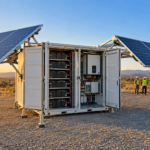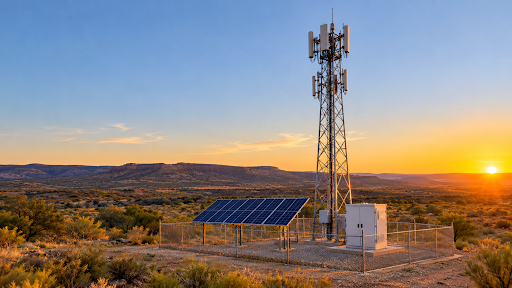
A cell tower never gets a day off. Radios, backhaul links, cooling fans, and safety lights all draw power around the clock, and a dead site means dropped calls for everyone in range. That pressure is why solar for telecom towers has moved from small pilots to a mainstream design option for tower owners, carriers, and rural network builders.
This guide explains how telecom towers work, what they need from a power system, and how telecom solar power systems are built. You will also see how much energy solar generates at a typical site, a worked sizing example, the fire code questions that come with lithium batteries, and what the 2026 tax rules mean for your budget.
The short answer is yes. A tower can run on solar when the array, battery, and controller are sized for the site’s real load and its worst month of sunlight. Most sites still keep a grid connection or a generator as backup, because two or three cloudy days can drain a battery that was sized for one night.
How Do Telecom Towers Work?
A macro tower is a steel structure that lifts antennas high enough to cover a wide area. The antennas connect to radio units that turn digital traffic into radio signals. Baseband equipment processes that traffic, and a backhaul link, usually fiber or a microwave dish, carries it to the carrier’s core network.
Everything on the ground sits in a shelter or an outdoor cabinet. That includes rectifiers, batteries, cooling, and monitoring gear that reports to a network operations center. A utility connection or a generator feeds the whole site.
The industry is large. The Wireless Infrastructure Association counted 154,800 purpose-built cellular towers and 248,050 macrocell sites in the United States at the end of 2024. Counts differ between trade groups because each group defines a tower a little differently, so treat any single figure as an estimate.
Power demand is the part that matters for solar. One industry analysis found that a typical three-sector site draws between 2.5 and 10 kW, depending on cooling and the number of carriers. Data from China Mobile, cited in a peer-reviewed paper, shows that a typical 5G macro base station draws more than 4 kW. At 5 kW, a site uses 120 kWh every day.
Telecom Tower Requirements That Shape Every Power Design
Before you choose a solar panel for telecom towers or a battery bank, look at what the site already has to satisfy.
- Continuous availability. Operators set a battery autonomy target for each site based on how critical it is and how reliable the grid is. That number drives almost every sizing decision.
- DC power. Many telecom systems are built around a nominal -48 V DC architecture, so rectifiers, charge controllers, and batteries are matched to that voltage window. Solar has to plug into that architecture, not the other way around.
- Lighting and registration. Towers taller than about 200 feet, or located near an airport, generally require FAA notice and antenna structure registration with the FCC. The FCC also makes the FAA’s lighting standards binding, since its rules turn advisory FAA marking and lighting guidance into mandatory requirements. A failed top light is not a small problem either. Owners must notify the FAA when a top steady-burning or flashing obstruction light stays out for more than 30 minutes. Obstruction lights are a tiny load with a big compliance consequence, so they belong on the protected side of any backup design.
- Structure and space. Steel towers are designed to the ANSI/TIA-222 structural standard, and anything added to the tower adds wind load. Ground-mounted arrays need leased compound space, and many compounds are small.
- Permits and reviews. New towers and some collocations trigger environmental and historic preservation review. Adding solar and batteries inside an existing compound usually runs through local building and electrical permits, landlord consent, and utility interconnection for grid-tied systems.
- Electrical and fire codes. The National Electrical Code covers PV wiring in Article 690 and energy storage in Article 706. Fire codes can add another layer for lithium batteries, which is covered below.
How Solar for Telecom Towers Works From Panel to Radio
A home solar system converts panel output to AC and leans on the grid as a buffer. A tower system is built around DC and a battery, because the radios never stop and the site cannot borrow from anyone.
The power path is simple to describe. Panels produce DC power. A charge controller or DC power plant regulates it and charges the battery bank. The battery and the DC bus feed the radios, transport gear, and cooling. If the site has a grid connection or generator, rectifiers convert that AC power to DC, and a hybrid controller decides which source to use at any moment.
Keeping the system on DC avoids wasted conversion steps. The National Laboratory of the Rockies, which was renamed from the National Renewable Energy Laboratory in a Department of Energy announcement, validated exactly this idea with Verizon. It tested a cell tower power system prototype that connects PV through direct current rather than alternating current, using batteries and DC cooling.
People sometimes search “how do solar towers work” and land on concentrating solar power towers, where mirrors focus sunlight to make steam. That is a different technology. Here, a solar tower means a telecom tower powered by solar.
What Is Inside Telecom Solar Power Systems
- PV modules with racking rated for local wind, snow, and ice
- A charge controller or DC power plant
- Rectifiers for grid or generator input
- A battery bank with a battery management system
- An inverter, only where AC loads such as some cooling units exist
- A hybrid controller that sets source priority
- A generator interface for sites that keep diesel as a last resort
- Grounding, bonding, and surge protection
- Remote monitoring and alarms
Choosing a Solar Panel for Telecom Towers
Mounting panels on the tower looks like a space saver, but it rarely pays off. Engineering guidance notes that tower height does not automatically improve production, since antennas, steelwork, and cables cast shadows, and added wind area and work-at-height access can outweigh the space saved. Ground mounting is usually easier to orient, clean, and expand when the compound has secure, unshaded land.
Panel choice itself is less dramatic. Standard crystalline modules do the job. Higher-efficiency options may matter at cramped sites. American Tower and Swift Solar recently announced a collaboration to evaluate perovskite-silicon tandem panels for telecom towers, aimed at squeezing more power from limited space. Treat that as a promising pilot, not a proven product line.
How Much Energy Does Solar Generate at a Tower Site?
The key number is peak sun hours, which is the daily sunlight expressed as hours of full-strength sun. Modeling based on the federal PVWatts tool puts the U.S. average at about 4.98 peak sun hours per day, with a default system loss factor of 0.77. Most states land between 4.5 and 5.5 hours, while Arizona reaches about 6.5 and the Pacific Northwest and Alaska fall well below the range.
Here is the rule of thumb. One kilowatt of panels at 5 peak sun hours produces roughly 3.85 kWh per day after losses (1 kW × 5 hours × 0.77). Sunlight also swings with the seasons, so designers size for the weakest month rather than the annual average.
A Worked Example
A 23.4 kW array means about 59 panels rated at 400 watts. The 60 percent case needs about 35. That gap explains why hybrids win so often. The last 40 percent of energy forces you to oversize for winter, and that is the most expensive part of the array.
These are screening numbers, not a quote. A real design adds cooling loads, temperature effects, battery aging, load growth, and an hourly simulation. The PVWatts calculator is a good free way to check local sunlight before you talk to an engineer. For a vendor’s view of load modeling, autonomy targets, and monitoring KPIs, the Solar Telecom Energy resource hub includes an industry guide covering site load and energy balance, architecture and source priority, storage safety and lifecycle, and monitoring and alarms.
Battery Storage and Fire Code
Lead-acid batteries were the long-time default at telecom sites. Lithium iron phosphate is now common because it offers longer cycle life and a smaller footprint, though it usually costs more up front. Either way, plan for temperature control, a battery management system, and remote monitoring.
The fire code deserves early attention. NFPA 855 covers stationary storage, and it applies to lithium-ion systems above 20 kWh of aggregate stored energy. Telecom exemptions exist in some published code amendments, but they focus on lead-acid and nickel-cadmium systems under 50 V ac or 60 V dc in communications installations that comply with NFPA 76. A lithium retrofit at an old lead-acid site can therefore face a fresh review. Ask for UL 9540 listings and UL 9540A test data, since UL 9540A is the long-standing benchmark for thermal runaway and fire propagation testing. Then confirm the rules with your local fire marshal, because adoption varies by jurisdiction.
What Solar Costs and Saves, Including the 2026 Tax Credit Deadline
Cost comparisons go wrong when they use the wrong fuel price. Use the delivered price at the tower, not the pump price, because road access, distance, and delivery size change the number. Then count the full picture. Include survey and civil work, panels, batteries, controllers, cleaning and vegetation control, battery replacement, and the cost of downtime.
Global evidence shows what is possible where diesel dominates. GSMA reports that a Huawei solar-diesel hybrid rollout in Somalia reached a return on investment in less than three years. In parts of Africa, diesel can account for 30 to 60 percent of operating expenses for some operators. Those are not U.S. conditions, but they show why fuel logistics drive the business case.
For U.S. buyers, the bigger news is the federal tax clock, and many guides have not caught up. Under the One Big Beautiful Bill Act, solar facilities that begin construction after July 4, 2026 must be placed in service by December 31, 2027 to qualify for the Section 48E credit, and the change does not affect related energy storage. That deadline has now passed, and projects that missed it need permission to operate by the end of 2027. Projects that did start construction in time keep a longer runway, since they can place the system in service within four years, which extends to the end of 2030. The base credit is 30 percent. From today, that leaves about 15 months for new solar projects, which is tight once permits and utility approvals are counted.
Two more items belong in your budget review. The law made 100 percent bonus depreciation permanent, which helps first-year economics. Also, projects that began construction after 2025 must avoid material assistance from prohibited foreign entities, so ask every supplier for sourcing documentation. This article is general information, not tax advice, so confirm details with a tax professional.
Where Solar Makes Sense and Where It Does Not
Solar tends to fit best at remote sites, at bad-grid sites, and at sites where generator runtime and fuel deliveries are expensive. GSMA defines a bad-grid tower as one where grid outages exceed six hours a day on average. Its research estimated that in early 2020, 88 percent of off-grid and bad-grid tower sites in low- and middle-income countries still ran on diesel. The GSMA renewable energy work shows how large that opening remains.
Solar is a weaker first move when a site has heavy year-round shade, no secure space, a short remaining lease, or a very reliable low-cost grid. Engineering guides also point to uncertain load growth and extreme low-sun seasons as reasons to consider a generator, grid extension, or wind-solar hybrid instead. Sometimes the smartest first investment is efficiency. Every continuous 100 watts you remove saves 2.4 kWh a day and shrinks both the array and the battery.
Solar for Telecom Towers in the United States Today
The U.S. picture is moving in small, practical steps. The National Laboratory of the Rockies says it continues to support Verizon with photovoltaic projects at cell sites in the western United States. Verizon states that it expects net-zero operational emissions by year-end 2035 and notes that most of its operational footprint comes from the electricity that powers its networks. T-Mobile was the first U.S. wireless carrier to set a net-zero target across its full footprint by 2040, and AT&T aims for carbon neutrality across global operations by 2035.
Much of that progress comes from buying renewable power, so on-site solar at towers is one tool among several. Still, tower owners now treat it as a normal option during site planning, especially where resilience matters.
Design Mistakes That Derail Projects
- Sizing on the annual average. The worst month decides whether the site stays up.
- Leaving out cooling and heating. Cabinet climate control can add a meaningful share of daily demand, especially at hot sites.
- Sizing storage but not recovery. A big battery is only useful if the array or rectifiers can recharge it before the next event.
- Buying by nameplate. Ask for usable energy at end of life and at the design temperature.
- Ignoring access. If a technician cannot safely clean or replace a panel, its theoretical output does not matter.
- Skipping monitoring. Set alarm ownership and response times before handover.
- Underestimating lead times. Permits, inspections, and utility approvals now compete with a hard tax deadline.
How to Get Started
- Collect 12 months of load data, generator run hours, and fuel delivery records.
- Check local sunlight for the worst month with PVWatts.
- Decide the operating model, whether grid-tied, hybrid, or off-grid.
- Confirm lease terms, permit paths, and fire code requirements early.
- Request proposals that show assumptions, usable battery energy, and recovery time side by side.
Suppliers approach this in different ways. The process at Solar for telecom towers from Huijue Group is a useful template for any request for proposal, since it moves from site assessment through system design and factory integration to commissioning.
Frequently Asked Questions
Can a telecom tower run entirely on solar power?
Yes, when the array and battery are sized for the site’s load and its worst month of sunlight. Critical sites usually keep a generator or grid connection for rare multi-day cloudy stretches.
How many solar panels does a cell tower need?
There is no standard count. It depends on daily load, sunlight, losses, and how much of the energy solar must supply. In the example above, a 3 kW site needs about 35 panels for a 60 percent solar share.
Does a solar telecom site need an inverter?
Only for AC loads. Many telecom loads run on -48 V DC and can be served through a DC power system, which avoids extra conversion losses.
Do I need a permit to add solar to a tower site?
Usually yes. Expect building and electrical permits, landlord approval, possible fire code review for lithium batteries, and utility interconnection for grid-tied systems. Rules vary by jurisdiction.
What is the difference between a solar tower and a solar-powered cell tower?
A solar power tower is a utility-scale plant that uses mirrors to focus sunlight. A solar-powered cell tower is a normal telecom tower that draws part or all of its energy from panels and batteries.
Solar will not rescue a poorly planned site, but it rewards good planning. Start with real load data, design for the worst month, respect the fire and tower rules, and keep the tax deadline in view. Do that, and a tower can stay online while burning far less fuel.