Text-to-3D Character Generation: Game Development Pipeline
The Character Design Bottleneck in Game Development
AAA studios have character pipelines: concept artists, character modelers, riggers, and animators. Indie studios have one person doing all of it. Mid-size studios have 2–3 people doing everything. The constraint is always character production. A game designer wants 30 unique enemy types. The character artist says “I can do 8 in the timeline we have.”
The game suffers because the character artist is the bottleneck, not the designer.
Where Text-to-3D Changes the Game
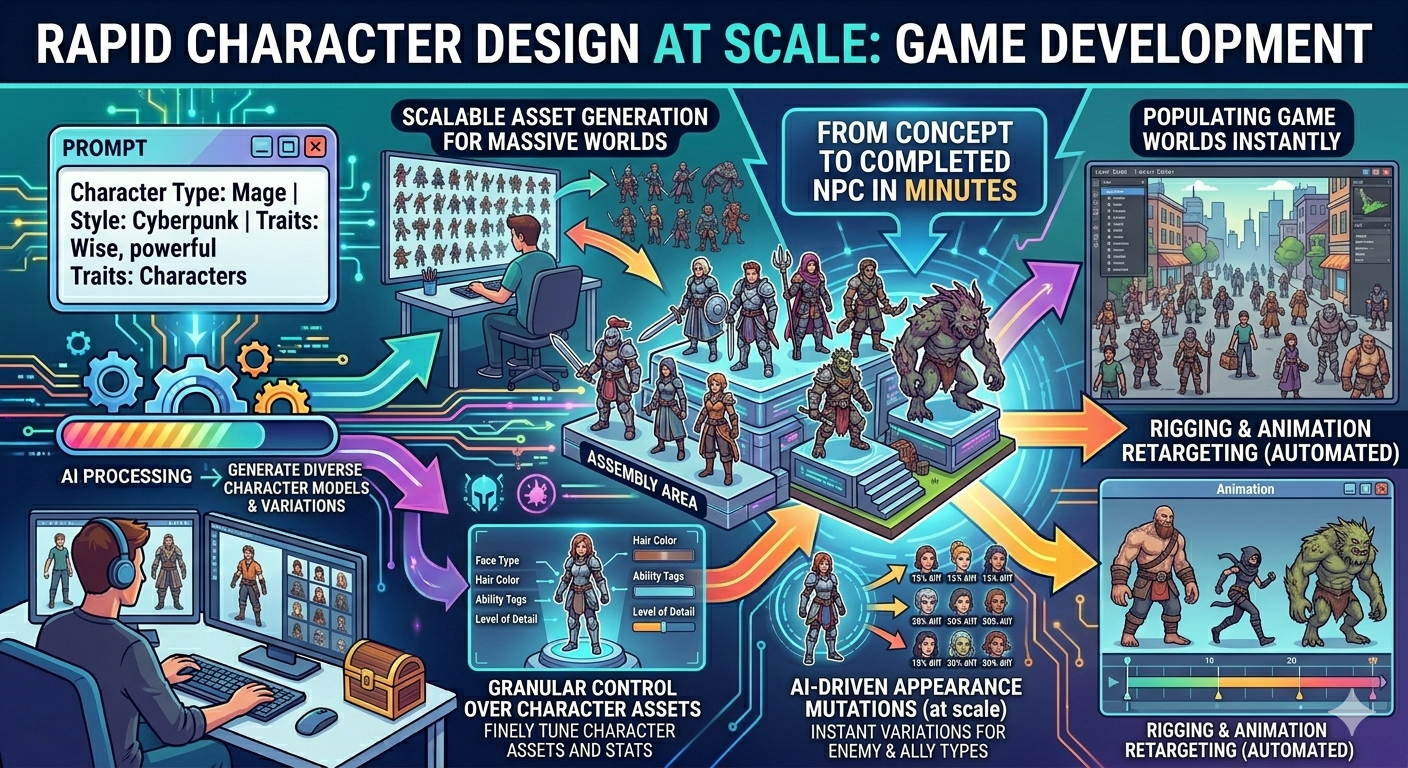
A game designer can now describe a character: “A humanoid creature, alien-looking, with elongated limbs, chitinous plating, and a hunched posture. Think insectoid but bipedal.” A text-to-3D tool generates a 3D model. Within minutes, the designer can see the character in 3D.
If the proportions are off, they refine the description: “Make the limbs shorter, more muscular. The plating should be thicker and more pronounced.” Another generation. Another minute. In 20 minutes, the designer has a 3D model that matches their vision.
How This Changes Production Dynamics
With fast character generation, the bottleneck shifts. It’s no longer “how long does it take to model?” It’s “how good is the concept direction?” Character artists spend less time on exploratory modeling and more time on refinement. Designers spend more time on creative direction and less time waiting for drafts.
For a game with 50 character types: Old pipeline (50 characters × 3 weeks each = 150 weeks), New pipeline (50 characters × 3 days of refinement each = 150 days). With a team of 3, that’s 50 weeks calendar time vs. 50 days. The difference is massive.
The Quality Question in Production Context
Will characters generated via text-to-3D be AAA-quality? No. Not immediately. But they don’t need to be. A generated character model is a solid foundation that a character artist can refine. The artist isn’t starting from scratch. They’re starting from a validated concept translated into 3D.
The quality floor is higher. The iteration cycle is faster. The designer’s vision is captured earlier.
Practical Integration: The Workflow That Works
Smart game studios are integrating text-to-3D into their character pipeline: Phase 1 Rapid concepting (text-to-3D): The game designer describes character archetypes. The tool generates 3D models. The design team evaluates and selects the strongest directions.
Phase 2 Directed refinement (character artist): For approved concepts, the character artist refines the model: adds detail, fixes topology, optimizes for the game engine, prepares for rigging.
Phase 3 Technical preparation (technical artist): The character is rigged, animated, and integrated into the game engine.
Text-to-3D accelerates phase 1, making phase 2 more efficient. The character artist isn’t guessing at the designer’s intent. They’re refining a validated concept.
The Staffing Implication
If character generation becomes 10x faster, do studios need fewer character artists? Short answer: they need different character artists.
Instead of “artist who can model a character in 3 weeks,” studios need “artist who can refine and optimize a generated character in 3 days.” The skillset shifts from modeling to refinement and problem-solving.
For character artists, the shift is uncomfortable but ultimately empowering. Instead of doing routine modeling, they’re doing creative refinement. Their expertise is on display in how they improve the generated work.
The Competitive Advantage
Game studios that adopt text to 3D model generator workflows first will have an advantage: they can ship more character variety in shorter timelines. They can iterate faster on character design based on playtesting feedback.
This doesn’t replace character artists. It makes them more valuable because they can do more work in less time.