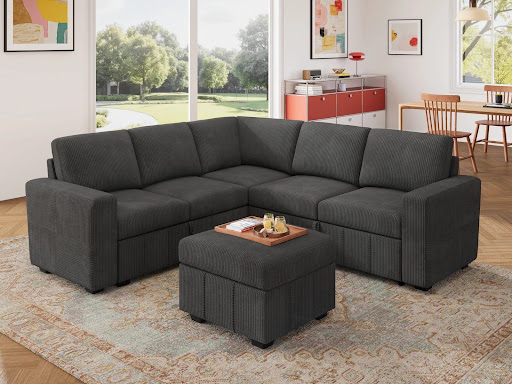
Homes today rarely stay the same for very long. Renters move every couple of years, families grow, remote work reshapes what a living room needs to do, and open-plan layouts blur the line between lounging, working, and entertaining. Traditional fixed-shape sofas were designed for a slower, more static way of living. That is why the modular sofa has quietly become one of the most useful pieces of furniture in modern homes.
This guide is written for people who need furniture that adapts. Two groups in particular will get the most from it: renters who move often and cannot invest in furniture that only fits one specific room, and families in growing households who need seating that can flex through different life stages, from young kids to teenage sleepovers to hosting extended family. Both need something better than “buy a sectional and hope for the best.” The sections below walk through how modular systems actually work, how to plan a configuration you will not outgrow, and how to judge which pieces are worth the money.
What Modular Really Means, and Why It Matters
A modular sofa is built from individual seat and corner units that connect together to form a larger piece. Instead of one fused shape, you get building blocks: armless middles, corner units, chaise sections, ottomans, and sometimes storage bases or pull-out sleeper modules. You choose the combination, and you can rearrange or expand it later. That is the difference between owning a sofa and owning a system.
The practical value shows up the first time your life changes. Move to a smaller apartment? Reduce the module count. Move to a bigger place? Buy two extra seats and expand. Kids getting older and needing lounging space? Add a chaise. Guests visiting for the holidays? Reshape the couch into an L for extra seating. The same core investment adapts instead of getting replaced.
Modular vs. Traditional Fixed Sectional
A traditional sectional looks similar from across the room, but the resemblance ends there. Fixed sectionals are one piece with a permanent shape, which means they are harder to move up stairs, harder to fit through doorways, and impossible to reconfigure if your room changes. Modular systems solve all three issues. Each piece is small enough to carry alone, easy to bring into narrow apartments, and endlessly rearrangeable once inside.
The Cost Argument Nobody Talks About
Most sofa buyers replace their couch every five to eight years, often because it no longer fits a new home or a changed household. A modular system, chosen well, can survive multiple moves and life stages because it evolves with you. When you calculate cost per year of use rather than sticker price, modular systems frequently come out ahead of cheaper fixed pieces that get replaced faster.
Planning a Configuration You Will Not Outgrow
The most common regret with modular pieces is not the sofa itself; it is the initial configuration. People plan for the room they have today and forget about the room they will have in three years. A little planning up front prevents that.
Start With How You Actually Live
Skip design inspiration for a moment and answer honest questions. How many people usually sit on the sofa on a normal weeknight? How often do you host guests, and do any of them ever sleep over? Does anyone stretch out full-length to watch a movie or nap? Do you need storage for blankets, remotes, or toys? Your answers will point directly to whether you need a straight configuration, an L-shape, a U-shape, a chaise, a sleeper, or a storage base. Design the sofa around your life, not the other way around.
Reserve Room to Grow
Choose a system where you can buy additional matching modules later. That single decision protects your investment. If a growing family, a home office pivot, or a bigger apartment adds new needs, you expand rather than start over. It is worth confirming, before you buy, that your chosen line offers the extra pieces you might want down the road.
Storage, Sleepers, and Multi-Function Modules
For small apartments and family homes alike, multi-function modules are where the real practicality lives. Storage bases hide bulky items you would otherwise trip over. Pull-out sleeper modules mean you can host overnight guests without owning a dedicated guest room. Deep chaise pieces double as guest bedding in a pinch. HONBAY, known for these kinds of practical modular systems, offers configurations that mix and match these functions so a single piece of furniture can quietly do three jobs in a modern home.
Judging Modular Quality Before You Buy
Modularity is only valuable if the pieces still feel like a sofa. Bad modular systems shift, gap, and wobble; good ones lock together so tightly they behave like one solid piece.
Connection Systems and Stability
The single biggest quality marker is how modules connect. Look for metal brackets, sturdy interlocking hardware, or clamp systems that pull adjacent modules firmly together. Weak systems rely on gravity or friction alone and drift apart with normal daily use. If a product listing does not clearly describe how modules connect, assume the connection is weak. Read owner reviews specifically about whether the pieces stay together over months of use.
Frame Materials and Cushion Construction
The construction rules for modular sofas are similar to any quality couch. Solid hardwood or heavy-duty engineered wood frames outlast particleboard. High-resilience foam cushions with a soft top layer hold their shape longer than a single layer of low-density foam. Serpentine or webbing suspension under the cushions provides the responsive give that makes a couch feel comfortable for hours rather than minutes. Ask, or read, until you know these details.
Covers, Fabrics, and Cleanability
Removable, washable covers are a significant advantage in modular systems because each cover is small enough to fit in a home washing machine. That matters a lot in homes with kids, pets, or messy hobbies. Even without removable covers, opt for tightly woven fabrics, performance textiles, or heathered tones that hide day-to-day wear better than solid pale colors.
Rearranging, Maintaining, and Getting Long Life From Your Sofa
Once installed, treat rearrangement as a feature, not a chore. Every six months or so, consider rotating modules or trying a different layout. This spreads wear evenly across the seats and keeps the room feeling fresh without buying anything new. Vacuum between modules regularly, since crumbs and dust naturally collect at the joints. Tighten connection hardware whenever you notice any shifting. Rotate and flip cushions where the design allows so no single seat sags before the rest. These habits sound minor, but combined they are the reason well-maintained modular systems can look nearly new after five or more years of daily use.
Furniture That Grows With Your Life
A modular sofa is less a single purchase and more a long-term system. Its real value is not the look on day one; it is the flexibility on year three, when your apartment, family, or lifestyle has changed and your furniture bends to fit rather than forcing a replacement. Take time to plan a starting configuration that reflects how you actually live, choose a system with strong connections and quality materials, and pick pieces from a line that lets you expand later. Do that, and your sofa becomes one of the few pieces of furniture that stops being a compromise the moment you carry it through the door and stays useful through every phase of the home it ends up in.