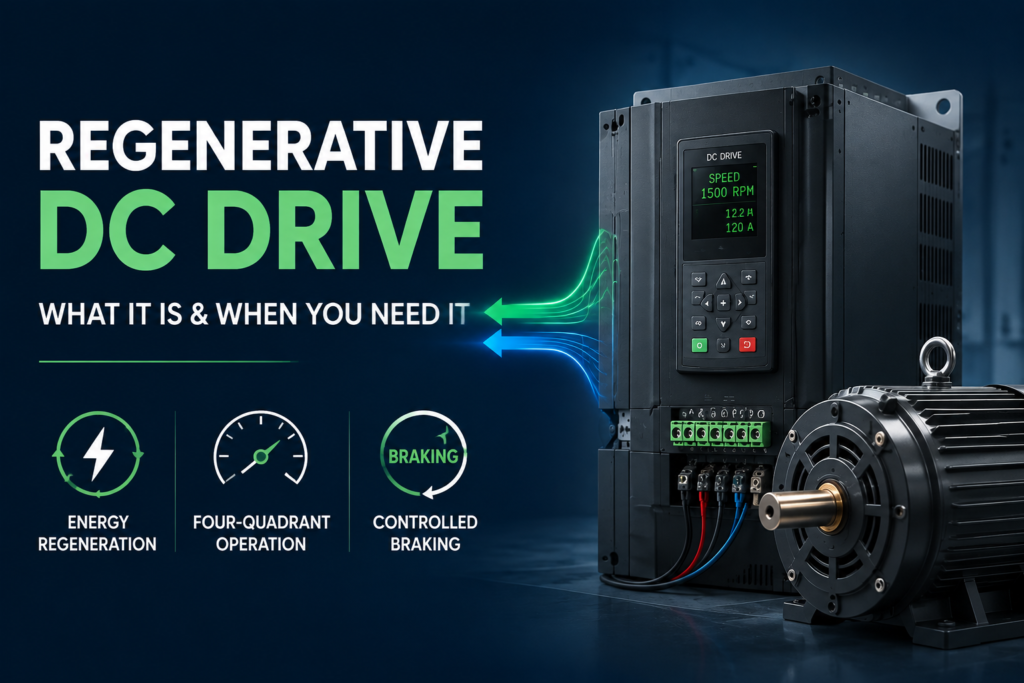
A regenerative DC driveis a four-quadrant motor-control system that can operate a DC motor in both motoring and braking modes, with controlled electrical power flow from the motor back towards the AC supply at the time of regeneration. Different from a conventional non-regenerative drive, it does not simply dissipate braking energy as heat.
For UK industrial installations, the distinction matters particularly in hoists, cranes, winders, rolling equipment, conveyors, test rigs, and material-handling systems, where quick deceleration, overhauling loads, or frequent condition changes can make conventional braking inefficient or hard to control.
Quick Answer: A regenerative DC drive is required when an application needs controlled braking, reversing under power, overhauling-load control, or recovery of substantial kinetic/potential energy. If the motor only accelerates and runs in one direction with infrequent stopping, a conventional single-quadrant or non-regenerative drive is usually more appropriate.
How Does a Regenerative DC Drive Work?
Traditional industrial DC drives commonly use controlled rectifier bridges to regulate armature voltage and current. In a regenerative configuration, coordinated power-conversion bridges permit current to be controlled in both directions.
A typical four-quadrant thyristor-based arrangement effectively uses two converter bridges. One handles motoring operation and while the complementary bridge provides the reverse-output path needed for regenerative operation.
The control system must manage:
- Armature current
- Armature voltage
- Motor speed
- Field current
- Torque demand
- Converter firing angle
- Bridge interlocking
- Current limits
- Acceleration/deceleration ramps
- Regenerative thresholds
Closed-loop systems may additionally use tachogenerator or encoder feedback where tight speed regulation is required.
The important point is that regeneration is not simply a braking command. The controller must establish the correct electrical conditions for generated power to flow from the motor back to the supply without causing excessive current, instability, or converter commutation problems.
Modern regenerative DC controllers can therefore combine speed regulation, torque control, current limiting, and four-quadrant operation within one coordinated control architecture.
Regenerative DC Drive vs Non-Regenerative DC Drive
The choice should be based on the load profile, rather than simply the rated power of the motor.
| Characteristic | Non-regenerative Drive | Regenerative Drive |
| Forward motoring | Yes | Yes |
| Reverse motoring | Possible with additional hardware/configuration | Yes |
| Controlled regenerative braking | No | Yes |
| Four-quadrant operation | No | Yes |
| Energy returned to supply | No | Yes |
| Overhauling-load control | Limited | Excellent |
| Rapid reversing | Limited | Suitable |
| Braking resistor needed for regeneration | Not applicable | Not normally required |
| System complexity | Lower | Higher |
| Best suited to | Simple speed control | Dynamic loads and frequent braking |
Where Does a Single Phase DC Drive Fit?
A single phase DC drive is not automatically synonymous with a non-regenerative drive.
Single-phase AC input can feed a controlled DC converter, with the resulting DC output regulating the motor armature. Some compact regenerative DC drives are available with single-phase AC inputs; the important difference is the quadrant capability and power-conversion architecture, not simply whether the input is single- or three-phase.
For example, some four-quadrant SCR DC drives are specified for 115/230 VAC single-phase input while providing controlled DC armature output and regenerative operation.
Therefore, when specifying a single phase DC drive, engineers should verify:
- AC input voltage and frequency
- Maximum armature voltage
- Continuous and peak armature current
- Field voltage/current
- Required quadrant operation
- Regenerative duty cycle
- Motor feedback requirements
- Ambient and enclosure conditions
- Control-signal requirements
- Protection and braking requirements
Simply matching the drive’s voltage and current rating to the nameplate of the motor is insufficient for a regenerative application.
DC Motor Speed Controller vs DC Motor Controller
The terms DC motor speed controller and DC motor controller are often used interchangeably, but industrial specifications should be more accurate.
A basic DC motor speed controller primarily regulates rotational speed by controlling armature current/voltage.
An industrial DC motor controller may additionally provide:
- Current/torque regulation
- Field control
- Speed feedback
- Current limiting
- Acceleration/deceleration ramps
- Stall protection
- Overvoltage/overcurrent protection
- Four-quadrant operation
- Regenerative braking
- Analogue or digital references
- PLC integration
Regeneration vs Dynamic Braking
| Factor | Dynamic Braking | Regeneration Braking |
| Braking energy | Converted to heat | Returned to electrical supply |
| Braking resistor | Usually required | Not required for the regeneration path |
| Cabinet heat | Higher | Lower |
| Energy recovery | None | Yes |
| High-frequency braking | Resistor sizing becomes important | Converter and supply capability become important |
| Hardware | Simpler in some systems | More sophisticated |
| Best application | Occasional braking | Frequent/high-energy braking |
However, regeneration is not simply the best option, as it recovers energy. The recovered energy must be sufficiently large and frequent to justify the additional converter complexity.
When Is a Regenerative DC Drive Over-Specified?
A four-quadrant system is unnecessary for many straightforward applications.
A conventional drive may be sufficient for:
- Simple fans
- Pumps
- Unidirectional conveyors
- Low-inertia machinery
- Applications where natural coast-down is acceptable
- Processes with infrequent stopping
- Loads without an overhauling condition
The engineering mistake is specifying four-quadrant capability simply because it offers more functionality.
Instead, analyse the speed-torque profile first.
If the load operates almost entirely in Quadrant I, a single-quadrant solution may provide the lowest total cost. If it repeatedly crosses into Quadrants II, III and IV, four-quadrant regeneration becomes technically justified.
Industry Insight: DC Is Still Relevant for Legacy UK Machinery
The continued use of DC technology in UK industry is largely driven by installed equipment rather than new-build preference alone.
A large number of legacy DC motors remain in steel processing, paper, converting, plastics, wire, material handling, and other industrial environments. Replacing an entire DC motor, gearbox, mechanical transmission, and control architecture with an AC system can be considerably more disruptive than modernising the existing DC drive.
Sprint Electric’s application data, for example, identifies regenerative DC applications across sectors including wire and cable, extruders, bunchers, stranders, capstans, take-up/unwind stands and conveyors.
For UK plants, this makes drive replacement or retrofit engineering an important consideration. A modern DC motor controller from a reliable supplier such as Industrial Motor Warehouse can potentially retain a serviceable motor while upgrading speed regulation, diagnostics, control interfaces, and regenerative capability.
How to Specify a Regenerative DC Drive
Before selecting a drive, collect the following motor and load data:
Motor
- Rated armature voltage
- Rated armature current
- Field voltage/current
- Base speed
- Maximum speed
- Rated power
- Motor type
- Feedback device
Load
- Continuous torque
- Peak torque
- Inertia
- Acceleration time
- Deceleration time
- Maximum overspeed
- Overhauling torque
- Duty cycle
- Reversal frequency
Electrical system
- UK supply voltage
- Single- or three-phase input
- Available fault current
- Earthing arrangement
- Required EMC performance
- Regenerated-power destination
The most important parameter is often overlooked: how much energy is actually regenerated, how frequently, and for how long?
That determines whether regenerative capability delivers a meaningful engineering and financial advantage.
Conclusion
A regenerative DC drive should be selected when the machine needs genuine four-quadrant control, not simply variable speed.
If the application involves overhauling loads, rapid deceleration, frequent reversing, high rotational inertia or substantial regenerative energy, four-quadrant DC technology can provide controlled torque reversal while returning braking energy to the electrical supply.
For similar UK industrial machinery, a conventional single phase DC drive, DC motor speed controller, or non-regenerative controller may be more economical.
The correct specification therefore starts with the motor’s speed-torque operating envelope, not the drive catalogue. Once the required quadrants, braking energy, duty cycle, and feedback requirements are established, the appropriate DC motor controller architecture becomes considerably easier to determine.