Choosing a water filtration system involves more than finding a product that fits on a kitchen counter. Households have different water sources, consumption habits, budgets, and filtration requirements. Understanding these differences can help buyers select a product that offers practical convenience while addressing their actual water-quality concerns.
Gravity-based filtration systems are worth considering for people who want a simple method of storing and dispensing water without relying on an electric pump.
Start by Identifying Your Water Quality Needs
Before comparing products, consider where your water comes from. Municipal water supplies are generally treated and monitored, but local water characteristics can affect taste, odor, and the presence of certain substances. Private well water may require additional testing because its quality can vary with location and environmental conditions.
A gravity water filter system should be selected according to the contaminants it has been tested to reduce. Some products focus on taste and odor, while others may be designed to address specific chemicals or particles.
Review the manufacturer’s performance documentation and look for relevant independent certifications. If testing identifies a concern such as arsenic, nitrates, bacteria, or other potentially harmful contaminants, confirm that the proposed treatment method is suitable for that specific problem.
Choose a Suitable Capacity
Capacity determines how much water the system can hold and how frequently it needs refilling. A small household may find a compact countertop unit sufficient, while a larger family may prefer a bigger reservoir.
Consider daily drinking-water consumption as well as the space available in the kitchen. A large unit may reduce the number of refills but occupy more counter space. A smaller model may be easier to position and clean, although it could require more frequent filling.
Remember that reservoir capacity and filtration speed are not the same. The volume a system can store may differ from the amount it can filter within a particular period. Check both specifications before making a decision.
Compare Filter Technology and Performance
The filtration elements are among the most important parts of any gravity system. Different materials are designed to address different water-quality issues, and not all products offer the same level of performance.
When evaluating a gravity fed water filter, review the exact contaminants the manufacturer claims it can reduce, the conditions under which those claims were tested, and whether supporting certification is available. Do not assume that a higher number of filter elements automatically means better filtration.
Also, check whether the filter is intended for treated municipal water, tested well water, or other sources. Water from rivers, lakes, or unknown sources may require specific treatment for microorganisms and other hazards.
Consider Construction and Ease of Use
A filtration system should be practical for everyday use. Look for a design that is stable, easy to refill, simple to clean, and convenient to dispense from. The tap should be accessible, and the chambers should be easy to separate according to the manufacturer’s instructions.
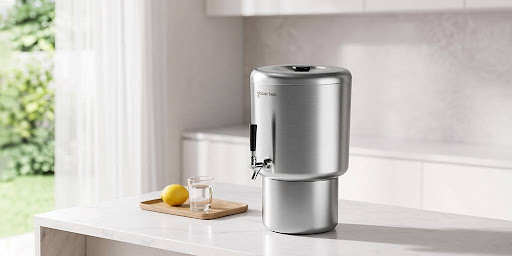
Stainless-steel models may appeal to buyers who prefer a metal exterior, while other materials may provide different advantages in weight, price, or visibility of the water level. Consider construction quality, seals, replacement-part availability, and the manufacturer’s warranty rather than focusing on appearance alone.
Check the product dimensions before buying to ensure that it fits comfortably on the intended countertop.
Calculate the Long-Term Cost
The purchase price does not represent the full cost of owning a filtration system. Replacement elements, cleaning supplies, shipping, and the expected service life of the product should also be considered.
Check how often filters need replacing and whether compatible replacements are readily available. The actual interval may depend on usage and incoming water quality, so follow the manufacturer’s guidance instead of assuming that every filter lasts for the same period.
Comparing long-term costs can help you choose a system that remains affordable after the initial purchase.
Understand Maintenance Requirements
Regular cleaning and timely filter replacement are essential for maintaining the system. Read the care instructions before buying to understand how the chambers, tap, and other components should be cleaned.
Use only compatible replacement filters and inspect the unit periodically for leaks or damage. Avoid using cleaning products that could harm the filtration elements or leave unwanted residues.
A well-maintained system is more likely to continue operating as intended, but maintenance cannot compensate for a filter that is unsuitable for the contaminants in your water.
Review the Manufacturer’s Information
Before making a final choice, read the product specifications, instructions, warranty terms, and replacement-filter information. Check whether the seller provides clear guidance about installation, initial preparation, and ongoing care.
Compare several models based on documented performance rather than relying solely on advertising claims or customer reviews. Reviews can provide useful information about convenience and usability, but they cannot independently establish that a filter removes a particular contaminant.
Conclusion
Choosing the right gravity filtration system begins with understanding your water quality, household consumption, and budget. A gravity water filter system can provide convenient countertop storage and filtration without electricity, but its suitability depends on verified performance and correct use.
When comparing a gravity fed water filter, examine filtration capabilities, capacity, construction, maintenance, and replacement costs. Taking time to assess these factors will help you select a system that fits your household and supports a more informed approach to drinking-water quality.