In modern industrial systems, data transmission has become just as important as power transmission. Many rotating devices, such as radar systems, medical imaging equipment, industrial robots, and communication platforms, require continuous rotation while maintaining stable and high-speed data communication.
Traditional slip rings have been widely used for transferring power and electrical signals between rotating and stationary components. However, as equipment becomes more intelligent and data-intensive, conventional electrical transmission methods may face limitations in bandwidth, signal interference, and long-distance communication.
This is where fiber optic rotary joints provide a new solution. By using optical technology instead of traditional electrical contacts, they enable faster, more reliable, and interference-resistant data transmission in advanced rotating systems.
The Limitations of Traditional Slip Rings
Slip rings remain an effective solution for many applications. They can transmit electrical power and various signals while allowing continuous rotation. However, with the increasing demand for high-speed communication, some applications require more advanced transmission technologies.
One of the biggest challenges is bandwidth limitation. Modern equipment often generates large amounts of data from sensors, cameras, and communication systems. Traditional electrical transmission methods may not always provide enough capacity for these high-speed data requirements.
Another challenge is electromagnetic interference (EMI). Electrical signals can be affected by surrounding electromagnetic environments, especially in complex industrial systems where multiple electronic components operate simultaneously.
For applications requiring large data volumes, long-distance transmission, or high signal stability, fiber optic technology provides significant advantages.
What Is a Fiber Optic Rotary Joint?
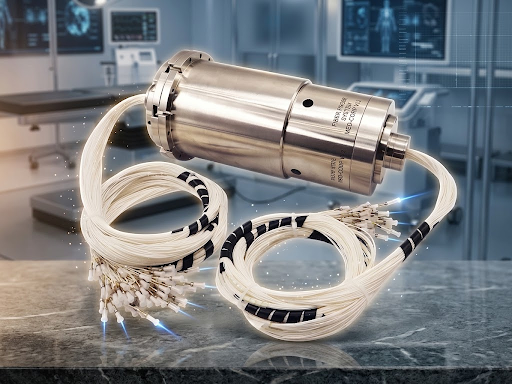
A fiber optic rotary joint, also known as a FORJ (Fiber Optic Rotary Joint), is a device that allows optical signals to pass between rotating and stationary components without interrupting continuous rotation.
Unlike traditional electrical slip rings that use conductive contacts, fiber optic rotary joints transmit information through optical fibers. This design enables high-speed data communication while maintaining stable performance during rotation.
A typical fiber optic rotary joint consists of precision optical components that maintain accurate alignment between rotating and fixed optical paths. This allows signals to transfer smoothly even during continuous movement.
Why Fiber Optic Rotary Joints Are Ideal for High-Speed Data Transmission
Higher Bandwidth for Large Data Transmission
One of the most important advantages of fiber optic rotary joints is their ability to support high-bandwidth communication.
Modern systems often require the transmission of:
- High-resolution video data
- Sensor information
- Communication signals
- Real-time monitoring data
Fiber optic technology can handle much larger data volumes compared with traditional electrical transmission methods, making it suitable for advanced equipment with increasing communication requirements.
Excellent Resistance to Electromagnetic Interference
Electromagnetic interference can affect signal quality in many industrial environments.
Because fiber optic rotary joints transmit data through light instead of electrical current, they are naturally resistant to electromagnetic interference. This makes them especially suitable for applications where signal accuracy and reliability are critical.
Industries such as radar, medical equipment, and communication systems often require stable transmission in environments with complex electromagnetic conditions.
Stable Performance During Continuous Rotation
Rotating equipment often operates continuously for long periods. Any interruption in signal transmission can affect system efficiency and reliability.
Fiber optic rotary joints are designed to maintain stable optical transmission during rotation. They help eliminate cable twisting problems and provide continuous communication between rotating and stationary parts.
This makes them an important component for systems that require uninterrupted operation.
Fiber Optic Rotary Joints vs Traditional Slip Rings
Traditional slip rings and fiber optic rotary joints both solve the challenge of transmitting signals during rotation, but they serve different application needs.
Electrical slip rings are commonly used for applications requiring power transmission or basic electrical signals. They are widely applied in automation equipment, machinery, and general rotating systems.
Fiber optic rotary joints are more suitable when applications require:
- High-speed data transmission
- Large communication capacity
- Long-distance signal transfer
- Strong resistance to electromagnetic interference
- High signal integrity
In some advanced systems, electrical slip rings and fiber optic rotary joints are even combined to provide both power transmission and high-speed optical communication.
Applications of Fiber Optic Rotary Joints
Radar and Antenna Systems
Radar and rotating antenna systems require continuous movement while transferring large amounts of data. Fiber optic rotary joints help maintain stable communication between rotating antenna components and stationary control systems.
Their high bandwidth and EMI resistance make them suitable for demanding communication environments.
Medical Imaging Equipment
Medical imaging systems require precise and reliable data transmission. Equipment such as imaging scanners often involves rotating structures that generate large amounts of information.
Fiber optic rotary joints help ensure stable transmission while supporting the high-speed data requirements of modern medical systems.
Industrial Automation and Robotics
Advanced automation systems rely on fast communication between sensors, controllers, and moving components.
Robotic systems, inspection equipment, and automated platforms can benefit from fiber optic rotary joints because they support continuous rotation without limiting data transmission performance.
Offshore and Marine Equipment
Offshore equipment often operates in challenging environments where reliability is critical.
Fiber optic rotary joints can support communication systems that require stable performance under demanding operating conditions, including vibration and continuous movement.
How to Choose the Right Fiber Optic Rotary Joint
Selecting the right fiber optic rotary joint depends on the specific requirements of the application.
Important factors include:
Fiber Type
Different systems may require single-mode or multimode fiber depending on transmission distance and communication requirements.
Number of Optical Channels
The required number of fiber channels depends on the amount of data and the complexity of the system.
Rotation Speed
The rotary joint design should match the expected operating speed to ensure stable performance.
Environmental Requirements
Applications exposed to dust, moisture, temperature changes, or harsh conditions may require customized protection designs.
Integration Requirements
Mechanical size, mounting structure, and connection methods should match the overall equipment design.
For specialized applications, working with an experienced fiber optic rotary joint manufacturer can help ensure the solution meets both technical and operational requirements.
The Future of Rotary Communication
As industries continue moving toward automation, intelligent systems, and high-speed communication, the demand for reliable rotary data transmission will continue to grow.
Fiber optic rotary joints provide an effective solution for overcoming the limitations of traditional electrical transmission. Their high bandwidth, strong EMI resistance, and stable performance make them increasingly important in advanced rotating equipment.
For systems that require continuous rotation and large-scale data transmission, fiber optic technology offers a more flexible and future-ready approach.
Conclusion
Traditional slip rings remain valuable for many applications, but the growing demand for faster and more reliable communication has created new challenges.
Fiber optic rotary joints provide a powerful alternative by enabling high-speed, stable, and interference-resistant data transmission in rotating systems.
From radar and medical equipment to industrial automation and offshore technology, fiber optic rotary joints are helping modern industries achieve more efficient and reliable communication.