Have you ever looked at the night sky and wondered whether other planets exist beyond our solar system? Our universe contains billions of stars, and many have planets orbiting around them. However, these distant worlds are incredibly difficult to see because they are small, faint, and hidden by bright starlight. Scientists use powerful telescopes and clever detection methods to discover these planets and learn what makes them unique.
What Are Planets Beyond Our Solar System?
Planets that exist outside our solar system are called exoplanets, or extrasolar planets. Unlike Earth, Mars, and Jupiter, these planets orbit stars other than our Sun. Some are rocky worlds, while others are enormous gas giants. Scientists study exoplanets to understand how planetary systems form and whether environments similar to Earth’s exist elsewhere.
Our Milky Way galaxy contains billions of stars, and researchers believe planets are extremely common. Some exoplanets orbit two stars, while others travel around small, cool stars called red dwarfs. Their temperatures, sizes, and orbital paths can differ greatly. These discoveries show that planetary systems are much more varied than scientists once imagined.
One famous discovery happened in 1995 when astronomers confirmed 51 Pegasi b, the first planet found orbiting a Sun-like star. Since then, scientists have identified thousands of additional exoplanets. Each discovery provides new information about the universe. Researchers now use several detection techniques to locate worlds that are otherwise invisible from Earth.
Why Is Finding New Planets So Difficult?
The greatest challenge in finding distant planets is their enormous distance from Earth. Even nearby stars are trillions of kilometers away, making their planets extremely difficult to observe. Most exoplanets produce little or no visible light of their own. Instead, they reflect light from their host stars, which makes them especially faint.
Another problem is the brightness of stars compared with their surrounding planets. A star can shine millions or billions of times brighter than a nearby planet. This overwhelming light makes direct observation difficult, even through advanced telescopes. Scientists must often detect tiny changes in starlight rather than observe the planet itself.
Planetary movement creates another challenge because planets constantly travel around their stars. Their orbital periods may last days, months, or even many years. Some detection methods only work when the planet moves into a favorable position. Astronomers therefore gather observations over long periods and carefully examine the results before announcing discoveries.
How Does the Transit Method Help Scientists Find Planets?
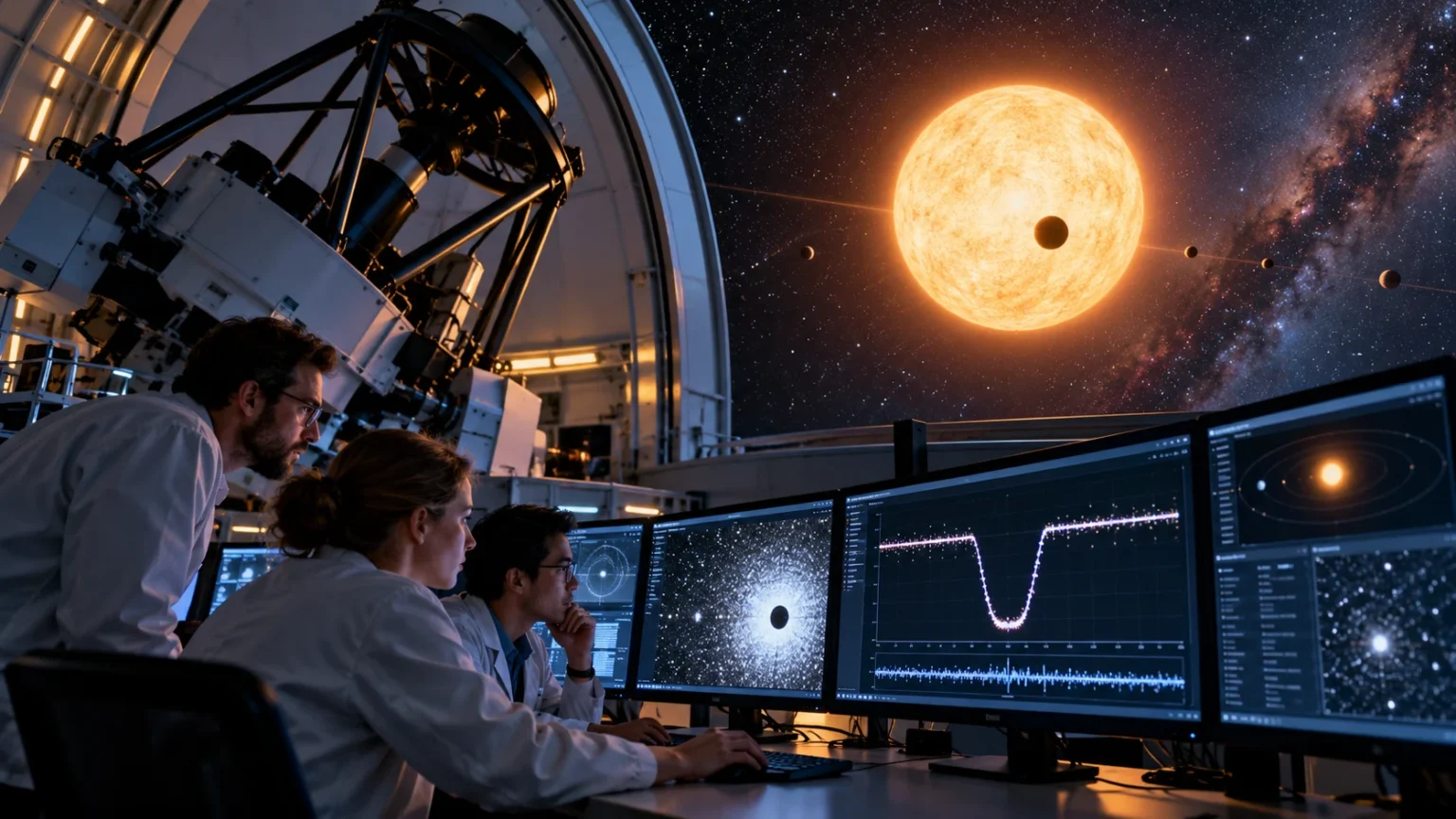
The transit method is one of the most successful techniques for discovering planets beyond our solar system. It works when a planet passes directly between its star and an observing telescope. During this event, the planet blocks a small amount of starlight. Scientists measure this temporary decrease in brightness to identify possible exoplanets.
Astronomers create a graph called a light curve to track changes in a star’s brightness. When similar dips happen at regular intervals, they may indicate an orbiting planet. The time between these events helps researchers calculate its orbital period. The amount of blocked light also provides valuable information about the planet’s size.
However, the transit method has an important limitation because the planet’s orbit must align with our viewing direction. Many planets never pass in front of their stars from Earth’s perspective. Other events can also produce similar brightness changes. Scientists therefore examine repeated signals and use additional observations to confirm whether a planet exists.
How Do Scientists Detect Planets Using the Radial Velocity Method?
The radial velocity method detects planets by measuring tiny movements in their host stars. A planet’s gravity pulls on its star, causing both objects to move around a shared center of mass. This creates a small stellar wobble that scientists can measure. Even an unseen planet can reveal its presence through this movement.
Astronomers study changes in the wavelengths of light coming from a star. When the star moves slightly toward Earth, its light shifts toward shorter wavelengths. When it moves away, the wavelengths become longer. This effect is called the Doppler shift, and it helps scientists detect the movement caused by an orbiting planet.
The radial velocity method also helps researchers estimate a planet’s mass. Larger planets usually create stronger gravitational effects, making them easier to detect. When combined with transit observations, this technique can help scientists calculate a planet’s density. That information provides clues about whether the distant world is rocky or rich in gas.
How Do Space Telescopes Discover New Planets?
Space telescopes play an important role in the search for exoplanets because they operate above Earth’s atmosphere. This allows them to observe stars without interference from clouds or atmospheric turbulence. They can measure extremely small changes in brightness. These precise observations help scientists discover planets that might be missed by ground-based instruments.
NASA’s Kepler space telescope transformed exoplanet research by observing the brightness of thousands of stars. Its mission showed that planets are common throughout the galaxy. Kepler discovered planets of different sizes and orbital distances. Its findings also helped astronomers understand how frequently small planets occur around distant stars.
The Transiting Exoplanet Survey Satellite, known as TESS, continues searching for planets around bright, relatively nearby stars. Meanwhile, the James Webb Space Telescope helps scientists study selected exoplanets in greater detail, especially their atmospheres. Different telescopes serve different purposes. Together, they help researchers discover planets and investigate their physical characteristics.
How Does Direct Imaging Allow Scientists to See Exoplanets?
Direct imaging is a detection method that captures actual light coming from a planet. Unlike transit or radial velocity observations, it attempts to separate the planet’s light from its host star. This is extremely difficult because stars are so bright. Astronomers use specialized instruments to reduce the overwhelming glare and reveal faint planetary objects.
One important instrument is called a coronagraph, which blocks much of the star’s light. Advanced imaging systems also correct distortions that would otherwise hide faint objects. These technologies make it easier to observe large planets that orbit far from their stars. Young gas giants are especially useful targets because they can still emit considerable heat.
Direct imaging can reveal information about a planet’s position, brightness, and atmosphere. By examining light at different wavelengths, scientists may estimate its temperature and identify certain atmospheric substances. However, directly photographing smaller Earth-like planets remains extremely challenging. Future telescope improvements may allow astronomers to study more distant rocky worlds using this technique.
What Is Gravitational Microlensing in Planet Detection?
Gravitational microlensing is a fascinating technique that uses gravity to discover distant planets. According to Einstein’s theory of general relativity, massive objects bend the path of nearby light. When one star passes in front of a more distant star, its gravity can magnify the background light. Scientists observe these temporary brightness increases to investigate possible planetary systems.
If the closer star has a planet, the planet’s gravity can create an additional change in the magnified light. Astronomers study this unusual pattern to identify the planet’s presence. The event may last only a short time, making careful observations essential. Microlensing can reveal planets that other detection techniques struggle to find.
One advantage of gravitational microlensing is its ability to detect planets far from their host stars. It can also help discover planets that travel through space without orbiting a star. These objects are sometimes called rogue or free-floating planets. However, microlensing events rarely repeat, which makes follow-up studies particularly challenging.
How Does Astrometry Reveal Hidden Planets?
Astrometry involves measuring the precise position and movement of stars across the sky. A planet’s gravitational pull causes its host star to shift slightly as both objects orbit their shared center of mass. These changes can be extremely small. By recording stellar positions over time, astronomers can search for patterns that suggest an unseen planet.
Unlike the radial velocity method, which measures motion toward or away from Earth, astrometry tracks movement across the sky. This difference allows scientists to investigate planetary systems from another perspective. Accurate measurements can provide information about orbital shape and orientation. In suitable cases, astrometry can also help determine a planet’s true mass.
The European Space Agency’s Gaia mission has collected highly precise measurements of stellar positions and movements. Such information supports research into stars and their possible planetary companions. Detecting planets through astrometry requires exceptional accuracy and careful analysis. As measurement techniques improve, this method may reveal more planets with wide orbits.
How Do Scientists Confirm That a New Planet Exists?
Finding an unusual signal does not automatically prove that scientists have discovered a planet. Other astronomical events can produce similar observations. For example, two stars passing in front of one another may create brightness changes that resemble planetary transits. Researchers must investigate alternative explanations before identifying a signal as a genuine exoplanet.
Astronomers often begin by observing the suspected planetary system several times. They examine whether the signal repeats consistently and matches the expected movement of a planet. Additional telescopes may collect different types of measurements. Combining transit data with radial velocity observations is particularly useful because the methods provide complementary information.
Scientists also study the host star to understand its size, temperature, and activity. These characteristics influence how planetary observations should be interpreted. Some candidates are confirmed through detailed measurements, while others can be statistically validated after competing explanations are ruled out. Careful verification ensures that published exoplanet discoveries are scientifically reliable.
How Do Scientists Learn About Exoplanet Atmospheres and Temperatures?
Discovering a planet is only the beginning of understanding its characteristics. Scientists also want to know its temperature, composition, and possible atmospheric conditions. They examine how light interacts with the planet and its surroundings. These measurements provide clues about distant environments without requiring spacecraft to travel directly to those worlds.
One important technique is transmission spectroscopy, which studies starlight passing through a planet’s atmosphere during a transit. Different gases absorb particular wavelengths of light. By measuring these changes, scientists can search for atmospheric substances such as water vapor, carbon dioxide, and methane. However, detecting these gases does not automatically mean that life exists.
Researchers also estimate planetary temperatures using information about the host star and orbital distance. A planet close to a hot star may receive intense radiation, while a distant world receives less energy. Atmospheric properties can strongly affect the actual temperature. Scientists therefore combine several measurements and models to develop a clearer understanding.
What Is the Habitable Zone and Why Does It Matter?
The habitable zone is the region around a star where temperatures might allow liquid water to exist on a planet’s surface. Its location depends largely on the star’s energy output. Around cooler stars, this region lies closer to the star. Around hotter stars, it generally extends farther away.
Scientists consider the habitable zone important because liquid water is essential for life as we know it. However, a planet must meet additional conditions to support a potentially habitable environment. Its atmosphere, surface pressure, and other characteristics are also important. Being located within the habitable zone does not guarantee that a planet contains water or life.
Astronomers study potentially habitable exoplanets to understand how Earth-like environments may develop elsewhere. They investigate planetary size, stellar radiation, and possible atmospheric conditions. Some planets may experience intense stellar activity that makes their environments difficult to sustain. These factors help scientists decide which distant worlds deserve further investigation.
What Are the Biggest Discoveries in Exoplanet Research?
One of the most important findings in modern astronomy is that planets appear to be extremely common. Scientists have discovered worlds orbiting many different types of stars. Some planetary systems contain several planets packed into surprisingly small orbits. Others feature enormous gas giants located much closer to their stars than Jupiter is to the Sun.
Astronomers have also discovered unusual planetary categories that are absent from our solar system. Super-Earths are planets more massive than Earth but less massive than Neptune. Mini-Neptunes are generally smaller than Neptune and often have substantial gaseous envelopes. Studying these worlds helps scientists explore how planets form and evolve under different conditions.
The discovery of systems such as TRAPPIST-1 has also generated significant scientific interest. This system contains seven known Earth-sized planets orbiting a small, cool star. Several receive amounts of stellar energy that make them interesting targets for habitability research. Such discoveries demonstrate how much remains to be learned about planetary systems.
How Will Future Technology Improve the Search for Exoplanets?
New telescope technology promises to make exoplanet discoveries more detailed and reliable. Scientists are developing instruments capable of detecting smaller changes in starlight and measuring fainter planetary signals. Improved sensors and observation systems can increase precision. These advances may make it easier to identify Earth-sized planets around distant stars.
Future space observatories will also investigate planets using advanced imaging and spectroscopy. NASA’s Nancy Grace Roman Space Telescope is designed to support exoplanet research, including microlensing surveys and coronagraph technology demonstrations. Other proposed missions aim to study potentially Earth-like worlds. Their success could expand our knowledge of planetary populations and atmospheric conditions.
Advanced computer systems also play a growing role in analyzing enormous astronomical datasets. Machine learning tools can help researchers identify unusual signals and prioritize promising planet candidates. However, automated findings still require scientific testing and verification. Combining better instruments with careful data analysis will help astronomers explore more distant planetary systems.
Why Is Finding Planets Beyond Our Solar System Important?
Studying exoplanets helps scientists understand whether our solar system is typical or unusual. By comparing different planetary systems, researchers can investigate how planets form around young stars. They can also study why some worlds develop rocky surfaces while others become gas giants. These comparisons improve scientific theories about the history of planets.
Exoplanet research also supports the search for environments that might sustain life. Scientists examine planetary temperatures, atmospheric chemistry, and orbital conditions to identify promising targets. No confirmed evidence of extraterrestrial life has emerged from these studies. Nevertheless, studying distant worlds helps researchers understand what conditions might make life possible.
The search also encourages technological progress in astronomy and related sciences. Developing precise instruments requires advances in optics, computing, and measurement techniques. Each discovery raises new questions about the universe and our place within it. As research continues, the growing number of known exoplanets will provide opportunities for future scientific exploration.
Conclusion
Scientists find new planets beyond our solar system by studying tiny changes in starlight, stellar movement, and gravitational effects. Techniques such as transits, radial velocity, direct imaging, microlensing, and astrometry reveal worlds that are otherwise extremely difficult to observe. Each method provides different information about distant planetary systems.
Advanced observatories, including Kepler, TESS, and the James Webb Space Telescope, have greatly improved our understanding of exoplanets. Researchers can now investigate planetary sizes, masses, temperatures, and atmospheric conditions. These discoveries show that planets exist in remarkable variety throughout our galaxy.
The search for new planets continues to expand our understanding of the universe. Future technologies may help astronomers identify smaller worlds and study their environments more closely. Although many questions remain unanswered, every carefully confirmed discovery brings scientists closer to understanding the diversity of planets beyond our solar system.
Frequently Asked Questions
How do scientists find planets outside our solar system?
Scientists use several detection techniques, including the transit method, radial velocity measurements, direct imaging, gravitational microlensing, and astrometry. Most methods identify changes in starlight or stellar movement caused by orbiting planets.
Can scientists actually see planets around other stars?
Yes, scientists can directly image certain exoplanets using specialized telescopes and instruments that reduce starlight. However, most distant planets are discovered indirectly because they are too faint or close to their stars to photograph.
What is the easiest method for finding exoplanets?
The transit method is one of the most productive exoplanet detection techniques. It identifies small, repeated decreases in a star’s brightness when an orbiting planet passes in front of it.
How far away are planets outside our solar system?
Exoplanets exist at many distances, ranging from a few light-years away to thousands of light-years or more. Their enormous distances make advanced telescopes and sensitive measurement techniques essential for discovering them.
Have scientists discovered another planet exactly like Earth?
Scientists have identified Earth-sized planets and worlds located within their stars’ habitable zones. However, no exoplanet has been confirmed to match Earth in every important way or to support life.