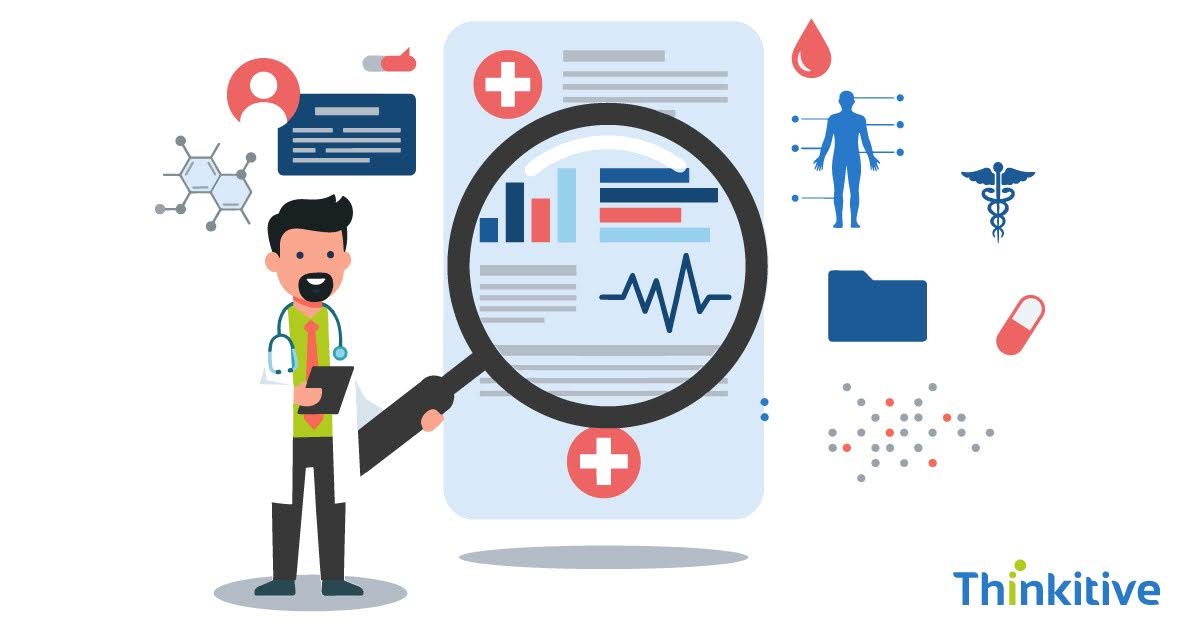
Healthcare organizations are sitting on a goldmine of data. In fact, nearly 30% of the world’s data volume is generated by healthcare.
Now, providers have access to more information than ever before. For example, from patient histories and lab results to imaging records and medication data. Still, despite this abundance of data, better outcomes do not automatically follow.
The simple reason here is that data by itself does not drive decisions. Clinicians are more likely to struggle with identifying patterns, predicting risks, or acting quickly at the time of intervention, when critical information is scattered across reports, dashboards, and EHR records.
As healthcare becomes increasingly complex, organizations need a strategic way to turn raw information into insights that can not only support patient care but also operational performance. This shift further pushes providers to look beyond traditional reporting and focus on intelligence that can guide real-world actions.
And this is exactly where custom EHR and EMR software development starts to make a difference. Through modern EHR software development, organizations can incorporate advanced analytics capabilities that extract actionable insights from EHR data, helping transform scattered information into meaningful guidance for clinicians, administrators, and care teams.
Let’s explore how custom EHR analytics help healthcare organizations convert data into valuable clinical insights and drive more informed care delivery.
Why Traditional EHR Reporting Falls Short
Even after having more data than ever before, many organizations still struggle a lot to turn that information into better decisions.
Have you ever wondered why?
Well, the common answer is the limitations of traditional EHR reporting. Even though most EHR systems come with built-in reports and dashboards, these tools are often designed to provide basic information instead of meaningful insights.
One of the major challenges is that standard reports are not built around the specific needs of a healthcare organization. They typically offer a fixed set of metrics and charts, leaving little room to explore data in ways that matter most to a specific practice, specialty, or care team.
If providers want to look deeper into patient populations, treatment outcomes, or operational performance, they often hit a wall.
Traditional reporting also tends to focus on what has already happened instead of what might happen next. Even though reports show how many patients visited the clinic last month, it is less likely to identify patients who are at high risk of complications or highlight care gaps that need quick attention. Ultimately, key opportunities to improve care can slip through the cracks.
Along with this, another key challenge is that healthcare teams can easily become overwhelmed by large volumes of information. Finding measurable insights without the right tools to organize and interpret data can feel like looking for a needle in a haystack. In simple terms, the data is there, but turning it into action is another story.
And due to this, many organizations started to move beyond standard reporting and invest in analytics solutions tailored to their workflows, goals, and patient populations. These tools can help to uncover the insights that drive better clinical and operational decisions, rather than simply showing data.
How Custom EHR Analytics Transform Data into Clinical Insights
Traditional EHR reports can show what happened, but they fail to explain what actually needs attention next. By helping providers to turn everyday healthcare data into insights they can actually see, custom analytics helps to fill that gap.
Custom analytics bring data from different systems into one place, which is one of its major advantages. Providers can get a more complete view of both patients and operations, rather than switching between EHRs, lab systems, billing platforms, and other tools.
Custom analytics also power real-time clinical decision support systems, which further give providers useful information when they need it the most. For example, a clinician can receive an alert about a potential drug interaction, a missed screening, or abnormal results while the patient is still in the office. This helps them to intervene quickly, while avoiding any serious complications.
Population health data visualization is another important capability. Easy-to-understand dashboards help care teams track trends across patient groups, identify care gaps, and see which populations need extra attention. Rather than getting lost in spreadsheets, they can quickly spot what actually matters the most.
To identify high-risk patients earlier, custom analytics are also valuable. Providers can recognize warning signs earlier and reach out before a condition worsens by analyzing patterns in patient data. This is a practical example of extracting actionable medical data from an EHR system.
Imagine a primary care practice caring for thousands of patients with chronic conditions. Rather than waiting for hospital admissions or emergency visits to reveal a problem, the care team can use analytics dashboards to identify at-risk patients, prioritize follow-ups, and intervene earlier. The data is the same, but the outcome is different because the insights arrive when they can still make a difference.
Key Benefits for Healthcare Organizations
The point of all this is not technology for its own sake. It is what better insight delivers to the organization and its patients.
-
Improved patient outcomes and quality of care
When clinicians can see risks early and act on clear guidance, care gets more proactive. Understanding how custom EHR analytics improve patient outcomes comes down to this: better-timed decisions lead to fewer missed problems and better follow-through on care.
-
Better population health management
Analytics make it realistic to manage whole populations, not just the patient in front of you. Teams can target outreach, close care gaps systematically, and measure whether their efforts are working.
-
More informed decision-making
Both clinical and administrative leaders make stronger decisions when they are working from accurate, consolidated data. Staffing, scheduling, resource planning, and care strategy all improve when they rest on real evidence rather than guesswork.
-
Enhanced efficiency and resource utilization
Good analytics highlight where time and resources are being lost — bottlenecks in the schedule, underused capacity, redundant testing. Fixing those issues frees clinicians to spend more time on care and less on administrative drag. Over time, those operational gains compound into real revenue and capacity improvements, which is why decision-makers increasingly view analytics as a growth lever rather than just a clinical tool.
The Future of Analytics-Driven Healthcare
Where this is heading is clear, and it is moving quickly. Healthcare predictive analytics platforms are becoming central to how forward-looking organizations operate. Rather than only describing what already happened, predictive models help anticipate what is likely to happen next — who may be readmitted, which patients may miss appointments, and where demand is building.
That shift supports a move from reactive to proactive and personalized care. When a team can reasonably anticipate a patient’s needs, they can intervene earlier and tailor care to the individual rather than treating everyone the same. The result is care that feels less like firefighting and more like genuine management of health over time.
Artificial intelligence and advanced analytics are accelerating this trend, helping surface patterns in large datasets that humans simply cannot review manually. These tools work best as support for clinical judgment, not a replacement for it — the clinician stays in charge, with better information at hand.
All of these points point to a practical reality: analytics-ready EHR systems are becoming a competitive advantage. Organizations succeeding in value-based care and quality programs increasingly depend on knowing their data deeply. Those who can turn information into insight are better positioned to grow, while those stuck with static reports fall behind. This is why many organizations are now treating analytics as a core requirement when they invest in custom EHR development, rather than something to add on later.
Conclusion
The organizations that win in modern healthcare will not necessarily be the ones with the most data — they will be the ones that turn that data into action. As we have seen, raw information has little value on its own. Its worth comes from being consolidated, understood, and delivered to the right person at the right moment, where it can shape a real decision about care or operations.
Often supported through bespoke EHR development and customizable EHR solutions, these tailored systems align with actual workflows, helping providers catch risks early, manage populations effectively, use resources wisely, and prepare for a future built on proactive, data-driven care.
In a field where better decisions save lives and strengthen the bottom line, the ability to see clearly is hard to overstate.
Frequently Asked Questions
- What are custom EHR analytics and how do they differ from standard reporting tools?
Custom EHR analytics are tailored to an organization’s specific workflows and questions, while standard reporting offers fixed, generic dashboards. Custom solutions consolidate more data sources and surface actionable insights rather than static counts.
- How can EHR analytics improve patient outcomes?
By identifying risks and care gaps early and delivering guidance at the point of care, analytics help clinicians intervene sooner, follow through more consistently, and make better-informed decisions for each patient.
- What is the role of real-time clinical decision support systems in healthcare?
Real-time clinical decision support systems present relevant prompts—like alerts, reminders, or recommendations—to providers during care, so insights arrive in time to influence the decision rather than after the fact.
- How do healthcare organizations use predictive analytics to identify patient risks?
Predictive analytics combine clinical and operational signals to estimate which patients are most likely to face issues such as readmission or deterioration, helping teams prioritize outreach and intervene proactively.
- What types of insights can be generated from EHR data?
EHR data can reveal patient risk levels, care gaps, population health trends, utilization patterns, quality measure performance, and operational bottlenecks — supporting both clinical and administrative decisions.
- How does population health data visualization support care management?
It lets care teams see trends across entire patient groups, making it easier to spot widening gaps, track chronic-disease cohorts, target outreach, and measure whether interventions are working.
- Can custom EHR analytics help healthcare organizations succeed in value-based care programs?
Yes. Value-based care depends on understanding and improving outcomes across populations, and tailored analytics help organizations track quality measures, manage risk, and demonstrate results.
- What should healthcare providers consider when implementing advanced EHR analytics solutions?
Key considerations include data integration across systems, data quality, alignment with clinical workflows, security and HIPAA compliance, usability for busy clinicians, and how insights will actually drive action.