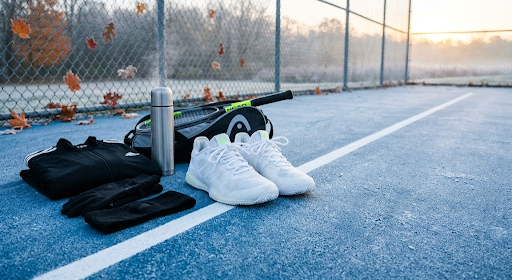
Why On Tennis Shoes Belong in Your Cold-Weather Bag
Cold mornings test your commitment more than your backhand. The court feels harder, your fingers go numb, and the couch starts to look like a smart plan. Still, you can play all year if your gear does its job. That’s where on tennis shoes help. They’re light, they’re cushioned, and they’re clean enough to wear from the court straight to the street, which matters when you’d rather not carry a second pair in freezing weather. I’m not claiming any shoe turns a frosty court into July. It won’t. But the right pair plus smart layers keeps your legs loose, and loose players pick up fewer injuries. Here’s a plain plan for October through February, built around real court problems like stiff muscles, damp leaves, and numb toes. Grab a pen, because you’ll want to jot down a few checks for your own bag.
What Cold Air Does to Grip and Bounce
Cold changes the game in two quiet ways. First, rubber gets harder as the temperature drops, so an outsole that felt sticky in August can feel slippery at 4°C. Second, the ball loses energy. It bounces lower and travels slower, so you have to bend your knees more and move your feet earlier. Many players blame their strokes when the real cause is the air. Then there’s the surface itself. Morning dew freezes into a thin glaze on shaded corners, and wet leaves hide under the fence like banana peels. Hard courts hold water in tiny dips, so walk the baseline before you play. If you see a shiny patch, avoid it during rallies. On clay, cold makes the surface heavy and sticky, which slows sliding. Also, keep your shoes inside the car cabin on the drive, not in the trunk. A shoe that sat in a freezing trunk feels like a board for the first ten minutes, and that stiffness is when ankles get twisted.
A Six-Minute Warm-Up for Stiff Legs
Cold muscles need more time, so double your usual warm-up and keep your warm layer on for it. Here’s the routine I use before every winter match:
- Walk briskly around the court for two minutes with your hoodie on.
- Do ten slow bodyweight squats, pausing at the bottom to loosen your hips.
- Swing your racket in easy circles and then add ten shadow forehands.
- Add side shuffles along the baseline, three lengths each way.
- Hop lightly on each foot for twenty seconds to wake up your calves.
- Hit mini-tennis from the service line, and only then move back.
Don’t skip step five. Cold calves are the most common source of that sudden tight feeling halfway through the first set.
Choosing On Tennis Shoes for Damp, Chilly Courts
Now think about the shoe. You want a firm, secure fit, a tread that clears wet grit, and a platform that doesn’t feel like concrete when it’s cold. If you’re browsing, the full range of on tennis shoes includes the Roger Pro line and the Roger ADV Z5, which the listing describes as a hybrid made for both court use and everyday wear. That second part matters in winter, because you’ll probably wear the shoe more often off court than on it. The page also lists a 30-day wear trial, so read the terms and test a pair at home on a cold day. Here’s my honest limit: these shoes use mesh uppers, and mesh lets in cold air and water. They aren’t rain shoes, and no pair grips ice or wet leaves well. If the court looks glazed, stay home. I’d also size up half a size only if you plan to wear thick socks, since too much room hurts lockdown more than the cold does.
Your Three-Layer Kit
Layering beats one thick coat because you can peel pieces off in seconds. Think base, middle, and outer:
- Base: a thin synthetic or merino top that moves sweat away from your skin.
- Middle: a hoodie or fleece you can wear during warm-up and drop at the first changeover.
- Outer: a light windbreaker or vest for wind, which cools you faster than low temperatures alone.
- Bottoms: joggers to pull over shorts between games, or leggings under shorts if it’s near freezing.
- Extras: thin gloves, a headband to cover your ears, and a small towel for your racket handle.
Avoid cotton as your base layer. It holds sweat and then turns icy the moment you stop moving. Cotton is fine for the middle layer because you’ll take it off before the rallies get long.
Tracksuits and Hoodies for Changeovers
A tracksuit does something nothing else does: it keeps your legs and torso warm in one grab. A matching set from nofs, the German streetwear label, pairs a hoodie and jogger in the same design, which means you dress in one step instead of two. On the shop’s front page I saw sets in grey, black, burgundy, and blue at around €130, described as oversized fits. That roomy cut helps, since you can pull it over layers without feeling trapped. The catch is weight. A heavy cotton set holds sweat, so it’s for warm-ups and breaks, not rallies. It also gets damp quickly if you leave it on a wet bench. Hang it on the fence or keep it in your bag between sets. Before you buy, check the size chart on each product page, because boxy cuts run big.
Socks, Laces, and Other Small Fixes
Small things decide whether a cold session feels fine or miserable. Choose wool-blend socks, because they stay warm even when they get damp. Skip two pairs stacked on top of each other, since that cuts circulation and makes toes colder, not warmer. Laces stiffen in freezing air and can slip, so double-knot them and tuck the ends under the lace cage. If your shoes fog up inside after you walk in from the car, loosen the laces for a minute and let the heat out. Also, carry a spare pair of dry socks in a zip bag. Changing them after a wet warm-up takes thirty seconds and saves your whole afternoon. If your toes still go numb, a slightly thicker insole can add warmth without squeezing the foot.
Drying and Storing Gear After a Cold Session
Winter sessions leave gear damp, so dry it properly. Pull the insoles out, loosen the laces, and let the shoes air-dry at room temperature. Don’t put them on a radiator, because strong heat bends glue and shrinks materials. Stuff the toe area with crumpled paper to soak up moisture, and change the paper after an hour. Wash your hoodie and joggers inside out on a cool, gentle cycle, and skip the dryer, since heat cracks prints and stretches cuffs. Store the puffer vest or windbreaker flat or on a hanger so the fill doesn’t clump. A quick wipe of the outsole removes grit that would otherwise slick the next court.
Final Words
Cold-weather tennis works when you respect the cold instead of fighting it. Warm up longer, choose a secure shoe, and layer so you can adjust in seconds. Then keep one dry set of clothes in your bag for after the match. You’ll play more often, and you’ll enjoy the sessions that used to feel like chores.
FAQs
- Can I play tennis in winter with regular tennis shoes?
Yes, if the court is dry and clear. Skip play on icy or wet-leaf surfaces, since no shoe grips those well. - Do tennis balls play differently in the cold?
Yes. They bounce lower and travel slower, so bend your knees more and start moving earlier. - How long should my winter warm-up be?
Aim for about ten minutes, which is roughly double a summer routine, and keep your warm layer on for it. - Is a cotton hoodie good for tennis in cold weather?
It’s fine for warm-up and changeovers. Take it off before long rallies, because it holds sweat. - How do I dry wet tennis shoes quickly?
Remove the insoles, stuff the toes with paper, and air-dry at room temperature. Avoid radiators and hair dryers.