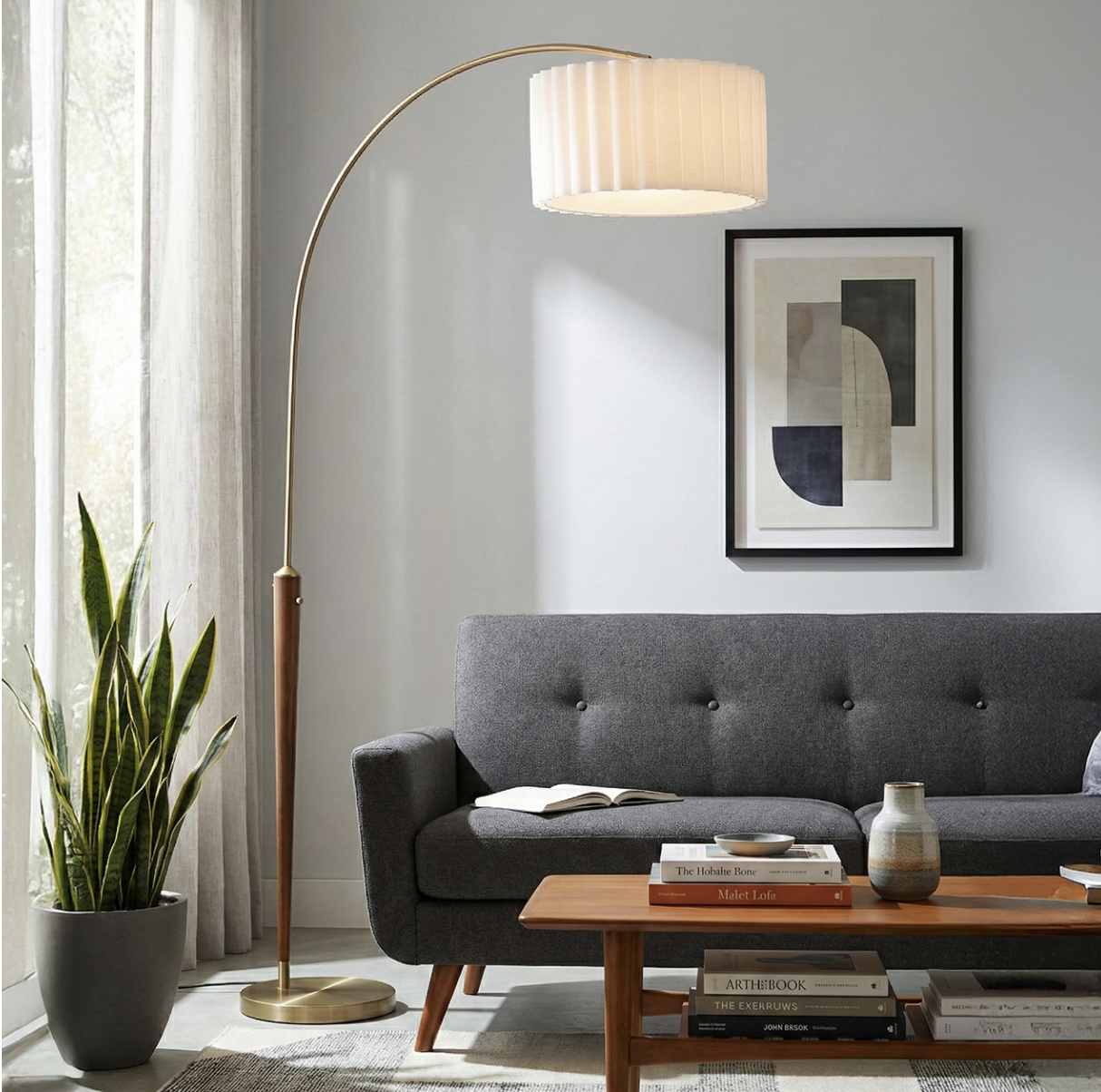
A modern floor lamp does more work than most homeowners give it credit for. It fills a dark corner, anchors a seating area, and replaces the harsh overhead glare that makes a living room feel like an office. At Nova of California, we have spent close to a century building lighting from wood, metal and glass, so we have seen which lamps actually hold up in real homes and which ones fall apart after a year. This guide walks you through everything that matters before you buy, from sizing math to bulb temperature, so the lamp you pick actually fits your room and your life.
What Makes a Floor Lamp “Modern” in 2026
The word modern gets thrown around loosely in furniture listings, so it helps to define it. A modern floor lamp typically favors clean geometric lines, minimal ornamentation, and materials like brushed steel, matte black metal, walnut, or frosted glass. Think slim torchieres, sculptural tripod bases, and arc lamps with a single sweeping arm. The style sits apart from traditional lamps, which lean on ornate bases and fabric shades with trim or fringe.
For 2026, three threads run through the category. First, sculptural minimalism, where the lamp itself reads as a small piece of furniture. Second, warm dimmable light replacing the stark white bulbs of a decade ago. Third, smart compatibility, so a lamp can sync with your existing home automation setup without an electrician.
Why the Right Floor Lamp Changes a Room
Ceiling lights spread brightness evenly across a room, which sounds useful but often makes the space feel flat and clinical. A floor lamp concentrates warm light exactly where you need it, in a reading corner, beside a sofa, or behind an armchair. Designers commonly recommend layering at least three light sources in any living space: ambient, task, and accent. A floor lamp can cover one or two of those layers on its own, which is part of why it earns its spot in nearly every well-lit room.
There is also a practical case. Most apartments and older homes were not built with overhead fixtures in every room, and rewiring for a pendant or chandelier costs real money. A floor lamp solves that instantly. Plug it in, position it, done.
How to Choose the Right Size Modern Floor Lamp
Size mistakes are the most common buying error we see. A lamp that towers over your sofa or disappears next to a tall bookshelf throws off the entire room’s proportions.
The eye-level rule is the simplest fix. Sit in the chair or sofa where the lamp will live, then measure from the floor to your eye height while seated. The bottom of the shade should sit at or just below that line. This keeps the bulb out of your direct sightline and avoids glare while you read or relax.
Standard heights run from 58 to 65 inches for most living room and bedroom lamps, though torchieres can reach higher. Arc lamps need extra clearance math, since the arm extends outward, not just up. Measure the horizontal reach from the base to where the shade hangs, and confirm it clears your sofa back or coffee table without crowding the walking path.
Room scale matters too. A 6-foot lamp can swallow a small reading nook, while a slim 28-inch accent lamp gets lost in a great room with 10-foot ceilings. Match the lamp’s visual weight to the furniture around it, not just the floor space available.
Understanding Lumens, Wattage, and Light Color
This is the section most buying guides skip, yet it determines whether your new lamp actually feels good to live with.
Lumens measure brightness, not wattage. For general ambient lighting in a living room, aim for a combined output of 1,000 to 2,000 lumens from the lamp plus any other fixtures in the room. A single floor lamp built for ambient use typically outputs 450 to 800 lumens. A dedicated reading lamp should hit closer to 800 to 1,100 lumens, since focused tasks demand more concentrated light.
Kelvin temperature determines color, and it changes how a room feels more than people expect. Bulbs in the 2700K to 3000K range produce a soft, warm yellow glow that suits living rooms and bedrooms. The 3000K to 4000K range reads as neutral white, useful for home offices or kitchens where you want clarity without starkness. Anything above 4000K skews blue and cool, which rarely flatters a residential living space.
Wattage is a ceiling, not a target. Every lamp lists a maximum wattage rating on its socket. Exceeding it risks overheating the fixture and shortening bulb life. LED bulbs solve most of this anxiety since they draw a fraction of the wattage that incandescent bulbs need for the same brightness.
Floor Lamp Types and Where Each One Works
| Lamp Type | Best For | Light Style | Typical Height |
| Arc Lamp | Sofas, sectionals, dining tables | Overhead-style downlight | 75–85 inches (arm extended) |
| Torchiere | Bedrooms, small living rooms | Indirect, bounced off ceiling | 58–72 inches |
| Tripod Lamp | Corners, reading nooks | Soft ambient or directional | 50–65 inches |
| Task/Reading Lamp | Beside armchairs, desks | Focused, adjustable beam | 40–60 inches |
| Tree/Multi-Head Lamp | Open-plan rooms, offices | Layered, multi-directional | 60–70 inches |
An arc lamp solves a specific problem: it delivers overhead-style light over a sofa or sectional without any wiring or drilling. The long arm stretches up and over, so the shade hangs directly above the seating area. The tradeoff is floor footprint, since the base needs enough weight and width to stay stable under that horizontal reach.
A torchiere points its light upward, bouncing it off the ceiling for a soft, diffused glow. It works especially well in bedrooms or small apartments where you want gentle ambient light without a visible bulb or harsh downward beam.
A tripod lamp brings sculptural presence to a bare corner. The three-legged base reads as a design object even when the lamp is switched off, which is part of why it has become a staple in Scandinavian and Japandi-style interiors.
Materials and Finishes That Define a Modern Look
Material choice carries as much design weight as the silhouette itself. Brushed steel and matte black metal deliver a cleaner, more industrial edge and pair naturally with leather and glass furniture. Walnut and oak bases bring warmth and a mid-century modern feel, especially when paired with linen or rattan shades. Marble bases add visual heft and a quiet sense of luxury, though they increase the lamp’s overall weight, which actually helps with stability.
Shade material changes how the light itself reads in a room. Linen and cotton shades diffuse light into a soft, even glow. Frosted or opal glass produces a cooler, more architectural look. Woven rattan or raffia shades cast dappled, textured shadows that add warmth to boho or coastal interiors.
Smart Features Worth Considering
Dimmable lamps have moved from a luxury feature to a near-standard expectation. A built-in dimmer or touch control lets you shift from bright task lighting during the day to a softer evening glow without swapping bulbs.
Smart bulb compatibility is the other feature worth checking before purchase. Many modern floor lamps work with standard smart bulbs through Alexa, Google Home, or Apple Home, controlled through a smart plug rather than built-in hardware. This route tends to be more affordable than buying a lamp with proprietary smart technology baked in, and it gives you the flexibility to upgrade the bulb independently of the fixture.
Safety and Certification Checks
A lamp that looks great but is not properly certified is not worth the risk. Look for UL or ETL certification on any lamp you are considering, which confirms the wiring and components meet recognized safety standards. If you plan to use the lamp anywhere near moisture, such as a covered patio or bathroom, check for a damp-rated or wet-rated UL listing specifically, since standard indoor ratings do not cover those conditions.
Base weight matters for safety as much as for aesthetics. A lightweight lamp with a tall, top-heavy shade is a tipping hazard, especially in homes with kids or pets. Marble, weighted steel, or wide tripod bases solve this far better than a slim pole on a small circular foot.
What a Modern Floor Lamp Should Cost
Budget-tier modern floor lamps typically run $50 to $150 and use basic steel or painted metal construction with standard fabric shades. This range works fine for renters or anyone furnishing a first apartment, though the materials rarely hold up to decades of daily use.
Mid-range lamps land between $150 and $400, where you start seeing genuine wood bases, marble accents, and better wiring and switch hardware. This is where most homeowners find the sweet spot between durability and price.
Designer and artisan-built lamps run $400 and up, often well into four figures for named designer pieces. At this tier you are paying for hand-finished materials, longer warranties, and construction meant to last generations rather than years.
A Real Buying Example
Picture a one-bedroom apartment with a single window, a sectional sofa, and a ceiling light that puts out flat, clinical brightness. The fix here is a torchiere or arc lamp in the 2700K range, positioned behind the sofa’s open end. An arc lamp with a 78-inch arm reach clears the sectional and casts warm light directly over the reading side of the couch, while the upward-facing option on a torchiere would instead bounce a softer wash across the ceiling. Either approach removes the need for an overhead fixture entirely and turns one dark corner into the most-used seat in the apartment.
Common Mistakes to Avoid
Buying based on photos alone is the biggest one. A lamp that looks perfectly scaled in a styled photo shoot can dwarf or disappear in your actual room, since photography rarely shows true proportions. Always check the listed dimensions against your own space before ordering.
Ignoring bulb compatibility costs people more than they expect. Some modern fixtures use proprietary bulb bases like G9 or bi-pin sockets rather than the standard E26 base, which limits your replacement options down the road.
Skipping the dimmer is another common regret. Once you live with adjustable brightness, a fixed-output lamp feels limiting fast, especially in a room used for both daytime tasks and evening relaxation.
Frequently Asked Questions
What height should a modern floor lamp be for a living room?
Most living room floor lamps work best between 58 and 65 inches tall, though the eye-level rule while seated is a more reliable guide than a fixed number, since furniture height varies by home.
How many lumens does a floor lamp need?
For ambient use, look for 450 to 800 lumens per lamp. For reading or task lighting, aim closer to 800 to 1,100 lumens for adequate brightness without straining your eyes.
Are LED bulbs better than incandescent for floor lamps?
Yes, in most cases. LED bulbs use less energy, run cooler, and last far longer than incandescent bulbs while still offering warm color temperatures in the 2700K to 3000K range that suit residential interiors.
Can a modern floor lamp work in a small apartment?
Yes. Slim torchieres, tripod lamps, and compact task lamps with a narrow footprint are built specifically for tight corners and smaller floor plans without overwhelming the room.
What is the difference between an arc lamp and a torchiere?
An arc lamp extends a curved arm outward to position the shade directly over furniture, similar to overhead lighting. A torchiere points light upward and relies on the ceiling to diffuse it into a softer ambient glow.
Do modern floor lamps need professional installation?
No. Nearly all modern floor lamps are plug-and-play fixtures that require no wiring, drilling, or electrician visit. Simply position the lamp and plug it into a standard outlet.
Final Thought
A modern floor lamp earns its place in a room when it solves a real lighting problem and looks intentional doing it. Start with the eye-level rule for sizing, match the lumens and Kelvin temperature to how you actually use the space, and choose a base weight that keeps the lamp stable for years. Get those fundamentals right, and the style decision becomes the easy part.