Supply chains have never been simple. Even when a process appears routine, the underlying work often involves dozens of systems, documents, suppliers, carriers, and decisions.
Automation has helped businesses manage much of this complexity. Organizations can automatically process invoices, update shipment information, route documents, and trigger notifications without requiring employees to handle every step manually. But traditional automation has an important limitation: it tends to work best when processes follow predictable rules.
Real-world supply chains rarely behave that way.
Suppliers submit incomplete information. Shipments are delayed. Documents arrive in unexpected formats. An invoice doesn’t match a purchase order. A customs document requires additional review.
These situations require more than a predefined rule. They require context and judgment.
That’s where AI agents are beginning to change the role of automation in supply chain operations.
Why Traditional Supply Chain Automation Has Limitations
Traditional automation remains valuable because it is excellent at repetitive, structured tasks. If a workflow follows a consistent pattern, businesses can define a rule and let software execute it repeatedly.
For example, a system might automatically route an invoice to the appropriate department when certain conditions are met.
The problem arises when the process deviates from the expected path.
A rules-based workflow generally cannot respond effectively when information is missing, contradictory, or presented in an unfamiliar format. Instead, the exception is often sent back to a human employee, who must investigate the issue and determine what should happen next.
As supply chains become more complex, these exceptions can consume a significant amount of operational time.
The goal, therefore, isn’t to replace traditional automation. It’s to extend it.
AI agents can potentially help businesses move from rigid workflows toward systems that can interpret information, make context-aware decisions within defined boundaries, and involve human employees when their judgment is needed.
What AI Agents Add to Supply Chain Operations
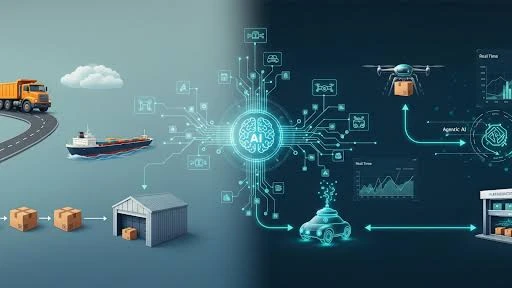
The difference between conventional automation and AI-agent-based workflows is largely about adaptability.
A traditional automated workflow might follow a sequence such as:
If X happens → perform Y.
An AI agent can approach a workflow more dynamically:
Understand the situation → determine what needs to happen → perform appropriate actions → escalate when necessary.
This distinction becomes particularly useful in supply chain environments, where information isn’t always standardized and unexpected events are common.
An AI agent may be able to gather information from multiple sources, interpret documents, identify discrepancies, determine the next step, and interact with existing systems as part of a larger workflow.
That doesn’t mean every decision should be delegated to AI. Instead, businesses can establish boundaries around what an agent can handle independently and which situations require human approval.
The result is a model in which automation handles more of the operational workload while employees remain responsible for higher-value decisions.
Where AI Agents Can Make a Practical Difference
The potential applications extend across many areas of supply chain management.
Supplier Onboarding
Supplier onboarding can involve collecting company information, reviewing documentation, checking whether required fields are complete, and coordinating tasks between procurement and other departments.
AI agents can help organize and process this information, identify missing documentation, and route outstanding tasks to the appropriate stakeholders. This can reduce the amount of manual coordination required to move a supplier through the onboarding process.
Document Processing
Modern supply chains generate enormous volumes of documents, including invoices, purchase orders, shipping documents, bills of lading, and customs paperwork.
Traditional systems often perform best when these documents follow highly standardized structures. AI-powered document processing can provide greater flexibility by interpreting information across different formats and extracting the details needed to continue a workflow.
Instead of requiring employees to manually review every document, organizations can potentially automate routine processing while directing unusual or incomplete documents for human review.
Shipment Tracking and Exception Management
Shipment tracking is another area where simply knowing a status isn’t always enough.
A shipment marked as delayed may require someone to determine why it is delayed, whether the delay affects other activities, and what action should be taken.
AI agents can help monitor relevant information, identify exceptions, and bring important issues to the attention of the right people. This shifts the focus from simply displaying information to helping teams act on it.
Freight Auditing
Freight operations generate significant amounts of transactional data. Reviewing this information for discrepancies can be time-consuming when performed manually.
AI-driven workflows can help examine freight-related information, identify potential inconsistencies, and surface issues that deserve further investigation.
Employees can then concentrate on reviewing meaningful exceptions rather than spending their time searching through every transaction.
Customs and Compliance Workflows
International supply chains also depend heavily on accurate documentation and compliance processes.
AI agents can help organize information, identify missing documentation, and route potential issues for review. For businesses managing large volumes of international transactions, even small improvements in these workflows can reduce administrative friction.
Exception Handling Is the Real Test of Intelligent Automation
Automation is relatively straightforward when everything happens exactly as expected.
The real test comes when something goes wrong.
A supplier may provide incomplete information. A shipment may suddenly be delayed. An invoice may contain a discrepancy that doesn’t fit an existing rule. A document may contain the necessary information but in an unexpected format.
These situations create exceptions—and exceptions are often where human employees end up spending the most time.
AI agents can potentially reduce this burden by interpreting the situation, gathering relevant information, and determining what should happen next within predefined operational boundaries.
Platforms such as Reindeer are applying AI-powered supply chain operations to workflows including document processing, supplier onboarding, shipment tracking, freight auditing, and other supply chain processes.
The broader opportunity is not simply automating more individual tasks. It is creating workflows that can respond more intelligently when real-world operations don’t follow a perfect script.
AI Agents Don’t Eliminate the Human Supply Chain Team
Despite the growing capabilities of AI, the strongest model for many organizations will not be AI working instead of people. It will be AI working alongside them.
AI agents can take on repetitive activities such as information gathering, document processing, routine workflow decisions, and initial exception analysis.
Human employees can remain responsible for decisions that require business context, relationships, experience, or accountability.
This creates a division of labor in which software handles more of the operational workload while people focus on the situations where their expertise has the greatest value.
For supply chain leaders, this distinction is important. The objective should not be to automate everything simply because automation is possible. Instead, organizations should identify where AI can remove unnecessary manual work while preserving appropriate human oversight.
What Businesses Should Consider Before Adopting AI Agents
Organizations considering AI agents should begin with the workflow rather than the technology.
First, examine workflow complexity. Processes with frequent exceptions may benefit more from adaptive AI than highly predictable workflows.
Second, consider data availability. Agents need access to the information required to understand a situation and make appropriate decisions.
Third, establish human oversight. Businesses should determine which actions an agent can perform independently and which require approval.
Fourth, evaluate integration requirements. Supply chain workflows rarely exist in isolation, so AI systems need to work with the organization’s existing procurement, ERP, logistics, and communication systems.
Finally, establish measurable outcomes. Businesses can track metrics such as processing time, manual intervention, exception resolution time, error rates, and operational costs to determine whether an AI-agent deployment is delivering meaningful value.
The Next Supply Chain Advantage Is Adaptability
Supply chain automation is moving beyond the simple goal of eliminating repetitive tasks.
Traditional automation will continue to play an important role, particularly for predictable processes. But AI agents create an opportunity to address a broader category of work—especially workflows involving unstructured information, changing conditions, and operational exceptions.
The organizations that benefit most may not be those that simply deploy the most AI. They will be the ones that thoughtfully combine AI agents, human expertise, and existing systems to create more responsive and resilient operations.
In an environment where unexpected events are inevitable, the ability to adapt may ultimately become just as important as the ability to automate.