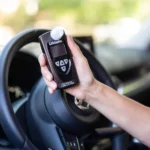
Documentation, The real meat of the Ignition Interlock Programs is the documentation that supports the devices. The hardware itself is rather mature and the breath sampling is very stable and comes in a number of different formats that can be used to determine a person’s blood alcohol content (BAC) and ensure that they provided a real sample prior to allowing them to start a vehicle. The real issue with Ignition Interlock Programs is the variations in the documentation for each installation and subsequent service of the device. These in turn create the largest number of disputed violations of program requirements.
The work of individuals and organizations involved with participants in interlock programs, of lawyers defending participants in interlock programs, and of the owners of service centers that provide interlock devices to participants in interlock programs can be greatly aided by several simple questions about interlock devices. Initially, these questions are not about whether or not the interlock device records and reports breath test samples. Rather, they are about whether or not the documentation of the work done to an interlock device (i.e., to install an interlock and then to service an interlock) will be sufficient to withstand monitoring by an authority (e.g., a court, the monitoring authority of a local program) long after the work was done.
What approval actually covers, and what it does not
There are two approvals that are required for a compliant installation of an ignition interlock device. The first is the approval of the device that has been selected for the participant. The approval of the device is typically in the form of a certification to a federal model specification for the devices. The certification to the federal model specification ensures that the selected ignition interlock device is of the correct accuracy for the participant’s needs and will not allow the participant to attempt to circumvent the device in some way. The second approval that is required for a compliant installation of an ignition interlock device is the approval of the provider who will be installing, servicing, and reporting on the device for the participant. The approval of the provider is typically granted by the state or local monitoring program, and is specific to a particular jurisdiction.
A certified interlock installed by an unauthorized provider will have all reports from that interlock device rejected by the monitoring authority. It does not matter if the participant moves to another location or even if the best price for interlock services is offered by another provider for installation, service and reporting.
Jurisdictional overlays
In addition to the federal requirements, each local program typically adds its own layer of requirements, including requirements for the cameras used in the breath testing, the type of reporting that is to be done by the provider, and the requirements for the installation certificate. Therefore, although a provider may be approved to provide interlock services in the state of Virginia, that approval does not necessarily extend to approval in local ASAP programs. Anyone assigned to a Virginia ASAP caseload in that region is best served by booking with a Winchester Virginia ASAP approved interlock provider from the very first appointment.
Installation quality as the evidentiary foundation
All of the subsequent events (e.g. Attempts to tamper with the interlock device) are then compared against the initial recording events (e.g. How wires were run and how splices were made) for the sufficient detail to verify or dispute a report of tampering.
Face verification photographs for breath testers will continue to be rejected until a correct photograph is taken for verification. This is very important for programs. Repeat attempts at verification that are rejected (i.e. Partially framed participant(s) with poor lighting) will continue to be rejected until a correct verification can occur within minutes. However, such attempts at verification will be read as avoidance and the participant(s) will be subject to a hearing for such attempts at verification in the future. Therefore, the camera for face verification should be mounted on the interlock device to allow for the best verification possible within minutes rather than twenty ambiguous verification attempts later followed by a hearing.
Vehicle-specific considerations
Many interlock installations are equipped with push-button start systems, are hybrid powered or even contain remote starters of all kinds, including aftermarket units, and thus need to be described in detail by the installing service provider and documented by him too.
Servicing intervals and the reporting chain
These events are reviewed along with the data log for each service event to ensure the proper reporting occurred for those events. The lack of driving between service events does not excuse the failure to report service events that did occur.
| Stage | Typical trigger | Primary record created | Risk if handled poorly |
| Installation | Court or administrative order | Installation certificate, baseline calibration, tamper seal log | Order not satisfied, restriction period does not begin |
| Routine service | Fixed interval, commonly 30 or 60 days | Data download, recalibration, physical inspection | Missed appointment logged as noncompliance |
| Lockout response | Failed retest or service window expiry | Event log with timestamps and readings | Unexplained lockout treated as a violation |
| Tamper review | Power interruption or circuit anomaly | Technician findings and photographs | Mechanical fault mistaken for circumvention |
| Removal | Program completion and written authorization | Final download, removal certificate | Unauthorized removal, restriction extended |
Where compliance most often breaks down
Below are the patterns of failure for many programs and how they can be prevented.
- Positive readings from mouth alcohol sources such as mouthwash, fermented food, or medication, without a prompt clean retest to establish context.
- Missed rolling retests caused by the participant misunderstanding the prompt window or the audible alert volume being set too low.
- Battery disconnections during unrelated mechanical repair, logged as power interruptions with no supporting repair documentation.
- Service appointments scheduled at the edge of the window, leaving no margin for weather, illness, or vehicle breakdown.
- Vehicle sale or transfer without coordinated removal and reinstallation.
Providing better information to participants at the time of the installation of an interlock device for drunk driving can help to prevent problems later on. In other words, participants need to know that an appointment for the installation of an interlock device for drunk driving is for a fitting for a drunk driving device, not just an appointment for the installation of a monitoring device that will report on the participant’s attempts to drive after drinking.
Assessing a provider before the first appointment
The cost difference between approved and unapproved providers for interlock devices is slight. However, the difference in their capability to provide service is significant.
Questions worth asking
- Which specific monitoring programs is the center authorized to report to, and can that be confirmed in writing.
- What is the average turnaround for a lockout call, including after hours and weekends.
- How quickly are data downloads sent to the monitoring authority after service.
- Does the center handle push-button start and hybrid vehicles in house.
- Can the participant obtain copies of their own event reports on request.
Answers to these five simple questions will be far more valuable to you and to others for whom you are trying to manage the interlock compliance of others than any interlock program brochure. How long will it take for a good provider to prepare and submit a report for a given set of data logs for a given participant? Any less than a clear and immediate answer to this simple question leaves you to your own devices.