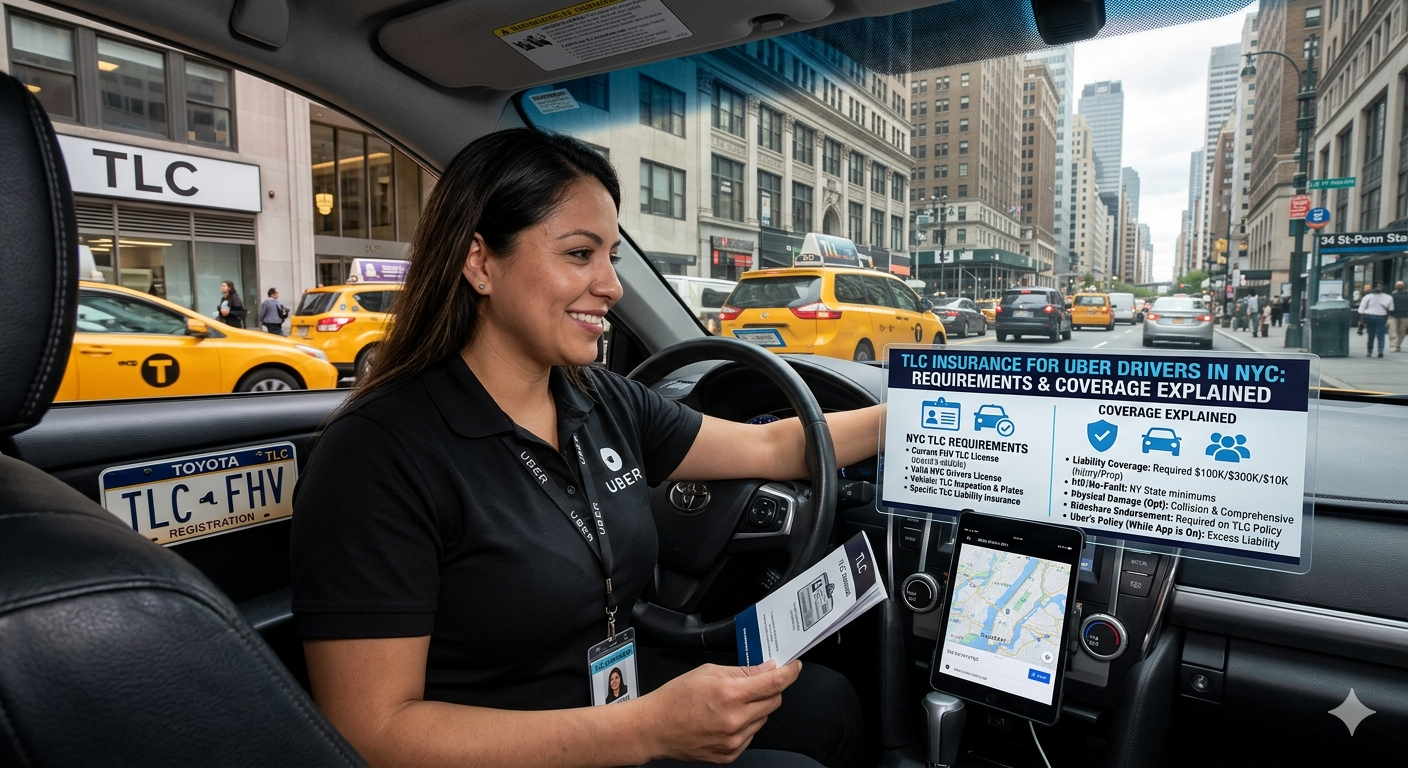
New York City’s rideshare rules make insurance less about a single policy and more about how several protections work together. For Uber drivers, the core question is not only which coverage exists, but when it applies and how claims flow between carriers. Small distinctions in policy language can shift outcomes in meaningful ways. Details matter.
How TLC coverage differs from personal policies
Personal auto contracts generally exclude carrying passengers for a fee, which is why NYC requires commercial coverage for TLC-plated vehicles. In practice, that commercial form is structured for for-hire use, reflecting city minimums and New York State no-fault. The term TLC insurance New York commonly refers to that commercial auto policy written for a TLC-licensed vehicle and driver, with liability as the backbone and Personal Injury Protection (PIP) layered in under state rules.
Compared with personal policies, TLC forms anticipate high-traffic exposure, frequent stops, and passenger injury scenarios. Liability responds to third-party harm, PIP addresses medical costs regardless of fault, uninsured/underinsured motorist can help if the other party lacks enough coverage.
When claims involve severe injuries or disputed liability, consulting a personal injury attorney can help drivers navigate these complex multi-carrier disputes. Collision and comprehensive are often optional, though many lenders and lessors require them. On the street, certain patterns become obvious, особенно при повторяющихся маршрутах в плотном потоке. Vehicles with clear endorsements and current filings tend to see faster claim coordination in most settings.
Comparing minimums, add-ons, and claim flows
Outside NYC, many rideshare programs rely on platform-provided coverage that toggles by app status, in the city, coordination with the vehicle’s own TLC policy is central. Discussions around UBER insurance NYC often blend the platform’s trip-based protections with the owner’s commercial limits and deductibles. During app-off time, the driver’s commercial policy typically governs, while waiting or driving to a pickup, the platform’s coverage may layer with the TLC policy according to carrier forms, once a passenger is onboard, platform protection often becomes primary, though wording and endorsements decide the order. Timing matters.
It helps to separate regulatory minimums, optional add-ons, and operational details. For example, liability limit choices affect exposure in multi-injury crashes. PIP management influences how quickly medical bills process. The Black Car Fund adds a distinct worker-injury benefit environment, interacting with claims pathways rather than replacing them. One detail can change the outcome. В реальном трафике эти стыки периодов становятся особенно заметны.
- Choose limits with real-world crash costs in mind, minimums meet compliance, while higher limits often reduce personal exposure.
- Consider collision and comprehensive if the vehicle is financed, review livery-use deductibles and OEM parts language with care.
- Verify no-fault, uninsured motorist, and policy territory wording, New York forms vary in sublimits and coordination clauses.
- Confirm certificate and filing requirements, keep TLC and base documents accessible to ease roadside and claim checks.
Some carriers describe bundled offerings as TLC insurance New York, packaging liability, PIP, UM/UIM, and optional physical damage for TLC vehicles. By contrast, when people search for UBER insurance NYC, they are often trying to map the three common app periods to policies they actually hold. In practice, late-night shifts make the handoff points between policies more visible, especially when a dispatch starts moments after a personal errand drive. The effect is incremental rather than dramatic, yet it shapes expectations.
Key takeaways for choosing compliant protection
A comparison lens suggests three priorities: confirm TLC compliance first, understand how platform coverage coordinates across app periods, and then fine-tune optional add-ons to match vehicle value and driving pattern. For many, that means reviewing declarations and endorsements line by line, noting deductibles, exclusions tied to commercial use, and claims-reporting instructions for trips versus non-trip incidents. With those pieces aligned, coverage tends to function predictably, and documentation checks at roadside stops become routine rather than stressful. The approach is methodical and, in most cases, sufficient for day-to-day NYC operations.