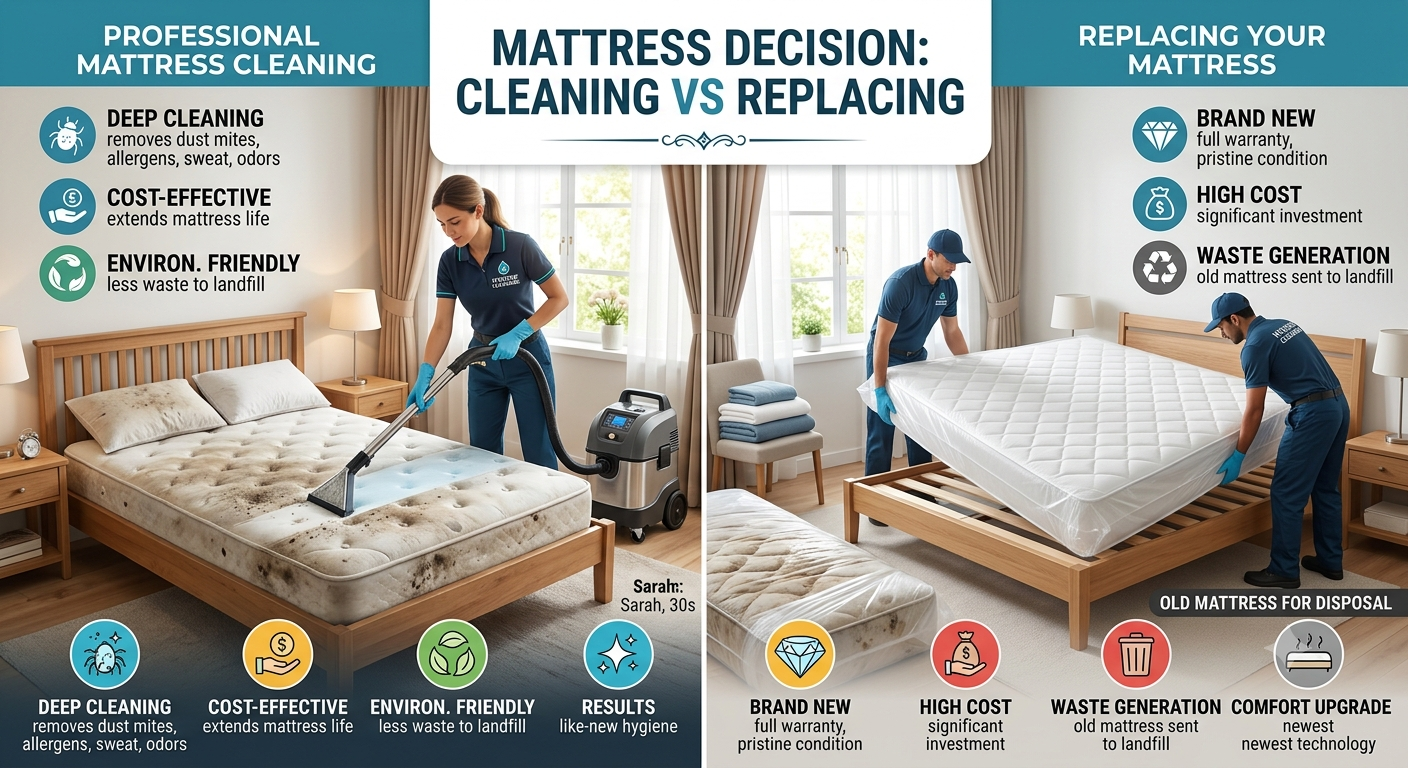
A mattress that has seen a few years of nightly use often carries more history than most people realise. Sweat, skin cells, dust mites, and the occasional spill accumulate quietly beneath the sheets, and eventually a homeowner has to decide whether the mattress can be salvaged or whether it has reached the end of its useful life. This decision is not always straightforward. A mattress with a stubborn stain might still have years of comfortable support left in it, while a spotless mattress could already be sagging in ways that damage posture and sleep quality.
Choosing between deep cleaning and replacement depends on several overlapping factors: the age of the mattress, the type of problem it has, the materials it is made from, and how much the household is willing to spend either way. Understanding these variables helps avoid two common mistakes: throwing away a mattress that only needed a thorough clean, or clinging to one that has genuinely outlived its usefulness and is quietly affecting sleep and health.
What Professional Mattress Cleaning Actually Involves
Professional mattress cleaning is a service designed to remove the buildup that accumulates deep within the fabric and padding layers, well below what a household vacuum or a quick wipe can reach. Companies offering this kind of service, such as mattress cleaning specialists, typically use a combination of hot water extraction, steam treatment, and targeted stain removal solutions to lift out dirt, sweat residue, and allergens that have settled into the fibres over time. The process is more thorough than home cleaning largely because of the equipment involved, which can reach temperatures and suction levels that ordinary household tools cannot match.
Most professional treatments begin with an inspection of the mattress surface to identify stains, discolouration, and any areas of unusual wear. Technicians then apply cleaning agents suited to the mattress material, since foam, latex, and traditional spring mattresses each react differently to moisture and chemical treatment. Steam or hot water extraction follows, drawing out trapped particles along with the moisture used in the process, and the mattress is left to dry fully before it can be used again.
The results of a professional clean are usually visible in three areas: reduced odour, lighter or removed stains, and a noticeable drop in dust and allergen levels. This last point matters more than people often realise, since mattresses are one of the largest reservoirs of dust mites in a home simply because they combine warmth, moisture from perspiration, and organic material such as shed skin cells, which mites feed on. A clean does not eliminate mites, but it can substantially reduce their numbers and the debris that supports them.
What a cleaning service cannot do is restore structural support. If the springs have weakened or the foam has compressed permanently, no amount of steam or extraction will bring back the original firmness. This distinction is central to the entire decision between cleaning and replacing, because hygiene issues and structural issues call for completely different solutions.
Reading The Warning Signs Correctly
Sagging is one of the clearest indicators that a mattress has reached the end of its structural life. A visible dip in the middle, or a permanent body-shaped impression that does not spring back after getting up, means the internal materials have lost their ability to support weight evenly. This kind of wear cannot be cleaned away because it is not a surface problem; it is a change in the physical properties of the springs or foam.
Waking up with new aches, stiffness, or discomfort that was not present a year or two earlier is another strong signal, particularly if the discomfort disappears when sleeping elsewhere, such as in a hotel or at a friend’s house. This pattern points directly to the mattress rather than to general health changes. It is easy to dismiss this as simply getting older, but a mattress that has lost its supportive structure will produce these symptoms regardless of the sleeper’s age or fitness.
Persistent odours that survive multiple cleaning attempts, along with stains that have penetrated deep into the padding rather than sitting on the surface, suggest that professional cleaning may still be worth trying before replacement is considered. Surface staining from spilled drinks or minor accidents responds well to extraction cleaning in most cases. Deep-set stains from years of accumulated sweat, or contamination that has reached the inner foam layers, are more resistant and may only partially improve even with professional treatment.
Comparing The Costs Realistically
Professional mattress cleaning is almost always cheaper than buying a new mattress, often by a significant margin, which makes it the more attractive option when the mattress is structurally sound. A single cleaning session addresses hygiene and odour concerns without requiring the household to dispose of a large item or transport a new one. For a mattress that is a few years old and otherwise comfortable, this cost difference alone can justify choosing the cleaning route.
Replacement costs vary enormously depending on the type of mattress chosen, from basic spring models to higher-end memory foam or hybrid designs, but the expense goes beyond the purchase price. Disposing of an old mattress often involves a collection fee, since many local councils and waste services charge extra for bulky items that cannot go into standard bins. Delivery of the new mattress, and sometimes the cost of a new base or frame if the dimensions differ, adds further to the total outlay.
The calculation shifts, though, once repeated cleaning attempts fail to resolve odour or allergy symptoms. Spending on multiple cleaning sessions without lasting improvement effectively becomes money spent delaying an inevitable replacement, and at that point the cumulative cost of cleaning can approach or exceed a reasonable budget for a new mattress. Treating cleaning as a one-time trial rather than a repeated fix helps avoid this kind of spending trap.
How Lifespan And Materials Affect The Decision
Different mattress types age in different ways, which affects how long cleaning remains a viable option. Innerspring mattresses tend to develop sagging earlier because metal coils fatigue with repeated compression, and once that happens, no cleaning treatment addresses the loss of bounce. Memory foam holds its shape longer in some respects but can develop permanent body impressions once the foam cells break down, a process that speeds up in warmer climates or with heavier use.
Latex mattresses generally last the longest among common types, partly because the material resists compression fatigue better than foam or springs, meaning a latex mattress with stains or odour issues is more likely to be worth cleaning rather than replacing. The general rule across most mattress types is that once a mattress passes the upper end of its expected lifespan, hygiene problems tend to appear alongside structural ones, making the replacement case stronger on multiple fronts at once rather than just one.
Humidity and climate also influence how mattresses age, since moisture from sweat or ambient humidity encourages mould growth within the padding layers if it is not allowed to dry out properly. A mattress kept in a poorly ventilated bedroom may show hygiene problems well before its structural components have worn out, which is precisely the scenario where professional cleaning offers the most value, since the underlying support is still sound even though the surface conditions have deteriorated.
Making A Decision That Fits The Situation
Choosing between cleaning and replacement comes down to matching the treatment to the actual problem rather than defaulting to either extreme. A relatively new mattress with stains, odour, or dust buildup is generally worth cleaning, since the support structure underneath is still functional and the issue is one of hygiene rather than mechanics. An older mattress with visible sagging, persistent aches, or allergy symptoms that resist cleaning has moved past the point where surface treatment can help.
It also helps to consider how the mattress is used going forward. A guest room mattress that sees occasional use might tolerate a few more years even with minor sagging, since the wear on sleep quality is limited to occasional nights. A primary bed used every night by someone with allergies or back pain deserves a stricter standard, since the daily impact of a compromised mattress compounds over time in ways that are easy to underestimate.
Sleeping On The Right Choice
Deciding between professional cleaning and full replacement is ultimately about identifying whether the mattress has a hygiene problem, a structural problem, or both. Stains, odours, and dust accumulation respond well to thorough cleaning and rarely require throwing out a mattress that still offers good support. Sagging, persistent discomfort, and wear that survives multiple cleaning attempts point toward replacement as the more sensible long-term choice, even though it costs more upfront. Paying attention to these distinctions, rather than reacting to age or appearance alone, leads to a decision that protects both the household budget and the quality of sleep that every night depends on.