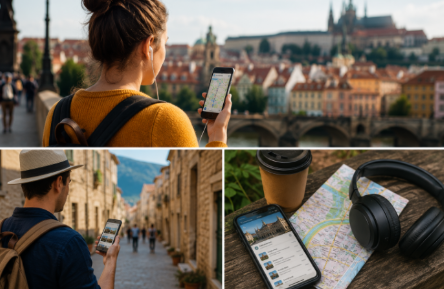
Exploring an unfamiliar city once required a paper map, a printed guidebook and a carefully planned itinerary. Travellers either joined an organised tour or worked out their route as they went, often spending valuable time checking directions and deciding what to visit next.
Smartphones have changed that experience considerably. Digital maps, audio guides, translation tools and travel-planning applications now allow visitors to organise much of a city tour independently. More recently, artificial intelligence has added another layer by helping travellers create routes based on their available time, interests and preferred way of getting around.
This does not mean that technology has replaced traditional guided tours. Instead, it has created another option for people who value flexibility and prefer to explore at their own pace.
Why Self-Guided Travel Appeals to Modern Visitors
A fixed group tour can be convenient, particularly for visitors who want expert commentary and do not wish to plan anything themselves. However, it also comes with a timetable. Participants normally need to arrive at a particular meeting point, follow a predetermined route and move on when the group moves on.
Self-guided exploration offers a different experience. Travellers can stop for coffee, spend longer at an interesting landmark, skip a place that does not appeal to them or change direction when they discover something unexpected.
This flexibility is especially useful during short city breaks. Someone with only two free hours may not be able to join a conventional half-day tour, but they can still follow a shorter route through a historic district. A visitor returning to a city may also prefer a specialist theme, such as architecture, literature, street art or local industrial history, rather than another tour of the best-known attractions.
Solo travellers can benefit as well. A structured route gives them some of the organisation of a tour without requiring them to join a group.
From Digital Maps to Contextual Travel Tools
Basic navigation applications are designed primarily to answer two questions: where is a place, and how do you reach it?
Travel-focused technology can provide more context. Instead of simply directing someone to a cathedral, monument or historic house, an audio guide can explain why the site is important. It might introduce the people connected with it, describe how the building changed over time or point out architectural details that are easily missed.
The latest generation of travel tools attempts to combine several functions:
- Discovering nearby attractions
- Organising stops into a practical route
- Estimating how long the route may take
- Providing directions between locations
- Presenting historical or cultural information
- Narrating information through audio
- Adjusting suggestions to the traveller’s interests
Artificial intelligence can make this process more adaptable. Rather than offering only one pre-recorded itinerary, an AI-based system may be able to create different routes for someone travelling on foot, by bicycle or by car.
The objective is not merely to show more places. A useful route should select a realistic number of stops and arrange them in an order that makes geographical sense.
What Personalisation Means in Practice
Personalisation in travel is sometimes presented as a complicated technical concept, but it can be relatively straightforward from the traveller’s perspective.
A visitor might specify that they have three hours, want to walk and are interested in medieval history and architecture. Another person in the same city may have an entire day, be travelling by car and prefer coastal scenery, gardens and photography locations.
Those two travellers should not receive identical itineraries.
One example of this approach is Votura, a self-guided audio-tour application that uses AI to create routes around real places based on factors such as available time, transport mode and personal interests. Its current service combines AI-generated tours with audio information, navigation and an interactive guide.
The important point is not the name of a particular application. It is the broader shift from static travel content towards itineraries that can respond to the circumstances of an individual trip.
The Importance of Reviewing a Digital Route
Technology can make planning faster, but travellers should not follow every automated suggestion without checking it.
Opening hours change. Roads close. Footpaths may become unsuitable because of weather or maintenance. A building described as an attraction may be privately owned, accessible only during certain hours or visible only from outside.
Before beginning a self-guided route, travellers should check:
- Whether the attractions are open
- Whether admission must be booked
- Whether the complete route is suitable for their mobility level
- Whether any sections involve unsafe or poorly lit streets
- Whether public transport is available for the return journey
- Whether the route remains practical in current weather conditions
AI-generated historical information should also be approached with reasonable caution. Artificial intelligence can produce useful summaries, but it can make mistakes or present disputed interpretations as established fact. Particularly important information should be checked against museums, heritage organisations, official tourism sources or other reliable references.
Offline Access and Battery Planning
A self-guided tour depends heavily on the traveller’s phone. That creates practical considerations that are easy to overlook.
Navigation, GPS tracking, audio playback and mobile data can use a significant amount of battery power. A portable charger can therefore be more useful than another travel accessory, particularly on a full-day route.
Where possible, maps, audio and itinerary information should be downloaded before departure. Offline access is particularly valuable in rural locations, inside thick-walled historic buildings or when travelling abroad without an appropriate mobile-data package.
Travellers should also save the address of their accommodation and identify an alternative way to return in case the phone becomes unavailable.
Technology Should Support, Not Distract From, the Visit
There is a risk that digital travel tools can encourage visitors to spend too much time looking at a screen. A good self-guided experience should do the opposite.
The phone should provide directions when required and then allow the traveller to concentrate on the place itself. Audio is particularly useful in this respect because information can be heard while looking at a building, landscape or artwork rather than constantly reading text.
It is also worth leaving space for unplanned discoveries. A route should provide structure, but it should not prevent someone from entering an interesting side street, visiting a local market or spending longer at a viewpoint.
The most memorable part of a trip is often something that was not included in the original itinerary.
Will Digital Tours Replace Human Guides?
Human guides continue to provide several qualities that technology cannot fully reproduce.
An experienced local guide can respond to unexpected questions, adjust the level of detail to the group and interpret how visitors are reacting. Guides can also discuss contested history, explain local humour and share personal experiences that may never appear in a standard database.
There is also a social dimension. For some travellers, meeting a knowledgeable local person or exploring as part of a group is an important part of the experience.
Self-guided technology is therefore better understood as a complementary option. It is useful when a scheduled tour is unavailable, when the traveller wants complete flexibility or when someone wishes to explore a subject not covered by conventional tours.
Many visitors may use both formats during the same trip: a guided tour for a major historic area and a self-guided route for another neighbourhood.
A More Flexible Way to Discover Places
Travel technology has progressed from showing points on a map to helping visitors understand the places around them. Audio narration, real-time navigation and AI-assisted route creation can make independent exploration more manageable, particularly for travellers with limited time or specialist interests.
The quality of the experience still depends on how thoughtfully the technology is used. Travellers should review routes, verify important information, prepare for connectivity problems and remain aware of their surroundings.
When used properly, digital tools do not need to dominate a journey. Their most valuable role is to remove some of the organisational work, leaving travellers with more time to observe, listen and discover a destination for themselves.