Take a walk around your yard and look closely at the base of your favorite tree. Does the trunk flare out naturally where it meets the soil, or does it plunge straight down like a fence post? That subtle difference can tell you a lot about your tree’s future.
Many homeowners never think twice about the ground level around their trees. Mulch gets piled high, soil settles after construction, or grading changes shift dirt closer to the trunk over the years. It seems harmless enough. But when soil buries the natural root flare, a tree can quietly struggle for years before showing obvious signs of decline.
This is one of the most overlooked issues in residential landscapes, and it’s also one of the most fixable. Understanding what’s happening beneath the surface can help you protect a tree that might otherwise be slowly losing its fight for survival.
Why Trees Struggle When Their Root Flare Disappears
Every healthy tree has a root flare, the natural widening where the trunk transitions into its root system. This area is meant to stay exposed to air. When soil, mulch, or debris covers it, the bark stays wet for extended periods, creating conditions that invite decay, fungal growth, and insect activity.
Buried root flares also encourage a hidden problem called girdling roots. Instead of growing outward and downward as they should, roots near the surface can begin circling the trunk. Over time, these roots tighten like a rope, restricting the flow of water and nutrients. A tree dealing with girdling roots might grow slower, develop thinning foliage, or become more vulnerable to storm damage, even if the canopy still looks green from a distance.
The frustrating part is that none of this is visible unless someone actually digs down to check. From the surface, a tree with a buried flare can look perfectly normal for years.
Signs Your Tree May Be Affected
A few warning signs tend to show up before a tree reaches a crisis point:
- The trunk looks like a straight pole with no visible widening at the base
- Mulch or soil has been piled against the trunk over multiple seasons
- Branches on one side of the canopy appear thinner or shorter than the rest
- Leaves are smaller than expected or drop earlier in the fall
- The tree seems to be leaning slightly more than in previous years
None of these signs guarantee a problem on their own, but together, they’re worth taking seriously. Catching the issue early gives a tree a far better chance of recovering fully.
What Happens During a Professional Evaluation
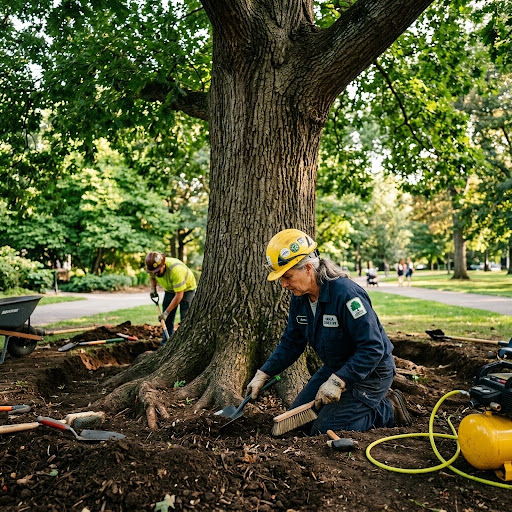
Because the real damage happens below ground, a visual inspection alone rarely tells the whole story. A trained arborist typically starts by carefully removing soil and mulch around the base of the tree, working by hand or with an air spade to avoid damaging the bark or nearby roots.
This process reveals exactly what’s happening at the root flare. If girdling roots are present, an arborist can assess how severe the constriction is and determine whether they can be safely pruned. In many cases, exposing the flare and correcting the grading around it is enough to relieve pressure and allow the tree to recover its natural growth pattern over time.
The goal isn’t just to expose the roots and walk away. It’s to set the tree up for years of healthier growth by correcting a problem that would otherwise keep getting worse.
Why Homeowners Choose Arborwright Tree Care
Root collar excavation gently uncovers a tree’s buried flare, easing pressure on its roots and giving it a genuine chance to recover strength it may have been losing for years, and it’s one of the services we take the most pride in at Arborwright Tree Care. We’ve seen firsthand how a tree that seemed to be declining for no clear reason can begin to rebound once its root flare is properly exposed and cared for.
Our team approaches every property differently, because every tree’s history is different. Some trees have been dealing with buried flares since the day they were planted too deep. Others developed the issue gradually as landscaping changed around them. We take the time to understand what led to the problem before recommending a fix, so the work we do actually addresses the root cause rather than masking a symptom.
Homeowners who work with us often tell us they had no idea their tree’s trunk wasn’t supposed to look the way it did. That’s not unusual. Most people simply haven’t been told what a healthy root flare looks like, or why it matters so much for long-term tree health. Part of our job is making sure that knowledge doesn’t stay hidden underground along with the roots.
Give Your Trees a Fighting Chance
Trees are patient. They can tolerate a surprising amount of stress before showing visible signs of trouble, which is exactly why problems at the root flare so often go unnoticed until a tree is already struggling. The good news is that catching the issue doesn’t require guesswork on your part. A quick look at the base of your trees, paired with a professional evaluation if something looks off, can make the difference between a tree that slowly declines and one that thrives for decades.
If you’ve noticed a trunk that looks a little too straight, or mulch that’s been piling up higher each year, it’s worth having a closer look. Reach out to Arborwright Tree Care to schedule an evaluation and give your trees the foundation they need to keep growing strong.