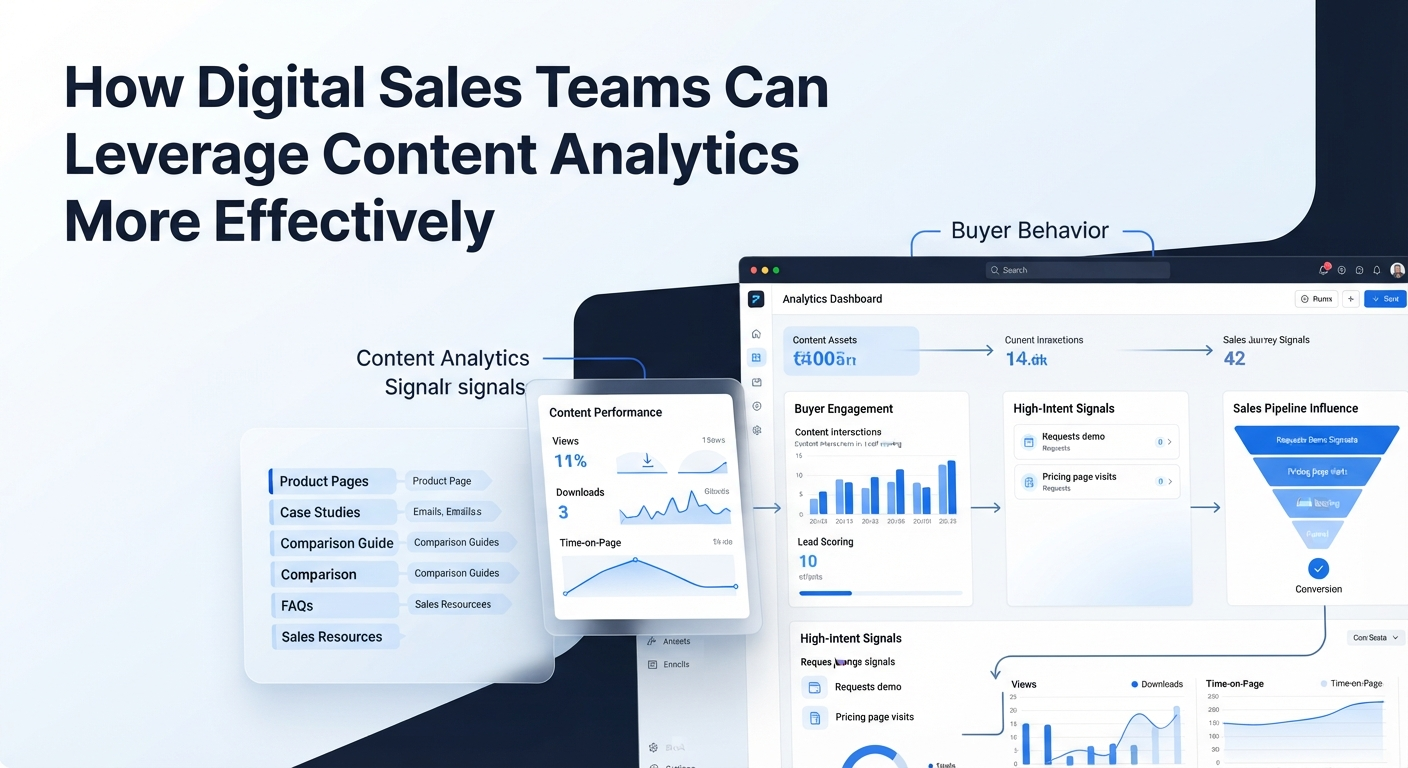
Digital sales teams use content every day to educate buyers, support conversations, answer objections, and move prospects closer to a decision. Product pages, landing pages, emails, case studies, comparison guides, FAQs, sales portals, and follow-up resources all influence how buyers understand a company’s value. However, many teams still struggle to know which content is actually helping sales performance and which content is simply adding volume to the journey.
Content analytics can help sales teams make smarter decisions by showing how buyers interact with resources across the funnel. When used properly, analytics can reveal which assets generate interest, which pages support conversions, which resources help leads move forward, and where buyers may be losing momentum. For digital sales teams, the goal is not only to collect more data, but to turn that data into clearer actions. By connecting content performance with buyer behavior, sales teams can improve follow-ups, prioritize better resources, and create more effective buyer journeys.
Understanding the Value of Content Analytics in Sales
Content analytics helps sales teams understand how content contributes to the buyer journey. Instead of guessing which resources are useful, teams can look at real engagement data to see which pages, guides, emails, and case studies buyers actually use. Learn about it to discover how content analytics can reveal valuable insights into buyer behavior and engagement. This gives sales teams a clearer view of buyer interest and intent. A prospect who reads several comparison guides may be showing stronger evaluation behavior than someone who only visits a general blog article.
For digital sales teams, content analytics can also reveal patterns that are not always visible in direct conversations. Buyers may repeatedly visit pricing content, return to a product page, or spend time with a specific FAQ before contacting sales. These signals can help representatives understand what the buyer cares about and where they may need reassurance. Content analytics turns buyer behavior into insight, helping sales teams prepare better conversations and send more relevant follow-up materials.
Connecting Content Data With Sales Outcomes
Content analytics becomes much more valuable when it is connected to sales outcomes. Page views and downloads can show engagement, but they do not always explain whether content is helping generate qualified leads, opportunities, or customers. A resource may receive high traffic but contribute little to sales progress, while another asset may receive fewer views but strongly support late-stage decisions.
Digital sales teams should connect content engagement with CRM data, pipeline stages, lead quality, and conversion activity. This helps teams understand which content appears in successful buyer journeys. For example, they may discover that prospects who read certain case studies are more likely to book demos, or that comparison pages often appear before sales-qualified leads are created. Connecting content data with sales outcomes helps teams focus on content that influences revenue, not just content that attracts attention.
Using Analytics to Identify High-Intent Buyer Behavior
Not every content interaction has the same meaning. A buyer who reads an introductory article may be at the beginning of the journey, while someone who views pricing pages, product comparisons, implementation guides, or decision-stage FAQs may be closer to taking action. Content analytics helps sales teams identify these high-intent signals more clearly.
By looking at the type of content a buyer engages with, sales teams can better understand readiness. A lead who repeatedly visits product-specific content may need a direct follow-up. A prospect who downloads a technical guide may need more detailed product information. Someone who opens several decision-stage emails may be ready for a sales conversation. These insights help teams prioritize outreach and avoid treating every lead the same. High-intent content behavior can guide timing, messaging, and follow-up strategy.
Improving Lead Scoring With Content Engagement
Lead scoring becomes stronger when it includes content analytics. Traditional lead scoring may assign value to form submissions, email clicks, or website visits, but not all actions indicate the same level of interest. A visit to a general resource page may be less valuable than repeated engagement with decision-stage content. Without this distinction, sales teams may spend time on leads that are not truly ready.
Content analytics allows businesses to assign more meaningful scores based on content type, funnel stage, and buyer intent. Awareness content can signal early interest, while comparison guides, case studies, pricing resources, and demo pages can indicate stronger buying intent. When these signals are added to lead scoring, sales teams can prioritize more effectively. They can focus on leads whose content behavior suggests active evaluation rather than casual browsing. Better lead scoring helps improve efficiency and increases the chance of timely, relevant outreach.
Understanding Which Content Supports Each Funnel Stage
Different sales funnel stages require different content. Awareness-stage content helps buyers understand problems and possibilities. Consideration-stage content helps them compare solutions and evaluate fit. Decision-stage content helps them overcome hesitation and take the next step. If sales teams do not know which content supports each stage, they may share resources that are too early, too advanced, or not relevant enough.
Content analytics can show how assets perform at each stage. Teams can see which educational articles bring in early traffic, which comparison pages keep buyers engaged, and which decision-stage resources influence demo requests or sales conversations. This helps teams identify where the funnel is strong and where it needs more support. If leads often drop off after product research, the team may need stronger mid-stage content. If opportunities stall late in the process, better proof, pricing explanations, or implementation resources may be needed.
Helping Sales Teams Send Better Follow-Ups
Follow-up content can make a major difference in digital sales. After a call, webinar, demo request, or form submission, buyers often need additional resources to continue evaluating the solution. If sales teams send generic materials, the follow-up may not answer the buyer’s real questions. Content analytics helps representatives choose resources based on what the buyer has already engaged with.
If a prospect has read several product pages, a sales representative can send a relevant comparison guide or case study. If they have visited implementation content, the follow-up can focus on onboarding, support, or setup expectations. If they engaged with industry-specific pages, the representative can share proof from that industry. This makes follow-ups more helpful and less random. Buyers receive content that continues their journey, while sales teams demonstrate that they understand the buyer’s interests.
Identifying Content Gaps That Slow Sales Progress
Content analytics can reveal where buyers are not getting the support they need. A business may have strong awareness content but weak decision-stage materials. Another may have product pages but not enough case studies for specific industries. If buyers frequently search for certain topics but do not find useful answers, that can indicate a content gap. These gaps can slow sales progress and create more work for sales teams.
Digital sales teams can use analytics to identify where buyers drop off, which questions appear repeatedly, and which content areas are underdeveloped. If many prospects ask about implementation after demos, the business may need better implementation guides. If leads from one industry rarely convert, the team may need stronger industry-specific resources. Identifying gaps helps content teams create materials that directly support sales outcomes instead of producing content without a clear purpose.
Measuring the Impact of Case Studies and Proof Content
Case studies, testimonials, and proof points are often critical in converting buyers. They help prospects see how similar customers achieved results and why the solution is credible. However, sales teams need to know which proof assets are actually influencing decisions. Some case studies may be widely shared but rarely connected to conversion, while others may play an important role in late-stage opportunities.
Content analytics can show which case studies are viewed, shared, downloaded, or engaged with before key sales actions. Teams can compare case studies by industry, product, buyer stage, region, and outcome. This helps identify which proof points are most persuasive for different buyer groups. Sales teams can then use the strongest examples more strategically. Content teams can also see where more customer stories are needed. Better proof analytics helps sales teams build credibility with more precision.
Using Content Analytics to Improve Sales Enablement
Sales enablement content should help representatives prepare for conversations, answer questions, and move buyers forward. However, many organizations create enablement resources without knowing which ones are actually used. Some materials may become outdated, while others may be difficult to find. Content analytics can help teams understand how sales representatives interact with internal resources.
By tracking usage inside sales portals, CRM tools, or resource centers, teams can see which product sheets, pitch decks, objection-handling guides, FAQs, and case studies are used most often. They can also identify resources that are rarely opened or shared. This helps sales enablement teams improve the content library and remove clutter. If a certain guide is used frequently in successful deals, it can be expanded or promoted. If an asset is ignored, it may need revision or retirement.
Aligning Sales and Content Teams Around Data
Sales and content teams often have different views of what buyers need. Sales teams hear questions and objections directly, while content teams see performance data across digital channels. Content analytics can bring these perspectives together. Instead of relying only on opinions or one-off requests, both teams can use data to decide what content should be created, updated, or removed.
When sales and content teams review analytics together, they can identify patterns more clearly. They may see that certain buyer questions appear both in sales conversations and search behavior. They may discover that a high-performing blog post needs a stronger next step, or that a sales resource should be turned into a public-facing guide. Data creates a shared language for collaboration. It helps content teams build more useful resources and helps sales teams understand which materials support buyer progression.
Improving Personalization With Content Insights
Personalization works best when it is based on real buyer behavior. Content analytics helps businesses understand what different buyer segments care about and how they move through the journey. One audience may engage more with product comparisons, while another may respond strongly to industry-specific proof. Without analytics, personalization can become guesswork.
Digital sales teams can use content insights to personalize recommendations, emails, landing pages, sales portals, and follow-ups. If a buyer shows interest in a specific product, the journey can surface related case studies and FAQs. If a segment responds well to educational content, the nurture path can include more learning resources before stronger sales prompts. Content analytics helps teams personalize in a way that feels useful rather than random. This can improve engagement and support stronger conversion rates.
Refining Calls-to-Action Based on Performance
Calls-to-action guide buyers toward the next step, but not every CTA works equally well in every context. A CTA that performs well on a product page may not work in an educational article. A demo request may be too direct for early-stage visitors, while a soft learning CTA may be too weak for late-stage buyers. Content analytics helps teams understand which CTAs work best at each stage.
By tracking CTA performance across pages, emails, portals, and campaigns, sales teams can identify where buyers are ready to act and where they need more guidance. If a comparison page drives strong demo requests, the CTA may be well placed. may be well placed. If an awareness article has strong engagement but weak next-step activity, the CTA may need adjustment. Refining CTAs based on analytics helps make the sales journey smoother and more effective.
Conclusion
Digital sales teams can leverage content analytics more effectively by connecting content performance with buyer behavior, sales stages, and revenue outcomes. Content analytics should not only show which pages received traffic or which emails received clicks. It should help teams understand which resources attract the right leads, support decision-making, improve follow-ups, influence opportunities, and help buyers become customers.
To use content analytics well, sales teams need structured content, clear metadata, CRM connections, funnel-stage tracking, and a process for turning insights into action. They should measure meaningful engagement, identify content gaps, improve personalization, refine CTAs, and align with content teams around shared data. As digital sales journeys become more complex, content analytics will become even more important for understanding what buyers need and how content can support stronger sales performance.