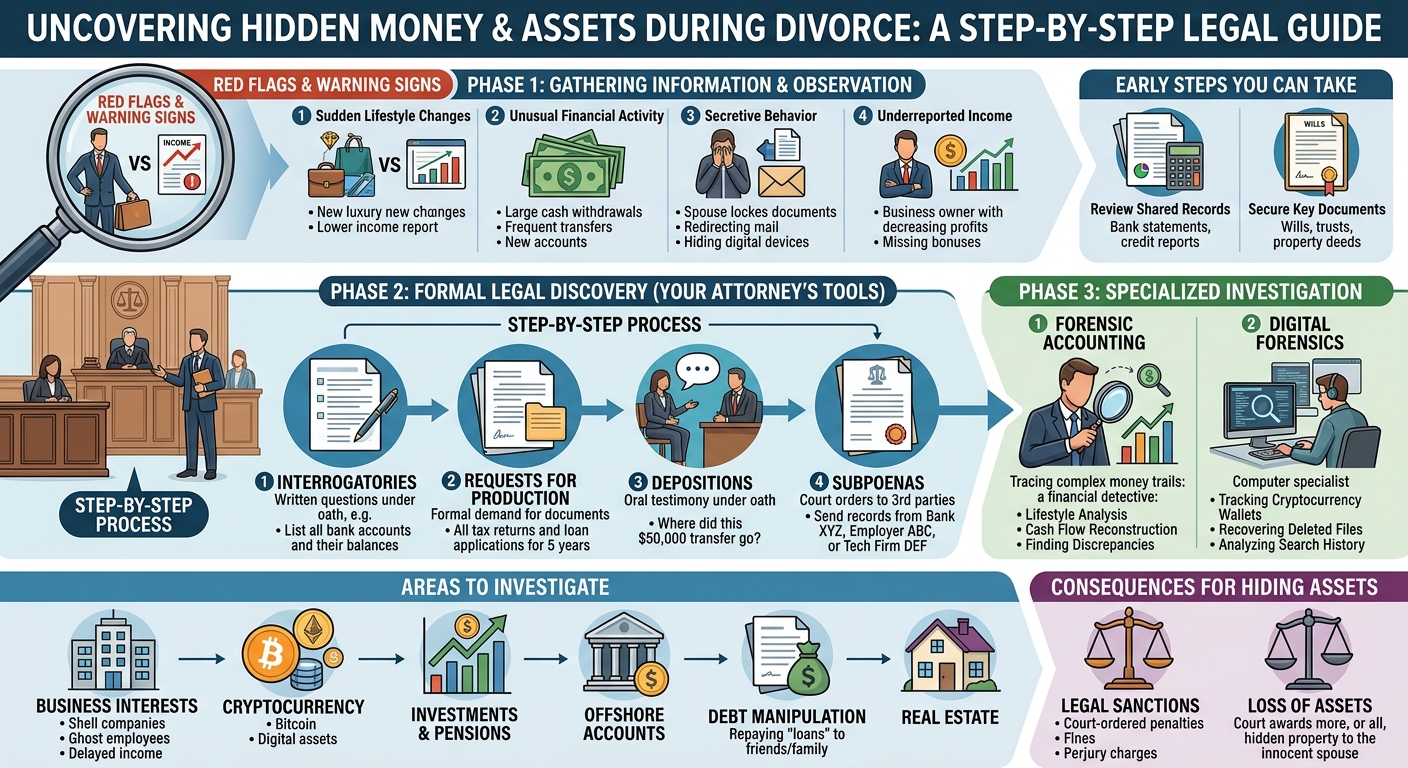
Finding money or property that appears to be missing from financial disclosure starts with evidence, not accusation. An unexplained transfer, a company figure that no longer matches earlier records or an account that seems to have disappeared can justify closer review, but none of those points proves concealment on its own.
The practical approach is to identify what does not add up, preserve the records you can properly use and turn each discrepancy into a specific financial question. Some gaps can be resolved through ordinary disclosure. Business structures, trusts, disputed valuations or assets held abroad may need specialist analysis. The legal process described here applies to financial remedy proceedings in England and Wales.
What to Check First in a Hidden Assets Divorce Case
The first useful task is to separate known facts from suspicions. That gives you a clearer baseline before requesting more information.
Start with five actions.
- List the accounts, property, businesses, investments and pensions you already know about.
- Note any unexplained transfers, changes in income or assets that no longer appear in the current financial picture.
- Put dates and amounts beside each concern.
- Gather records you already lawfully hold or have received.
- Keep each discrepancy separate rather than trying to prove one broad theory about missing money.
Avoid this
Do not try to fill gaps by accessing an account, device, email or correspondence that you are not authorised to use. Record why you believe information is missing and seek advice on the proper way to obtain it.
Document checklist
- Bank and investment statements already available to you
- Mortgage and property records
- Pension information
- Payslips or self-employed income records
- Company accounts or shareholder records you already hold
- Previous valuations
- Earlier financial agreements or disclosure documents
If you feel unsafe or at risk, seek urgent support before taking financial steps that could alert the other person.
Follow the Paper Trail Before You Escalate
The type of financial structure often determines where the gaps appear.
For an employee, the issue may be an unexplained account or investment. For someone who controls a private company, income may involve salary, dividends, director payments and business interests, so personal bank statements may tell only part of the story.
Trusts and international holdings need another level of context. The question may be who benefits from the asset, where it is held and whether it appears in the disclosed financial position.
Where money appears to move between companies, trusts or overseas accounts without a clear explanation, uncovering hidden assets in divorce may require specialist family law analysis alongside financial investigation. The question is no longer whether one statement is missing, but whether the financial picture being used for settlement discussions is complete.
Form E is relevant where an application for a financial order is being made. It asks for detailed information about property, bank accounts, investments, business interests, pensions, liabilities and other financial resources, supported by specified documents.
A figure that looks unusual should still be treated as a question rather than proof. Business income may change for legitimate reasons, an investment may have been sold or an account may have been closed. The next stage is to test the explanation against the records.
Turn Each Gap Into a Specific Disclosure Question
As you review the records, each unanswered point should become more specific.
- Establish what should be there
Write down the asset or income source you believe exists and the evidence for that belief. An old statement, previous tax record, company account or known transfer gives the question a factual starting point.
- Match the disclosure to supporting records
Where Form E is being used, check whether the documents support the figures entered. If a business interest is declared, for example, the useful question is whether the accounts and valuation material explain the figure rather than whether the number simply looks low.
- Record what remains unanswered
Turn the gap into a question that can be answered by a document.
Instead of asking where all the money has gone, identify the transfer, account, shareholding or valuation that needs explanation.
Under the standard financial remedy procedure, parties file questionnaires before the first appointment setting out further information and documents they seek. At the first appointment, the court determines which questions must be answered and which requested documents must be produced.
- Keep the request proportionate to the issue
A long request for every financial record can make the real discrepancy harder to see. Focus first on documents capable of answering the question you have identified.
This sequence also helps distinguish incomplete paperwork from a financial issue that genuinely needs specialist analysis.
When Forensic Accountants Help in Divorce
Forensic accountants in divorce can become useful when the difficulty lies in interpreting the records rather than obtaining one missing statement.
Private companies are a common example. Accounts may need analysis to understand cash flow, ownership, director transactions or the basis of a valuation. A complicated series of transfers may also need financial reconstruction before anyone can determine what the records actually show.
The first question should therefore be what the accountant is being asked to resolve. That might be a disputed business value, a transaction trail or an inconsistency between reported income and the underlying records.
Expert evidence is not automatic in family proceedings. Where expert evidence is to be put before the court in financial remedy proceedings, Part 25 requires the court’s permission, and permission is given where the evidence is necessary to help resolve the proceedings.
Specialist legal input becomes more relevant where the financial picture involves private companies, trusts, substantial investments, several properties or assets in different jurisdictions. Stowe Family Law’s high net worth divorce service covers hidden assets and complex financial portfolios and has access to specialist divorce accountants for financial analysis.
Specialist analysis is most useful where ordinary financial disclosure cannot answer the question clearly, rather than for every unexplained transaction.
What to Ask Before You Agree Anything
Before settlement discussions move too far, make sure the unresolved financial questions are easy to identify.
Questions to ask a solicitor
- Which discrepancies genuinely require further disclosure?
- What document would answer each outstanding question?
- Should a particular issue be raised in a questionnaire?
- Does any part of the financial picture require a valuation?
- Would forensic accounting add useful information in this case?
- Are trusts, business interests or overseas assets changing the disclosure needed?
- Is there anything I should avoid doing while the issue remains unresolved?
Mistakes to avoid
- Treating an unusual transaction as automatic proof of concealment
- Requesting large amounts of information without identifying the financial question
- Assuming a company’s headline value shows what the owner can actually access
- Moving joint funds in response to suspicion without understanding the implications
- Accessing private information without authority
- Agreeing financial terms while material disclosure questions remain unresolved
A clear record of what was requested, what was supplied and what remains unanswered is often more useful than a large unsorted file. It also makes it easier for a solicitor or accountant to see where additional work may be justified.
Frequently Asked Questions
Does everyone have to complete Form E when they divorce?
No. Form E is a financial statement used for applications for a financial order and certain financial relief proceedings. Divorce itself does not automatically require every couple to complete it.
What happens if financial disclosure appears incomplete?
The first step is to identify what information is missing. Under the standard financial remedy procedure, a questionnaire can request further information and documents, and the court determines at the first appointment what must be answered or produced.
Can I investigate an account myself?
Do not access an account, device or correspondence that you are not authorised to use. Record the evidence that makes you believe the asset or account exists and ask how the information can properly be sought.
When might a forensic accountant be useful?
A forensic accountant may help where specialist accounting knowledge is needed to understand a private company, disputed valuation, transaction trail or other complex financial records. If expert evidence is intended for use in the proceedings, the court controls that evidence under Part 25.
What if the other person refuses to provide more information?
What happens next depends on the procedure and the information being sought. In standard financial remedy proceedings, the court decides which questionnaire requests must be answered and can direct the production of further documents where necessary.
Finding potentially hidden assets often starts with narrowing down the financial questions rather than trying to prove concealment from the outset. Start with the records available to you, identify the gaps and move to formal disclosure or specialist analysis only where those gaps remain unexplained.
That approach is particularly useful with companies, trusts and international holdings, where the apparent discrepancy may have several possible explanations. A clear paper trail provides a stronger basis for deciding what genuinely needs further investigation.
This article is informational only and does not constitute legal advice. Circumstances vary, and tailored advice may be needed.