The business network carries various kinds of traffic all at once. The staff can use cloud applications, participate in video conferences, exchange files, utilize voice applications, and access their private applications. In addition, there can be traffic coming from branch offices and remote working environments.
Why Modern WAN Traffic Is More Complex
Old WANs were designed for predictable traffic flows. There was an arrangement whereby a branch office was linked to a main data center with all applications using predictable paths. This is becoming more difficult to accomplish as organizations embrace cloud services and remote work.
In modern networks, the traffic does not flow to any predictable central point. There is an option whereby a user in a branch accesses cloud applications, internal services, and video calls. Understanding how an SD-WAN network works helps explain how these different traffic patterns can be managed.
Consistency in latency, low jitter, and dependable packet delivery are critical for video calls. However, larger file transfers can afford some variance. Routing all the traffic through the same route might lead to performance issues.
The SD-WAN technology allows managing the above-mentioned distinctions in terms of the consideration of applications’ needs and network state during traffic management.
How an SD-WAN Network Directs Traffic
The SD-WAN network framework enables the routing policy to be defined independently of the physical WAN connection. The business can make use of broadband, leased lines, cell phone services, or other forms of transport while enforcing policies on each route.
The traffic is received by the edge of the SD-WAN network, at which point it may recognize the type of application or traffic and analyze the routes according to policies and circumstances.
Traffic decisions may be based on:
- Delay and latency
- Packet loss and jitter
- Bandwidth available
- Link availability
- Application requirements
Given these parameters, the traffic may be directed to an appropriate route. In case anything changes, the traffic can be adjusted as per the policies of the network.
The above strategy is related to traffic engineering, which refers to the optimization of traffic flows and network resources. According to the Internet Engineering Task Force, traffic engineering is the means of optimizing network performance.
What Happens When Network Conditions Change?
The performance of a WAN connection is dynamic and may vary through the day. A WAN link may experience congestion, packet loss, or latency increase without becoming unavailable.
Let us consider a scenario where there are two WAN links at a branch office. If one of them becomes slower or experiences packet loss, the SD-WAN solution will be able to notice the issue and follow the corresponding policy.
It is not necessary for the network to migrate all applications. It is possible for it to understand what types of traffic are affected and handle the issue in accordance with administrator requirements.
Application-Aware Traffic Management
Application-aware traffic management can also be managed through SD-WAN technology.
Applications have their own specifications; real-time applications require consistent performance, whereas background traffic can be handled with greater variations. Equal treatment of applications will not ensure the required results.
Policies can be built around traffic classes. Important applications will get the needed connectivity, whereas non-critical traffic will utilize the leftover capacity.
For instance, an organization may give priority to voice and video traffic but allow large file transfer traffic to utilize the leftover capacity. The basic idea is to make the network compatible with applications.
Routing, utilization, delay, and throughput are all part of traffic engineering.
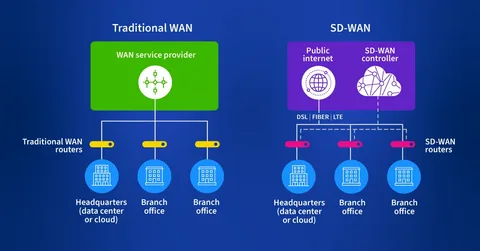
SD-WAN vs. Traditional WAN Traffic Handling
The difference between traditional WAN management and SD-WAN becomes clearer when their approaches are compared.
| Traffic Management Factor | Traditional WAN | SD-WAN |
| Path selection | Often relies on predefined routes | Can respond to policies and network conditions |
| Application awareness | More limited | Can identify and manage application traffic |
| Multiple connections | May require separate configuration | Can coordinate multiple WAN links |
| Response to changes | Often requires manual intervention | Can respond to defined conditions |
| Policy management | May involve individual devices | Policies can be managed centrally |
| Network visibility | Often spread across tools | Can provide centralized visibility |
SD-WAN generally provides a more policy-driven approach to managing traffic across distributed connections.
Handling Cloud and Distributed Applications
With the advent of cloud computing, traffic routing has been altered within the business. Application services could be hosted off-site, whereas users could be connected in a distributed fashion.
Traditional traffic patterns could be rendered outdated and wasteful. Passing cloud traffic through one central point of communication could create latency and utilize bandwidth.
The SD-WAN network could deploy a policy according to the destination of the application and the requirements of the connection.
Cloud traffic could be routed through an appropriate internet route, while other traffic could use some other connection altogether.
Maintaining Connectivity When a Link Fails
Reliability is yet another factor. Companies have more than one connection because the problem with one connection will disrupt their applications.
When having multiple connections, the SD-WAN network will monitor them and put policies into practice once a connection goes down.
A company will prefer one connection and make the other a backup. Once the first one goes down, the traffic will flow through the other connection.
Security and Traffic Management
There is a requirement to combine the concept of traffic management with security measures as well. With direct internet connections available for branch sites, not all of the traffic might go via usual centralized traffic controllers. This way, policies regarding security have to consider the traffic distribution.
Control measures, segmentation, inspection, and monitoring should be maintained irrespective of how the traffic is sent. It is important to keep in mind encrypted applications or services which exchange information directly with the outer environment. The guidance provided by the Cybersecurity Framework created by NIST could be used.
The goal is to improve traffic handling without creating gaps in visibility or protection.
What Businesses Should Consider Before Deployment
The implementation of the SD-WAN network must start off by knowing the traffic, application, and the connectivity at hand.
These are questions to ask:
- What applications require low latency and consistent performance?
- Where is there a need for redundant connectivity?
- How much traffic goes to the cloud applications?
- What policies should be maintained consistently across locations?
- When is there a need for changing paths?
- What will be done with the security controls on different connections?
These answers help organizations develop policies based on actual business requirements.
The Role of SD-WAN in Modern Networks
An SD-WAN network allows the management of WAN traffic in response to the demands of applications and changes in network circumstances.
It allows policy-based decision-making, performance monitoring, and multiple ways to connect in order to control the flow of traffic.
Such a concept is especially relevant for organizations that have branches and applications which reside both in the cloud and internally.
SD-WAN acts as an enabling technology that facilitates management of these flows in a centralized manner, giving control over the traffic behavior.
In simple terms, what this means is that all network traffic does not have the same demands and all connections do not behave the same way always. This is how an SD-WAN design becomes an adaptive one.
Frequently Asked Questions:
1. What is an SD-WAN network?
The SD-WAN Network is basically a software defined networking technique for wide area networking. This technology can manage various WAN connections through the use of policies to route traffic depending on application needs.
2. How does SD-WAN select a traffic path?
SD-WAN may use factors such as latency, packet loss, jitter, bandwidth, availability of links, and application needs. It selects an adequate connection for the traffic based on policy configuration.
3. Can an SD-WAN network use multiple internet connections?
Yes. The SD-WAN technology can combine broadband connections, dedicated links, and mobile connectivity options. Based on the configuration, these connections may offer more capacity, redundancy, or alternative paths.
4. Does SD-WAN replace the underlying WAN connections?
It does not have to. SD-WAN mostly alters the way WAN connectivity is managed by a company. Companies can use various forms of connectivity but manage them through software.