Agentic AI changes the development problem from generating responses to completing work. An AI agent can interpret a goal, access approved information, use software tools, interact with business systems, and complete a sequence of tasks within defined controls.
That capability creates engineering requirements beyond a chatbot or a standalone generative AI feature. Production agentic systems need tool permissions, workflow logic, business-system integrations, evaluation methods, monitoring, audit records, security controls, and human approval points.
Companies planning these systems face a second decision: build an internal agentic AI team or outsource development to a specialist company. The choice affects hiring, technical ownership, development capacity, domain knowledge, and maintenance after launch.
For companies considering outsourcing, the development partner needs evidence across agent engineering and the software infrastructure that supports agent actions.
What to Evaluate in an Agentic AI Development Partner
Start with agent architecture. The development team should define what the agent can access, which tools it can use, which actions it can perform, and where human approval enters the workflow. Multi-agent systems need added controls for task assignment, information exchange, and validation between agents.
Integration experience matters because enterprise agents depend on business systems. An agent may need to retrieve CRM data, search internal documents, create a support ticket, update an ERP record, or trigger an application through an API. Each connection introduces authentication, permission, data, and failure-handling requirements.
Evaluation should form part of the engineering process. Teams need test cases for task completion, tool selection, output quality, policy compliance, and failure conditions. Production logs should record agent actions so teams can investigate errors and understand how a workflow reached an outcome.
Security should cover both information and actions. Reading a customer record creates one risk profile. Editing that record, sending a message, approving a transaction, or triggering another system creates another.
Companies should therefore look for documented AI agent work rather than broad AI capability alone. Clutch now treats AI Agents as a distinct service category within its US AI development directory, which reflects the difference between general AI development and systems designed to perform tasks through tools and workflows.
5 Agentic AI Development Companies in the USA to Consider in 2026
1. GeekyAnts
GeekyAnts is an AI-Powered Digital Product Engineering & Consulting Company. Its agentic AI work includes AntFlow AI, a spec-driven software development framework built around multi-agent execution, independent AI code review, traceability, human control, and repository workflows. GeekyAnts also works across AI product engineering, enterprise integrations, cloud systems, data engineering, and application development. This engineering range supports agentic products where AI agents need to operate within a larger software system rather than function as isolated assistants.
Clutch Rating: 4.9 (120 reviews)
Address: GeekyAnts Inc, 315 Montgomery Street, 9th and 10th floors, San Francisco, CA 94104, USA
Phone: +1 845 534 6825
Email: info@geekyants.com , Website:www.geekyants.com/en-us
2. TechAvidus
TechAvidus provides AI agent development alongside custom software and enterprise application engineering. Its agent development offering covers systems that use large language models, memory, business tools, APIs, and workflow orchestration. The company addresses agent use cases across customer support, sales, healthcare, finance, and business operations. Its combination of AI and application engineering makes it relevant for organizations that need agents connected with existing software, data, and business workflows.
Clutch Rating: 4.7 (22 reviews)
Address: 1440 W Taylor St #1003, Chicago, IL 60607, USA
Phone: +1 603 835 3130
3. ThirdEye Data
ThirdEye Data works across enterprise AI, AI agents, generative AI, data engineering, and machine learning. Its agent-focused services include workflow automation and document-based AI systems, with applications across business operations and knowledge-intensive processes. The company’s data engineering background has relevance for agents that need access to enterprise information before performing an action. Organizations considering the firm should compare its experience with their integration requirements, data architecture, access controls, evaluation process, and deployment environment.
Clutch Rating: 4.6 (23 reviews)
Address: 333 West San Carlos Street, Suite 600, San Jose, CA 95110, USA
Phone: +1 408 462 5257
4. Pixel Genesys
Pixel Genesys provides AI agent development, custom software engineering, and web and mobile product development. Its agent services cover customer service, sales, productivity, voice, and data analysis use cases. The combination has relevance for companies that need an agent inside a customer-facing or employee-facing application. Buyers should examine its project evidence against the planned system’s tool integrations, permission model, evaluation requirements, human approval process, and production monitoring needs.
Clutch Rating: 4.6 (21 reviews)
Address: 7901 4th St N, St. Petersburg, FL 33702, USA
Phone: +1 855 569 1886
5. Relyx Digital
Relyx Digital works across AI development, workflow automation, custom software, and enterprise applications. Its agentic AI experience includes a sales workflow in which agents supported lead qualification, prospect research, outreach preparation, follow-up tasks, and workflow automation. This type of project provides a useful reference for companies exploring agents that operate across a defined business process. Buyers should assess the firm’s experience against the number of systems involved, agent permissions, security requirements, evaluation approach, and support expectations.
Clutch Rating: 4.5 (4 reviews)
Address: 411 W 1st St, Suite 2004, Sanford, FL 32771, USA
Phone: +1 307 466 6074
In-House vs Outsourcing Agentic AI Development
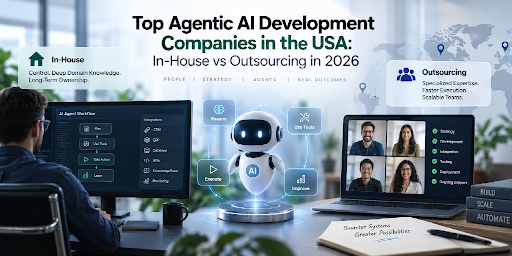
An in-house model places agent engineering, product knowledge, and system ownership within the organization. This structure can suit companies where agentic AI forms part of a core product or internal technology platform. The internal team retains knowledge of agent behavior, business rules, integrations, evaluation methods, and operating constraints.
The staffing requirement can be substantial. Agentic AI development can involve AI engineers, backend engineers, data engineers, cloud specialists, security teams, QA engineers, and product leaders. Hiring these roles for one experiment may create capacity that the company does not need after the first deployment.
Outsourcing provides access to a broader engineering team without requiring permanent hiring for every role. A development partner can support product discovery, agent architecture, prototypes, tool integrations, evaluation, application development, deployment, and production controls. This model can suit a defined product build or a company that has gaps in its AI engineering capability.
The trade-off concerns ownership. An outsourced engagement needs clear requirements for source-code ownership, documentation, architecture records, deployment access, evaluation assets, and knowledge transfer. These requirements help the internal team retain control after the external engagement ends.
A hybrid structure divides those responsibilities. Internal teams can own product strategy, domain rules, security decisions, and architecture governance while an external team supplies agent engineering skills or development capacity.
How to Choose Between an In-House Team and an Agentic AI Development Company
The expected life of the system provides a useful starting point.
An in-house team can fit a company that expects agentic AI to become a permanent engineering capability. This applies when the organization plans to build several agents, change agent behavior as products evolve, maintain sensitive integrations, and invest in AI engineering roles after the first release.
Outsourcing can fit a defined use case with a clear validation goal. A company may need to determine whether an agent can complete a customer support, research, document processing, or operational workflow within defined security and performance requirements. An external team can supply the required engineering disciplines for that development stage.
A hybrid model can fit companies that have software, cloud, data, and security teams but lack agent engineering experience. Internal engineers can retain system ownership while external specialists design agent workflows, evaluation methods, or model integrations.
The decision should cover ownership after launch. Before development begins, teams should assign responsibility for agent workflows, evaluation datasets, business-system integrations, infrastructure, access controls, monitoring, incident response, and future model changes. The development model should support those responsibilities after the first agent reaches production.
Final Thoughts
Agentic AI development requires decisions about both technology and ownership. The system needs more than a model that can reason about a task. It needs controlled access to information, tools, business applications, evaluation processes, security boundaries, monitoring, and human intervention points.
The development model should reflect how the organization expects to use and maintain that system. An internal team supports long-term capability ownership when agentic AI becomes part of the company’s technology foundation. Outsourcing can provide the engineering range needed for a defined build or capability gap. A hybrid structure can keep product and architecture ownership inside the organization while adding specialist agent engineering skills.
The key question is not where the first agent gets built. Companies need to decide who will understand, evaluate, secure, maintain, and change the system after it enters production. That ownership model should guide the choice between in-house development, outsourcing, and a combination of both.