


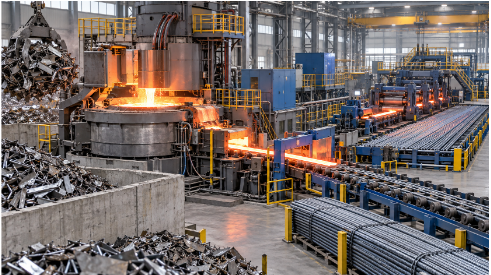
Compact steel plants are often built around one practical goal: turning locally available scrap into saleable bars with stable quality and controlled cost. The technical challenge is not only melting the scrap. It is keeping the flow from charge preparation to rolling consistent enough that each stage supports the next.
The process normally begins with reliable melting equipment. A plant that reviews metal melting furnaces should consider furnace capacity, power availability, cooling water, refractory practice, and the types of scrap that will be used most often. The furnace must handle real production conditions, not just ideal charge material.
After melting and composition adjustment, continuous casting becomes the bridge between liquid steel and rolling. A suitable continuous casting production line should match ladle practice, billet size, withdrawal speed, cooling requirements, and downstream mill capacity. If casting is unstable, the rolling mill will inherit defects, inconsistent billet temperature, and avoidable interruptions.
The final forming stage depends on a well-arranged rolling mill with enough power, stand rigidity, guides, cooling, and finishing equipment. For rebar production, stable billet heating and controlled pass design help produce uniform rib geometry and predictable mechanical properties.
A compact scrap-to-rebar line also needs practical auxiliary systems. Scrap charging equipment, fume collection, cooling towers, hydraulic stations, cranes, and electrical controls all influence output. A furnace or mill can be well designed on its own, but daily performance suffers if the support systems are undersized or difficult to maintain.
The best project plans start from the target product mix and local operating reality. Power cost, scrap supply, operator skill, water quality, and spare part access should all shape the final design. When melting, casting, and rolling are engineered as one route, a compact steel plant can turn scrap into finished rebar with fewer delays and better long-term economics.