



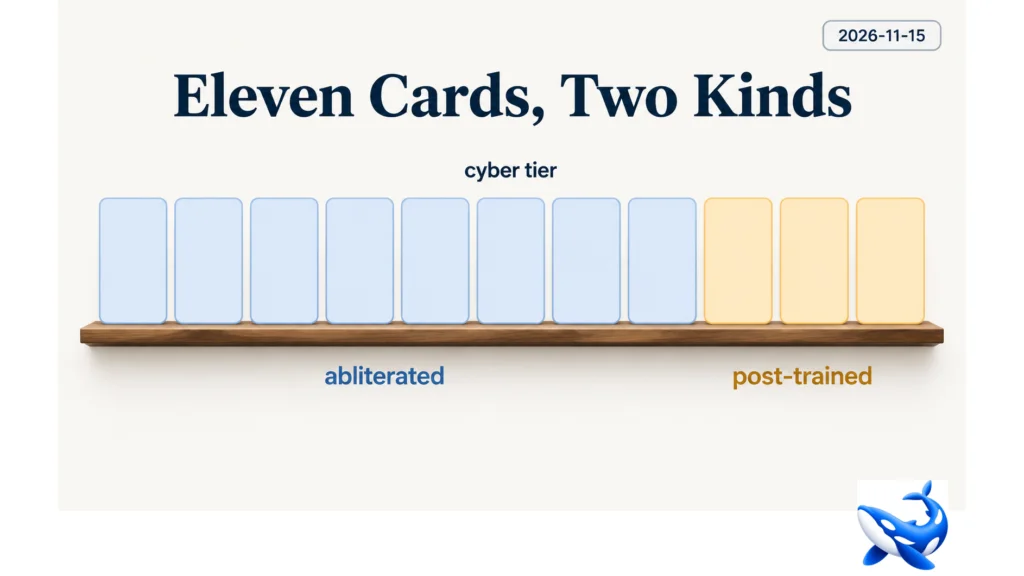
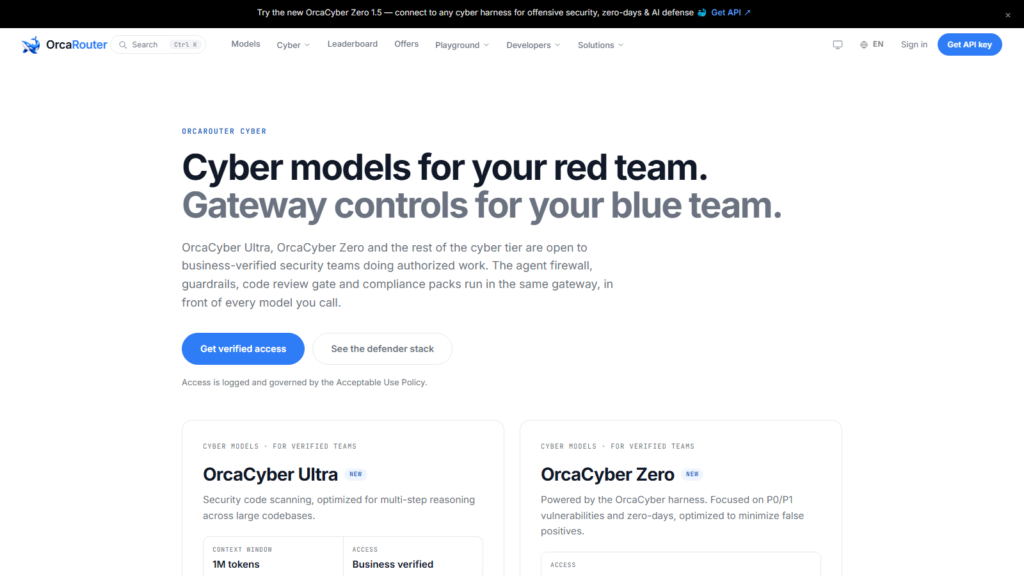
The word “cyber LLM” covers two different products on OrcaRouter, and the distinction decides almost everything about how you should buy one. Eight of the eleven cards on OrcaRouter’s cyber tier are abliterated checkpoints — an open model with its refusal behaviour edited out of the weights. Three are post-trained cyber models, built with the security job in the training mix rather than having a behaviour subtracted from a general model. Zero 1.0, Zero 1.5 and Ultra 1.0 are those three, and neither of their cards uses the word abliterated anywhere [OURS].
That matters because the two kinds fail in different ways and price differently. An abliterated card’s benchmark rows describe the checkpoint it came from. A post-trained card’s rows describe the product. Reading them off the same table without noticing the split is how a security team ends up comparing a 98.07 to an 88.1 and concluding something that isn’t true.
Here is the whole tier, read from the live catalogue on 2026-11-15.
| card | kind | blended $/1M | tok/s | p50 ms | error % | traffic 7d |
| Kimi K3.1 Pro | abliterated | 8.00 | 62.0 | 1,989 | 1.306 | 9.62B |
| GLM 5.3 | abliterated | 3.50 | 87.4 | 3,260 | 16.110 | 6.03B |
| DeepSeek V4.1 Flash | abliterated | 1.00 | 186.1 | 998 | 0.166 | 32.99B |
| Qwen3.8 Flash Next | abliterated | 1.00 | 94.0 | 1,838 | 0.603 | 1.86B |
| GLM 5.3 Flash | abliterated | 1.00 | 66.1 | 3,919 | 0.705 | 6.85B |
| MiMo V2.6 Flash | abliterated | 1.00 | 42.2 | 7,459 | 0.938 | 0.46B |
| MiniMax M3.1 Flash | abliterated | 1.00 | 129.9 | 1,695 | 0.272 | 2.74B |
| Hy4 | abliterated | 1.00 | 173.7 | 4,400 | 0.714 | 4.73B |
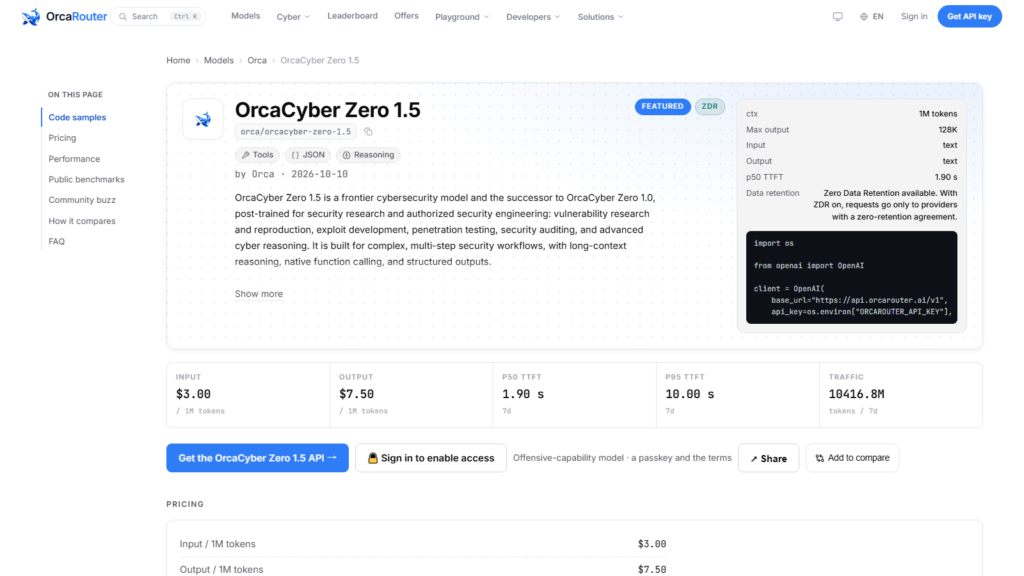
| OrcaCyber Zero 1.0 | post-trained | 4.13 | 199.5 | 1,936 | 0.183 | 4.20B |
| OrcaCyber Zero 1.5 | post-trained | 4.13 | 122.2 | 1,901 | 0.859 | 10.37B |
| OrcaCyber Ultra 1.0 | post-trained | 6.25 | 205.7 | 2,903 | 1.059 | 2.58B |
[OURS], seven-day windows ending 2026-11-15. Blended is our arithmetic at a 3:1 input-to-output mix.
Six cards at one price, and it is not a price decision
Six of the eight abliterated cards cost exactly $0.80 in and $1.60 out per million tokens. They are not the same product. They differ by a factor of four in throughput, by a factor of seven in median latency, by a factor of four in error rate, and by a factor of seventy in traffic [OURS].
A procurement sheet that ranks them by price ranks them all first. That is the trap the tier sets: identical list prices make the choice look like a preference when it is actually an engineering decision about throughput, modality and failure mode.
The three that are not abliterated
Zero 1.0, Zero 1.5 and Ultra 1.0 carry two price points between them — $3.00/$7.50 for both Zero builds and $5.00/$10.00 for Ultra — and all three publish benchmark rows that describe a security model rather than a general checkpoint.
Zero 1.0 reports 98.07 on CyberGym Level 1 pass@1. Zero 1.5 reports CVE-Bench 95.8 on the evaluable subset, Cybench 100 under unrestricted agent execution, HumanEval+ 93.9 and SWE-bench Pro V2 76.5. Ultra 1.0 publishes no benchmark rows at all [VENDOR].
Those numbers are the vendor’s own and no third party has reproduced them. Read them as claims with a shape rather than as measurements with a margin.
What the label changes about the evidence
An abliterated card’s benchmark block is inherited. Every row on the DeepSeek V4.1 Flash card was evaluated on 2026-09-09, six weeks before the card shipped; every row on the GLM 5.3 Flash card was evaluated on 2026-08-25, nine weeks before. The numbers describe the base checkpoint, and the refusal removal happened afterwards [VENDOR, dated per row].
A post-trained card’s rows are produced for that card. Zero 1.5’s Cybench 100 is a statement about Zero 1.5, not about some general model it was derived from.
So the two blocks are not comparable in kind. One is a ceiling the product might reach; the other is a claim about the product itself. The tier page puts them in the same visual style, which is a design convenience and not an equivalence.
Where the traffic actually is
One card carries 40% of the tier’s volume: DeepSeek V4.1 Flash, at 32.99 billion tokens in seven days against a tier total of 82.43 billion [OURS]. The second busiest is Zero 1.5 at 10.37B, then Kimi K3.1 Pro at 9.62B.
The least busy is MiMo V2.6 Flash at 0.46B — one seventy-second of the leader, at the same $0.80/$1.60 price. Whatever teams are choosing the flash cards on, it is not price, and whatever is driving MiMo’s low volume is not the rate card.
How to read the tier in ten minutes
Four steps, in this order.
First, split the eleven into the eight abliterated and the three post-trained, because everything downstream differs. Second, among the eight, discard price as a discriminator — six are identical. Third, rank what is left by the row your workload actually depends on: throughput for generation-heavy work, median latency for interactive work, error rate for unattended work, modality for anything that is not text. Fourth, look at whether the benchmark block belongs to the card or to its checkpoint before quoting any number from it.
Two rows that look like measurements and are not
Eight of the eleven cards show a p95 of exactly 10,000 ms over the seven days ending 2026-11-15 [OURS]. That is the reporting cap, not a reading. Kimi K3.1 Pro, Qwen3.8 Flash Next, GLM 5.3 Flash, GLM 5.3, MiMo V2.6 Flash, Hy4, Zero 1.0, Zero 1.5 and Ultra 1.0 all sit on it. Only DeepSeek V4.1 Flash (8,938 ms) and MiniMax M3.1 Flash (6,429 ms) land below it.
The same cap distorts two base checkpoints in the other direction. Qwen3.8 Flash’s base is recorded at 10,000 ms with an output rate of 2,112.8 tokens per second — a rate no serving stack sustains at that latency, which is the signature of a handful of very short responses. MiMo V2.6 Flash’s base reads 10,000 ms and 60.595% errors over the same window [OURS]. Neither is a usable comparison against the card above it, and quoting either as though it were would be a mistake worth catching before a procurement document.
What the tail row can still tell you, when a card is below the cap, is the shape of its week. DeepSeek V4.1 Flash at 8,938 ms against a 998 ms median is a long tail on a fast card: nine out of ten requests come back quickly and one in twenty does not. That is a different risk profile from a card whose median is 7,459 ms, where the tail and the middle are closer together and the whole distribution is slow.
What the price ladder actually rewards
Between the $1.00 blended abliterated cards and the $8.00 Kimi card there is one gap large enough to make a difference: the jump to $3.50 for GLM 5.3, which buys a 9/10 quality score and 87.4 tokens per second, and costs you text-only input and a 16.11% error rate. Above that, $8.00 for Kimi buys the tier’s only 943,718-token output ceiling and video input, at 62 tokens per second.
The three post-trained cards sit in the same space — $4.13 blended for both Zero builds, $6.25 for Ultra — and the thing they buy is not speed or ceiling. It is a model whose benchmark rows describe itself. Whether that is worth three to four times the flash price is the actual question on this page, and no row in the table answers it.
The short version
Eleven cards, two kinds. Eight abliterated checkpoints priced mostly at the same rate and separated entirely by serving behaviour; three post-trained security models at three price points with their own benchmark rows.
The label on the card tells you which kind of evidence you are reading. On an abliterated card the rows are a ceiling inherited from a checkpoint; on a post-trained card they are a claim about the thing you are buying. Treating the two blocks as one table is the single most common reading error on this page.
Sourcing note: prices, context windows, output ceilings, modalities, quality scores, latency, throughput, error rates and traffic are read from the eleven cards’ public model data on 2026-11-15, with seven-day windows ending that day [OURS]. Blended prices are our arithmetic at a 3:1 input-to-output mix. Benchmark rows are OrcaCyber’s own, unreproduced by any third party, and each is dated where quoted [VENDOR].