
Quick Answer
The pitch deck mistakes that cost founders second meetings are a vague problem statement, too many slides, inflated market size, hidden traction, a missing “why now” and a fuzzy ask. Investors skim a deck in about two minutes, so any slide that makes them work harder becomes a reason to pass. Weak design adds to the damage: dense text, unreadable charts and inconsistent branding signal a team that is not ready. PitchWorx, a pitch deck design agency with 14 years of experience in the design industry, helps founders fix these mistakes with a clear story, tight structure and investor-ready design.
Table of Contents
- Why the Second Meeting Is Won or Lost on the Deck
- Investors Have Less Time Than Ever
- 8 Pitch Deck Mistakes That Cost Second Meetings
- Case Study: From Polite Passes to Partner Meetings
- Expert Tip From Shubham
- PitchWorx Hack: The Headline-Only Read
- PitchWorx Services for Founders and Growing Teams
- Industries PitchWorx Covers
- Frequently Asked Questions
Why The Second Meeting Is Won or Lost on the Deck
Founders often think the first call is the real test. In practice, the deck usually decides whether that call happens again. Investors forward decks to partners, skim them between meetings and compare them with dozens of others that week. If a deck is confusing, the second meeting quietly never gets scheduled.
The good news is that most rejections come from a small set of repeat mistakes. After reviewing and rebuilding hundreds of investor decks, the team at PitchWorx sees the same patterns again and again. This guide covers the mistakes that cost founders second meetings, what investors read instead, and how a pitch deck design agency fixes each one.
Investors Have Less Time Than Ever
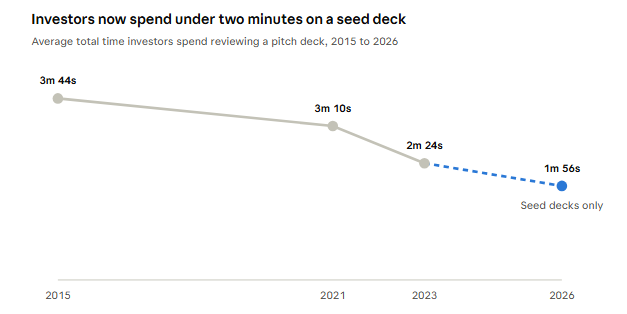
With less than two minutes per deck, there is no room for slides that make an investor hunt for the point. That is why founders increasingly hand the final design to a pitch deck design agency rather than polishing slides themselves the night before.
- Seed-stage decks now get about 1 minute and 56 seconds of total viewing time, down 24% since 2021.
- In DocSend’s 2023 data, founders contacted 71 investors on average and secured 46 meetings.
- Investors spent 48% more time on business model slides and 25% more on traction slides than on other sections.
8 Pitch Deck Mistakes That Cost Second Meetings
- A Vague Problem Slide
If the problem sounds like “businesses struggle with efficiency,” investors stop reading. Name who has the problem, how often it happens and what it costs them.
- Too Many Slides
A 30-slide deck signals a founder who cannot prioritize. Keep the core deck to 10 to 15 slides and move details to an appendix.
- Inflated Market Size
A trillion-dollar TAM with no bottom-up math reads as a red flag. Show the serviceable market you can actually reach and how you calculated it.
- Traction Buried at the Back
Revenue, users or pilots are your strongest proof. If traction is real, put it near the front so a skimming investor sees it in the first minute.
- No “Why Now”
Investors want to know what changed in the market, technology or regulation that makes this the right moment. Without it, the opportunity feels optional.
- A Fuzzy Ask
“Raising a seed round” is not an ask. State the amount, the runway it buys and the milestones it unlocks.
- Dense, Unreadable Slides
Paragraphs of text, tiny fonts and charts pasted from spreadsheets force investors to work. Use one idea per slide and a headline that states the takeaway. This is the most common fix a pitch deck design agency makes.
- Inconsistent Design
Mismatched fonts, colors and layouts suggest a rushed team. A clean, consistent deck does not raise money on its own, but a messy one can stop the conversation. A pitch deck design agency builds a master template so every slide looks like it belongs.
Case Study: From Polite Passes to Partner Meetings
Client: a US climate-tech startup raising a seed round (name withheld under NDA).
Challenge: the founders had sent their 27-slide deck to more than 40 investors and received friendly replies but almost no second meetings. Their traction, three paid pilots with utilities, sat on slide 19, and the market slide claimed a global TAM with no supporting math.
What PitchWorx did: the team cut the deck to 13 slides and moved the pilot results to slide 3. It rebuilt the market slide as a bottom-up calculation, added a “why now” slide on new grid regulations, and turned the task into one line: amount, runway and three milestones. A clean master template replaced five different slide styles.
Result: the new deck was ready in 9 working days. In the next outreach round, the founders reported a much higher reply rate and several partner meetings within a month. The pitch deck design agency did not change the business; it made the strongest parts impossible to miss.
Expert Tip From Shubham
“Investors don’t read a deck from start to finish, they hunt for proof. Put your best number where their eyes land first, and design every other slide to support it.”
Shubham, Senior Presentation Designer, PitchWorx
PitchWorx Hack: The Headline-Only Read
Hide everything on your slides except the titles, then read them in order. If the titles alone tell the story of problem, solution, proof and ask, your deck is ready. If not, rewrite the titles before you touch the design.
PitchWorx Services for Founders and Growing Teams
PitchWorx is a Pitch deck design agency founded in 2012, with 14 years of experience in the design industry and ISO 27001:2022 certification, so your financials and investor data stay secure. Beyond a one-off investor deck, founders who present every month can use our Presentation design subscription services for investor updates, board decks, sales decks and demo day slides.
Our presentation design subscription services also cover the rest of your startup’s creative work on one flat plan, starting at $699 a month:
- Brand identity, logos and brand guidelines
- PowerPoint, Google Slides and Keynote templates
- Website and landing page graphics
- Social media posts and ad creatives
- Pitch videos, product demos and motion graphics
With presentation design subscription services, every file gets a senior designer review, and you keep full ownership of editable source files.
Industries PitchWorx Covers
PitchWorx designs for technology and SaaS, healthcare and life sciences, finance and fintech, private equity and investment banking, legal, real estate, consulting, e-commerce and retail, education, manufacturing, government and the public sector, and nonprofits.
Frequently Asked Questions
- What is the most common pitch deck mistake?
Burying traction. Many founders save their best proof for the end, but investors skim and may never reach it. Put real traction in the first few slides.
- How many slides should a pitch deck have?
Aim for 10 to 15 slides in the main deck, with extra detail in an appendix you share after the first meeting.
- Why do investors pass after reading a deck?
The usual reasons are an unclear problem, unproven market size, weak traction, no clear “why now” and an ask that does not explain what the money will achieve.
- Should I hire a pitch deck design agency?
If you are raising a priced round or pitching institutional investors, yes. A specialist team brings investor-tested structure, clean data slides and consistent design, which helps your deck survive a two-minute skim.
- How much does professional pitch deck design cost?
One-off decks from specialist agencies usually cost $2,500 to $15,000. PitchWorx presentation design subscription services start at $699 a month and also cover investor updates, branding and video.