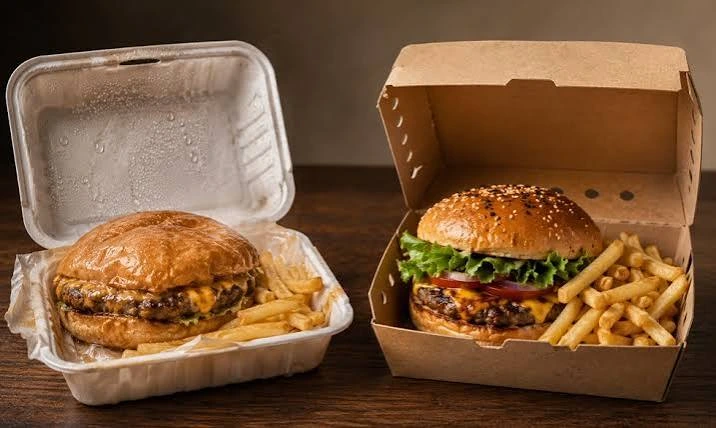
A delivered burger has to survive a different environment from one served immediately. Steam builds up, sauces move and the weight of the filling can compress the bun. Improving the result means reviewing assembly, packing and the time before the customer opens it.
Check the burger before packing
Examine whether the bun is already absorbing excessive liquid at the preparation station. Review sauce quantities and the condition of wet ingredients. Keep the recipe consistent during trials so packing changes can be judged fairly.
Burger Boxes need enough clearance for the finished burger without leaving it free to move excessively. Check how the lid closes and whether stacking places pressure on the bun.
Manage the components
Consider whether a sauce or particularly wet ingredient should be supplied separately. Any change must remain convenient for the customer and workable during service.
Unilever Food Solutions discusses moisture and ventilation in delivery food. Use that principle to investigate the actual burger, rather than assuming that an airtight or heavily vented pack is always the right answer.
Shorten avoidable waiting
Record the time between assembly, packing and collection. A burger sitting ready while another item is prepared may spend longer enclosed than the delivery journey itself.
Coordinate sides and drinks so the complete order is ready together. Keep the handover area organised and make order identification easy for staff and couriers.
Examine the burger before it leaves
Check whether the bun is already becoming wet during assembly. If it is, the delivery journey may be making an existing problem more noticeable rather than causing it. Record where moisture first appears and which ingredients touch that area.
Use the normal recipe and portion sizes during the investigation. A trial with less sauce or a specially selected bun will not describe the product customers usually receive. Keep ingredient preparation consistent so the results are useful.
Look at the structure as well as the moisture. A tall stack can shift and squeeze sauces towards the edges. If the burger is difficult to hold immediately after preparation, the delivery version may need a simpler arrangement.
Review wet ingredients individually
Sauces, cooked fillings and salad components contribute differently to the finished result. Check their preparation and portioning within the restaurant’s food-safety procedures. Excess surface moisture on a salad ingredient and excessive sauce are different issues.
Consider whether a specific component can travel separately without making the meal inconvenient. A small amount of customer assembly may be reasonable for one recipe, while another should arrive ready to eat. Test the experience with the utensils and space the customer is likely to have.
Do not treat a barrier layer as a universal fix. It may change how moisture reaches the bun, but it can also affect texture, flavour and stability. Assess the complete burger rather than one ingredient in isolation.
Include dispatch waiting in the trial
A journey test should start when the food is ready for the next stage, not only when the driver begins moving. Record the ordinary waiting and handover process. Unplanned delays can undermine a packing arrangement that performs well in an immediate test.
Check how burgers are grouped with sides and drinks. Different components may need separate treatment, and the overall order should remain easy to identify. Do not place additional weight on the burger simply to make the bag look compact.
Use the approved container as intended. Improvised openings, unusual stacking or forced closures can introduce problems beyond texture. Any change should be assessed with the business’s hygiene and handling requirements in mind.
Turn feedback into a specific adjustment
Ask useful internal questions: was the bottom bun wet, did the filling slide, or was the top crushed? These observations point towards different parts of the system. A general request for a stronger pack may miss the actual issue.
Keep photographs and notes from controlled trials, then select the change that addresses the observed failure. Recheck the recipe during a representative busy period before adopting it widely.
Once approved, update the assembly sequence and show staff the intended result. A workable method needs to survive ordinary service, including shift changes and high order volumes, rather than depend on one person preparing each burger carefully.
Compare controlled trials
Test one recipe in two packing arrangements over a representative journey. Assess bun texture, filling position and ease of eating. Record observations rather than changing the entire system after one disappointing order.
When discussing custom packaging uk, share the burger’s height, diameter and service process. Ask for samples and evaluate them during a realistic packing routine.
Maintain the restaurant’s temperature and hygiene controls throughout. Texture testing does not establish food safety. Once a workable method is found, document the assembly and packing sequence so busy shifts do not introduce avoidable variation. A consistent process gives customers a better chance of receiving the burger as it was intended.