Mark owns a small HVAC repair shop outside Dallas. Last July, during the busiest week of the year, his phone rang 40 times in one day. He answered 14 of them. The rest went to voicemail, and most of those callers never called back. Two of them left one-star reviews that mentioned “no one ever picks up.”
Mark isn’t careless. He was under a sink fixing a leak, or driving between jobs, or already on another call. His phone just couldn’t keep up with his business. That’s the exact gap an AI Receptionist for your Business is built to close.
TL;DR: Small businesses miss more calls than most owners realize, and each one is a customer who may not try again. This guide breaks down what an AI Receptionist actually does, what it costs against hiring staff, and whether the switch makes sense for your business in 2026.
What is an AI Receptionist?
An AI Receptionist is software that answers your business phone calls automatically, day or night, and handles them the way a trained front desk employee would. It picks up on the first ring, talks to the caller in natural language, and books appointments straight into your calendar. Businesses use it so no call, and no customer, slips through the cracks.
Unlike a phone tree or basic voicemail, it can hold a real back and forth conversation. It answers questions about hours, pricing, and services. It also recognizes urgent calls, like a burst pipe or a medical concern, and routes them to a real person fast.
Why do businesses miss so many calls?
Most businesses miss calls because the people meant to answer them are already doing something else, whether that’s a stylist mid cut, a contractor on a roof, or a single receptionist juggling three lines at once. There’s only so much one person can cover.
A 30-day study by 411 Locals that tracked 85 small businesses across 58 industries found that only 37.8% of calls were answered by a live person. Another 37.8% went to voicemail, and 24.3% got no response at all. That’s roughly six calls out of ten never reaching a human.
That’s not a staffing failure. It’s just math. One phone, one person, and calls that don’t wait their turn.
How does an AI Receptionist solve the missed call problem?
An AI Receptionist solves this by answering every call the moment it comes in, without needing a person free to take it. It doesn’t get tied up with one caller while three others wait. It doesn’t clock out at 5 PM or take a lunch break.
Here’s what a call looks like end to end:
- The customer calls, and the AI answers within a second or two, using your business name and a greeting you set.
- It listens to what the caller needs, whether that’s booking a service, asking about pricing, or reporting an emergency.
- It checks your calendar in real time and offers open slots.
- It confirms the appointment and sends the caller a text or email confirmation.
- You get notified instantly, with the full call summary already logged.
If the request is too complex or the caller wants a person, it hands the call off to a live agent instead of leaving the customer stuck. Nobody hits a dead end.
What do the numbers say about customer expectations?
Customers don’t just get annoyed by a missed call. They act on it. A 2025 CallRail survey of 1,000 US consumers found that 78% have abandoned a business entirely after a call went unanswered, and 82% said they’d call a competitor instead.
That same research found something worth noting for 2026: 52% of consumers say a business using an AI assistant after hours signals better service, not worse. The stigma around automated answering is fading fast, especially among younger callers.
One missed call is one lost customer. Multiply that by a year, and it adds up fast.
What does an AI Receptionist cost compared to hiring staff?
An AI Receptionist typically costs a small fraction of what a full-time front desk hire costs each year. A human receptionist runs a business somewhere between $40,000 and $62,000 annually once salary, benefits, and training are factored in, and that only covers about 40 hours a week.
An AI Receptionist covers all 168 hours in a week for a monthly subscription fee, often under $300 a month depending on call volume and features. You can compare the full cost breakdown against hiring staff here to see the math for your own call volume.
Before: one receptionist, one line, calls stacking up during lunch. After: every call answered, appointments booked automatically, and your staff free to focus on the actual work.
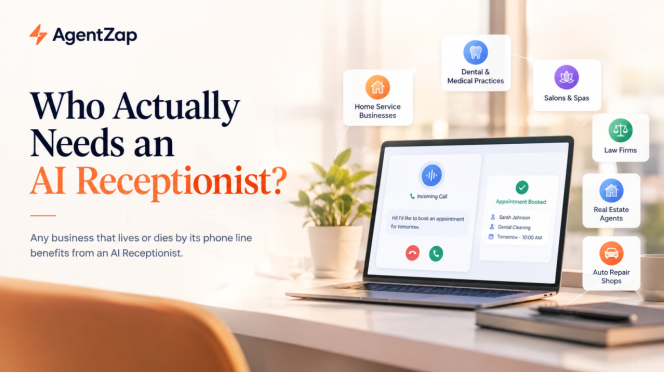
Who actually needs an AI Receptionist?
Any business that lives or dies by its phone line benefits from an AI Receptionist. That covers more industries than most owners assume.
- Dental and medical practices: patients calling about appointments, insurance questions, or urgent symptoms
- Home service businesses (HVAC, plumbing, electricians): emergency calls that can’t wait for a callback
- Salons and spas: booking requests that come in while stylists are with clients
- Law firms: new client intake calls that often decide who they hire
- Real estate agents: buyers calling about a listing the moment they see it
- Auto repair shops: customers checking on repair status or booking service
If your business answers its own phone instead of paying someone to sit by it all day, this list probably includes you.
Common questions about AI Receptionists
Will customers know they’re talking to an AI?
Most modern AI Receptionists use natural, conversational voices that sound like a real person, not a robotic phone tree. Some businesses disclose it upfront in the greeting, others don’t, and that choice is usually up to the business owner. Either way, callers care more about getting their question answered than about who or what answered it.
Can an AI Receptionist actually book appointments, not just take messages?
Yes. A properly set up AI Receptionist connects to your live calendar, whether that’s Google Calendar, Outlook, or an industry specific scheduling tool. It checks real availability, offers open slots, and confirms the booking on the call itself, not through a follow-up message.
What happens if the AI can’t answer a question?
It transfers the caller to a live person or takes a detailed message for a callback, depending on how you’ve set it up. Emergency or high-value calls, like a legal consultation or a medical concern, typically get flagged for immediate human follow-up.
Does an AI Receptionist work for businesses with more than one location?
Yes. Multi-location businesses can set unique greetings and routing rules per location while still viewing performance across all of them in one dashboard. This matters more as a business grows past a single storefront or office.
Is an AI Receptionist only useful after hours?
No. Most missed calls actually happen during business hours, when staff are already busy with in-person customers or other calls. An AI Receptionist covers both the gaps during the day and the hours nobody’s in the building.
How long does it take to set one up?
Most AI Receptionist providers handle setup for you, connecting your phone number, calendar, and business details within a day or two. You’re not stuck configuring anything from scratch.
Does it replace my staff entirely?
Not usually, and most businesses don’t want that. It handles the repetitive front desk work, routine bookings, FAQs, after-hours calls, so your staff can focus on customers who are already in front of them.
The bottom line
Mark’s HVAC shop switched to an AI Receptionist three months after that missed-call week. His team stopped losing jobs to voicemail, and appointment bookings picked up without anyone spending more time on the phone.
An AI Receptionist for your business isn’t about replacing people. It’s about making sure every call gets answered, whether that’s at 2 PM during a rush or 2 AM on a Sunday. If missed calls are costing you customers, that’s a fixable problem, not a staffing one.
You can also read more general small business advice on Charfen’s business section for other ways to run a leaner front office.